
You’ve likely noticed how strategic lighting transforms a basic pergola into an architectural focal point after sunset. The interplay between light placement, intensity, and shadow creates spatial depth that fundamentally alters your outdoor room’s functionality and visual impact. Whether you’re working with traditional wood beams or modern metal frameworks, understanding which lighting techniques complement your structure’s proportions and sight lines will determine whether your space achieves subtle sophistication or falls into decorative excess.
String Lights for Ambiance
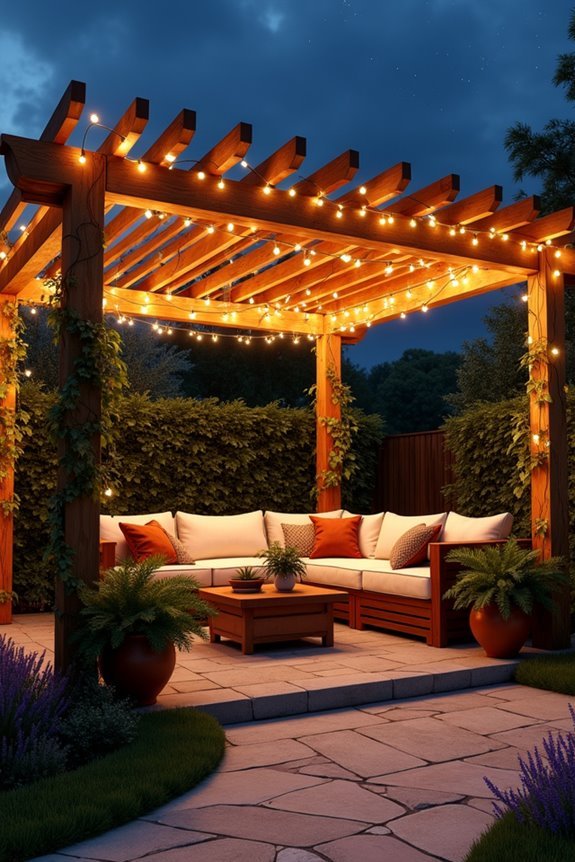
String lights transform pergola spaces through deliberate placement and layering techniques. You’ll achieve ideal illumination by draping strands parallel to beam structures, creating geometric patterns that enhance architectural lines. Position lights 18-24 inches apart for consistent coverage during outdoor gatherings.
Layer multiple strand heights—suspend primary lines at beam level, then add secondary strands 12 inches lower. This dimensional approach prevents harsh shadows while establishing depth. Choose 2700K warm white bulbs for cozy evenings, avoiding cooler temperatures that create sterile atmospheres.
Secure attachment points with weatherproof hooks rated for your strand weight. Install dimmer controls to adjust intensity based on occasion—brighter settings for dining, softer illumination for relaxation. Test configurations before permanent installation, ensuring even distribution across your pergola’s footprint.
[affiai keyword=”string lights for pergola” template=”carousel” count=”3″]
Fairy Light Canopy Designs
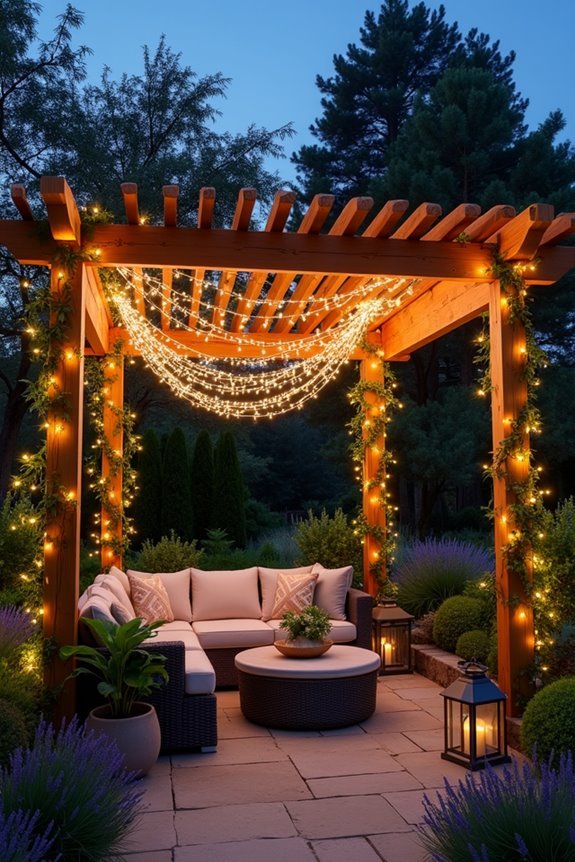
Several canopy configurations create stunning overhead displays when you suspend fairy lights across pergola frameworks. You’ll achieve ideal density by spacing parallel strands 8-12 inches apart, creating uniform light distribution. Whimsical draping introduces dimensional interest—position anchor points at varying intervals to form gentle swoops between beams. Install eye hooks at adjustable heights along vertical posts, allowing seasonal modifications to your canopy structure. For concentrated illumination, converge multiple strands toward a central point, radiating outward in a sunburst pattern. Alternatively, drape lights diagonally from corner to corner, forming an X-configuration that emphasizes architectural lines. Consider layering techniques: establish a base grid at beam level, then add lower swooping elements at 18-24 inches below. This creates depth perception while maintaining functional headroom beneath your pergola.
[affiai keyword=”fairy light canopy designs” template=”carousel” count=”3″]
Lanterns for Rustic Charm
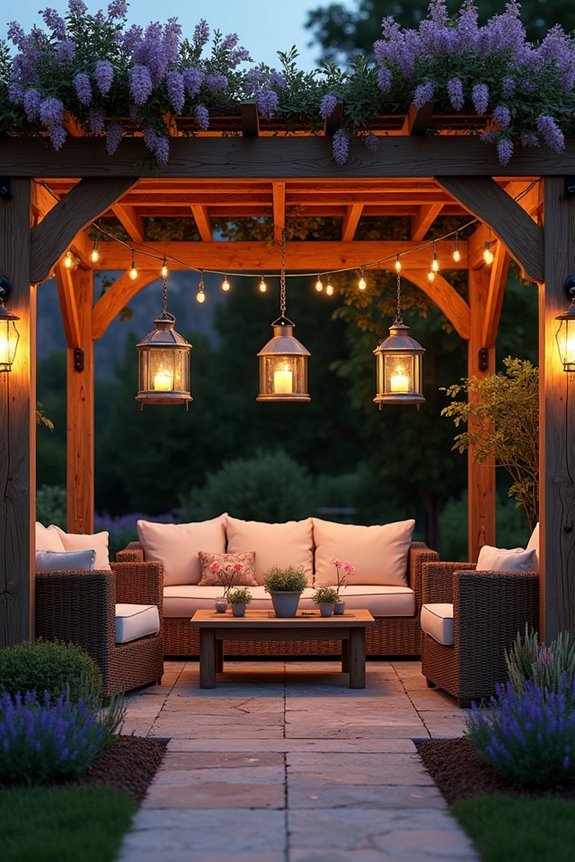
Vintage lanterns establish authentic rustic aesthetics when you position them strategically throughout your pergola’s vertical and horizontal planes. Your rustic lantern placements should follow odd-number groupings—clusters of three or five create visual balance while maintaining organic appeal. Suspend varied heights from crossbeams using chains or rope, ensuring 18-24 inch vertical spacing between units.
Your lantern material choices directly impact atmospheric quality and durability. Galvanized metal withstands weather exposure while delivering industrial-farmhouse character. Wrought iron provides substantial visual weight for larger pergola structures. Wood-framed lanterns with glass panels suit intimate garden settings but require protective sealants.
Mount bracket-style lanterns on pergola posts at 60-65 inches—optimal height for ambient illumination without glare. Integrate battery-operated LED candles for flameless operation, or select UL-rated electric conversions for permanent installations requiring consistent lighting performance.
[affiai keyword=”rustic lanterns for pergola” template=”carousel” count=”3″]
LED Strip Accent Lighting
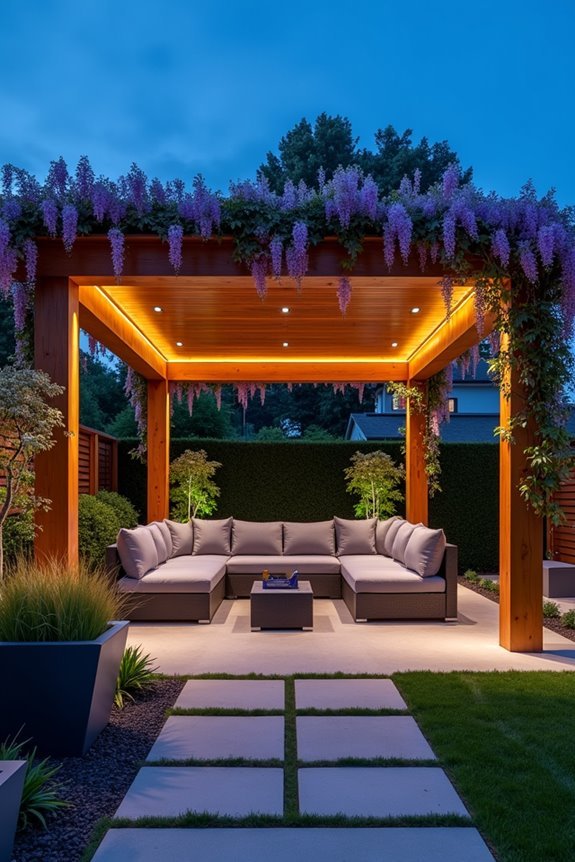
LED strip lighting transforms pergola architecture through continuous linear illumination that emphasizes structural geometry and creates depth after dark. You’ll achieve professional results by installing strips along beam undersides, creating clean light channels that define spatial boundaries. Recessed lighting options integrate strips into routed grooves, protecting LEDs while producing seamless illumination without visible hardware.
Position strips to highlight architectural intersections where beams meet posts, accentuating your pergola’s framework. LED color changing capabilities let you shift ambiance instantly—warm whites for intimate gatherings, cool tones for modern aesthetics, or programmable colors for celebrations.
Install strips with aluminum channels for heat dissipation and diffusers to eliminate distracting LED dots. Weatherproof ratings of IP65 or higher guarantee durability. Strategic placement along perimeter edges creates floating visual effects that expand perceived pergola dimensions.
[affiai keyword=”LED strip accent lighting for pergola” template=”carousel” count=”3″]
Solar-Powered Pathway Illumination
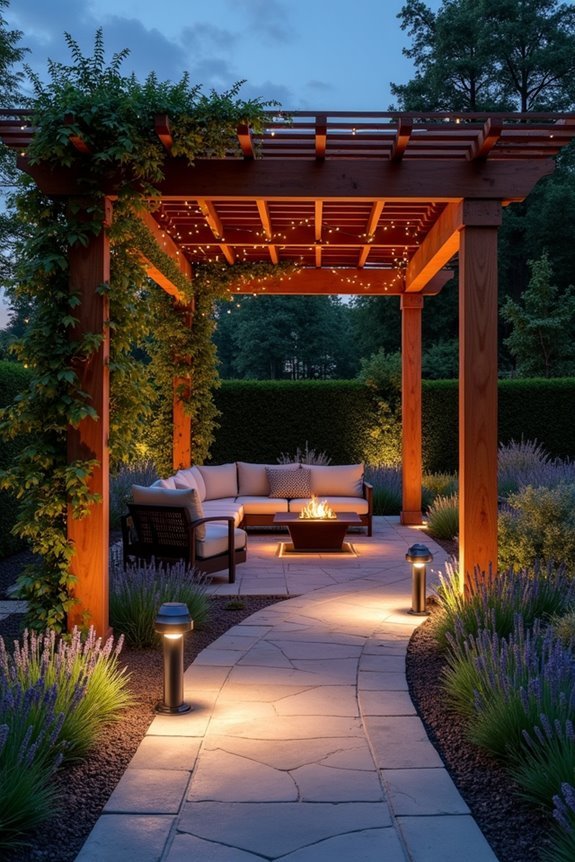
Solar pathway lighting establishes circulation corridors that guide movement between your pergola and surrounding landscape features while maintaining energy independence. You’ll maximize solar efficiency by positioning fixtures where they receive six-plus hours of direct sunlight daily. Strategic placement creates pathway branding—a distinct visual signature that reinforces your landscape’s navigational logic. Install units 6-8 feet apart along primary routes, adjusting spacing based on lumens output and beam spread. Consider fixture height proportional to path width: low-profile bollards for intimate walkways, taller posts for expansive approaches. Modern photovoltaic cells generate sufficient charge even during overcast conditions, storing energy in lithium batteries that power LEDs for 8-12 hours. Select color temperatures between 2700-3000K to create warm changes from pergola to garden zones.
[affiai keyword=”solar powered pathway lighting” template=”carousel” count=”3″]
Chandelier Statement Pieces
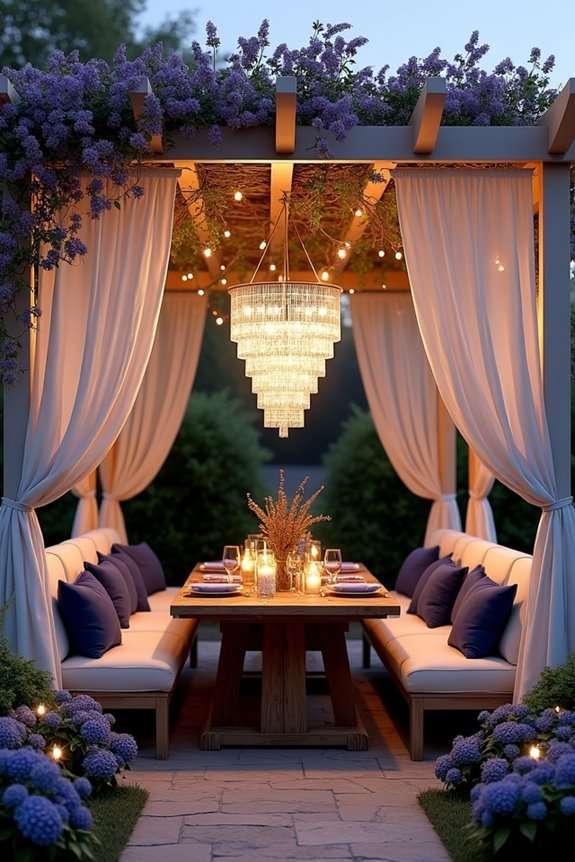
A suspended chandelier transforms your pergola’s central zone into an architectural focal point, establishing vertical hierarchy within an otherwise horizontal structure. When considering chandelier placement, position the fixture at least seven feet above the floor to guarantee clearance while maintaining visual impact. Center it over your primary seating or dining area to create intentional spatial definition.
Chandelier materials directly influence both durability and aesthetic coherence. Weather-resistant options include powder-coated metal, marine-grade brass, and treated wood compositions. Glass elements require tempered varieties to withstand temperature fluctuations. Scale matters critically—your chandelier’s diameter should measure one-half to two-thirds of your table’s width, or occupy fifteen to twenty percent of the pergola’s overhead plane. This proportional relationship guarantees the piece commands attention without overwhelming your outdoor architecture.
[affiai keyword=”outdoor chandelier pergola” template=”carousel” count=”3″]
Vintage Edison Bulb Strings

While chandeliers establish dramatic verticality, vintage Edison bulb strings create horizontal luminous pathways that emphasize your pergola’s linear architecture. These carbon-filament bulbs deliver warm 2200K color temperatures, producing an ambient glow that softens geometric beam structures without overwhelming spatial dimensions.
You’ll want to position strings 18-24 inches apart across parallel rafters, maintaining consistent spacing ratios that complement your pergola’s proportions. The exposed filaments create dimensional light sources—unlike modern LED diffusion—allowing you to see both the illumination mechanism and resulting shadows.
For authentic vintage aesthetics, select bulbs with visible support structures and hand-wound filaments. Mount them on black twisted cord or braided fabric cable that recedes visually, keeping focus on the light sources themselves. This arrangement transforms overhead space into layered planes of warm illumination.
[affiai keyword=”vintage edison bulb string” template=”carousel” count=”3″]
Colored Uplighting for Drama
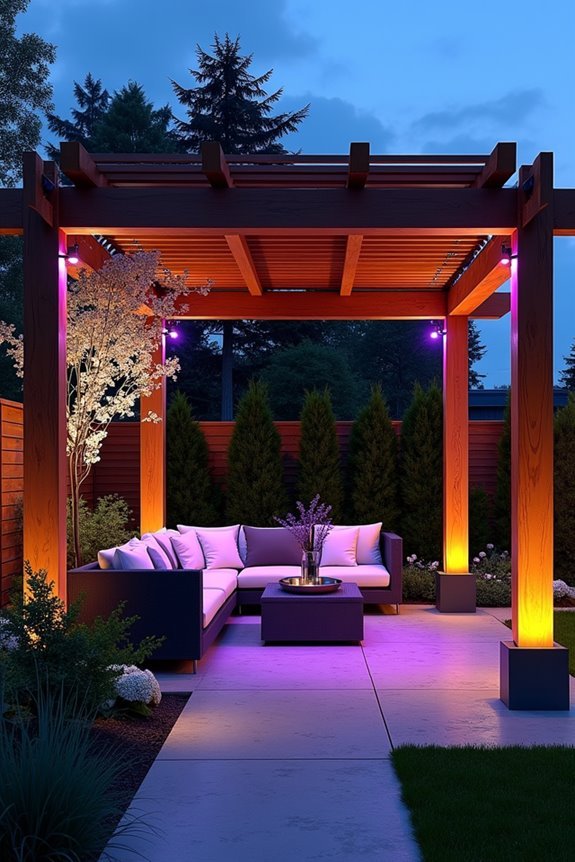
Strategically positioned ground-level fixtures transform pergola columns into architectural monuments through chromatic projection that redefines vertical surfaces after dark. You’ll achieve maximum impact by installing adjustable LED uplights at each post’s base, angling beams to graze textured wood or stone surfaces. Dramatic color schemes ranging from deep amber to jewel-toned blues create distinct atmospheric zones within your outdoor space.
Your lighting placement techniques should account for beam spread and fixture spacing—position units 8-12 inches from column bases to prevent harsh shadows while ensuring even wash coverage. Layer complementary hues across opposing posts to establish visual rhythm, or deploy single-color temperature washes for unified architectural emphasis. Dimmer-compatible RGB systems provide programmable control, letting you shift between energetic entertaining modes and subdued ambient settings.
[affiai keyword=”colored outdoor lighting for pergolas” template=”carousel” count=”3″]
Candle Clusters on Surfaces
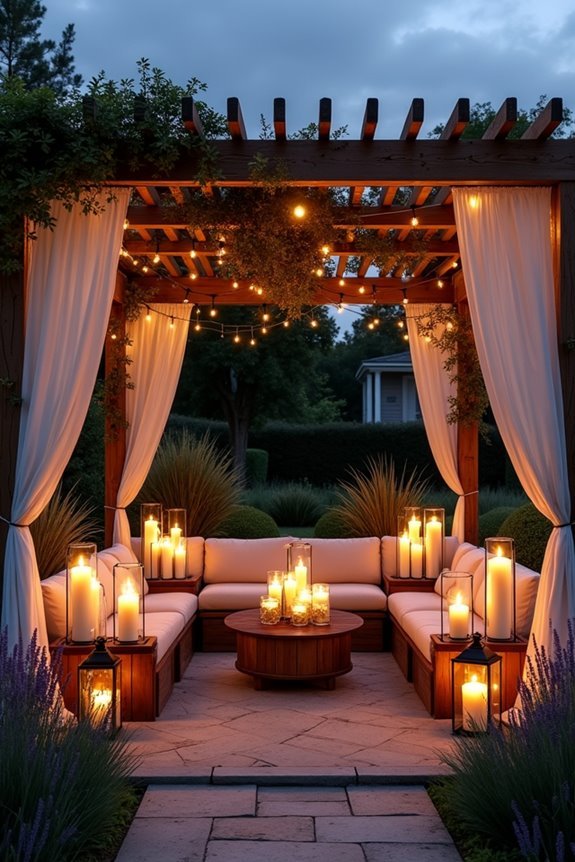
Grouping candles by height and container type across pergola surfaces creates dimensional focal points that pulse with organic movement. You’ll achieve maximum impact by arranging pillar candles alongside votives and tea lights in staggered elevations. Place clusters on side tables, ledges, and built-in seating to establish multiple light sources throughout your space.
Select candle varieties with varying burn times to maintain consistent illumination during gatherings. Hurricane glasses protect flames from wind while amplifying their glow through glass refraction. Mason jars and lanterns add rustic charm to casual settings, while mercury glass elevates formal arrangements.
Your surface arrangements should follow the rule of threes—odd-numbered groupings create visual interest. Space clusters 4-6 feet apart to distribute light evenly without creating dead zones beneath your pergola’s canopy.
[affiai keyword=”candle clusters for pergola” template=”carousel” count=”3″]
Twinkling Curtain Light Walls
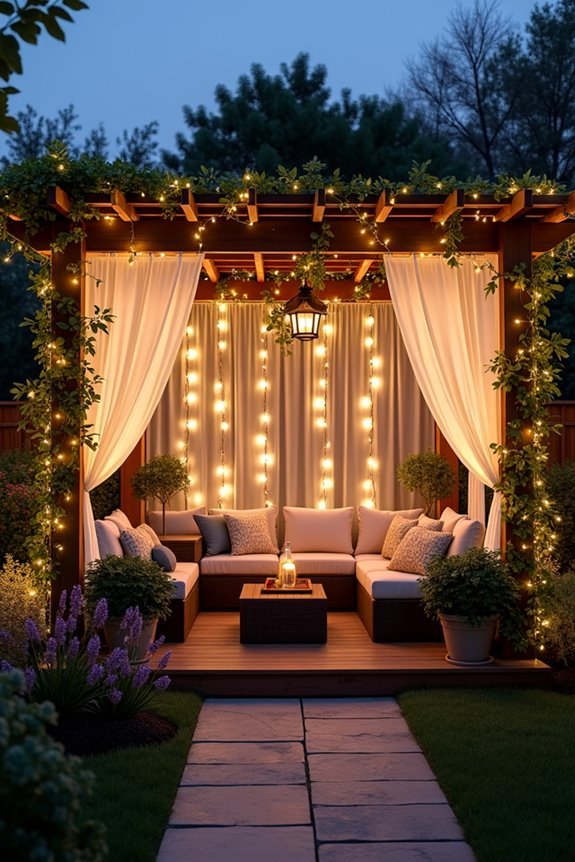
When you suspend curtain lights vertically from your pergola’s beams, you’ll transform the entire structure into an enclosed luminous sanctuary. Position strands 12-18 inches apart to create dense light walls that define spatial boundaries while maintaining visual permeability. You’ll achieve ideal coverage by measuring beam-to-ground height precisely and selecting strands that extend 6 inches beyond for proper anchoring.
Layer multiple twinkling designs at varying intensities to add dimensional depth. Warm white produces intimate ambiance, while cool white creates modern sophistication. Consider integrating sheer curtain materials behind the lights to diffuse illumin
Smart App-Controlled Lighting Systems
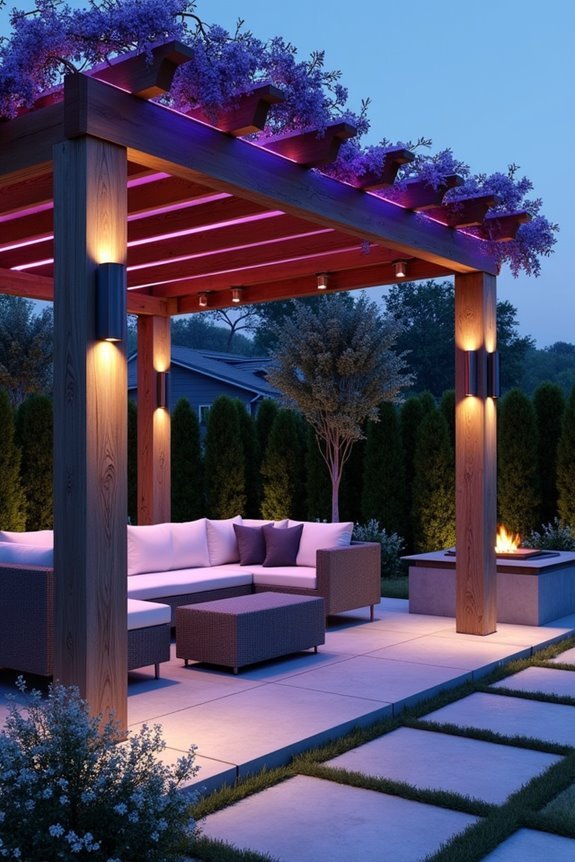
Smart app-controlled lighting systems deliver programmable precision that transforms your pergola’s atmosphere through wireless command. You’ll orchestrate color temperature, brightness levels, and scheduling sequences from your smartphone, creating dynamic environments that shift throughout evening hours. Smart home integration connects your pergola lighting to voice assistants and existing automation platforms, enabling seamless coordination with indoor spaces and outdoor zones. Wireless connectivity eliminates complex hardwiring requirements while providing instant adjustments for different occasions—dim amber tones for intimate dinners, vibrant hues for celebrations, or crisp white light for functional tasks. You can program sunset-triggered activation, gradual dimming sequences, and vacation security modes. These systems store multiple preset scenes, allowing you to switch between distinct atmospheric profiles with single-touch efficiency, adapting your pergola’s character to match evolving spatial requirements.
[affiai keyword=”smart app-controlled pergola lighting” template=”carousel” count=”3″]