

You’re standing at the threshold of transforming your property’s perimeter from purely functional to architecturally compelling. The right fence design doesn’t just mark boundaries—it establishes spatial rhythm, controls sight lines, and sets your landscape’s aesthetic foundation. Whether you’re working with western red cedar, pressure-treated pine, or reclaimed lumber, these ten construction approaches offer distinct solutions for privacy, ventilation, and visual interest. Each technique demands specific joinery methods and material calculations that will determine your project’s structural integrity and longevity.
Horizontal Slat Privacy Fence
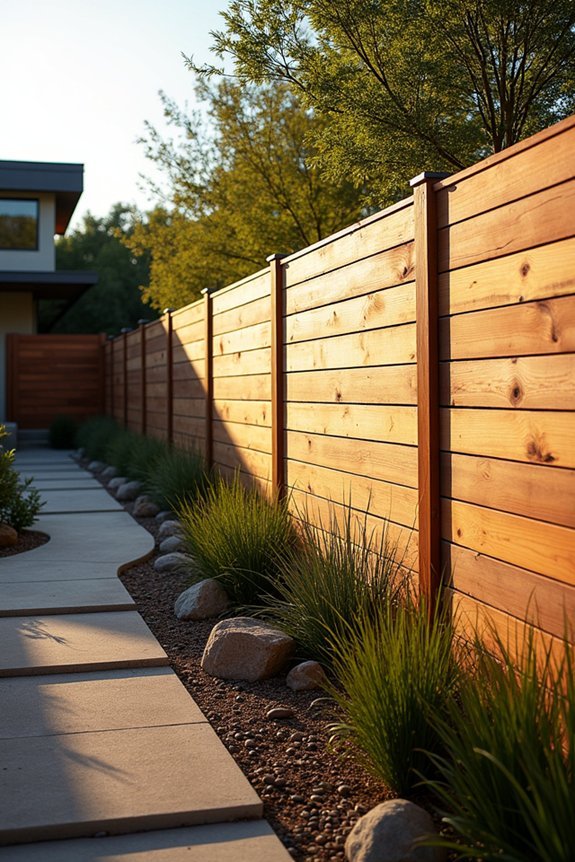
Horizontal slat privacy fences deliver a contemporary aesthetic while maintaining functional screening requirements. You’ll need premium fence materials like cedar, redwood, or pressure-treated lumber for maximum longevity. Select boards measuring 1×4 or 1×6 inches, ensuring consistent grain patterns for visual uniformity.
Critical installation tips include establishing level framework posts at 6-8 foot intervals with concrete footings extending below frost lines. Mount horizontal rails to support your slat arrangement, spacing them 24 inches apart for structural integrity. Attach slats using stainless steel fasteners, maintaining precise ¼-inch gaps for drainage and wood expansion. You can adjust slat spacing from tight configurations for complete privacy to wider arrangements allowing partial visibility and enhanced airflow. Apply exterior-grade sealant immediately after installation to protect against moisture penetration and UV degradation.
[affiai keyword=”horizontal slat privacy fence” template=”carousel” count=”3″]
Board-and-Batten Style Fence
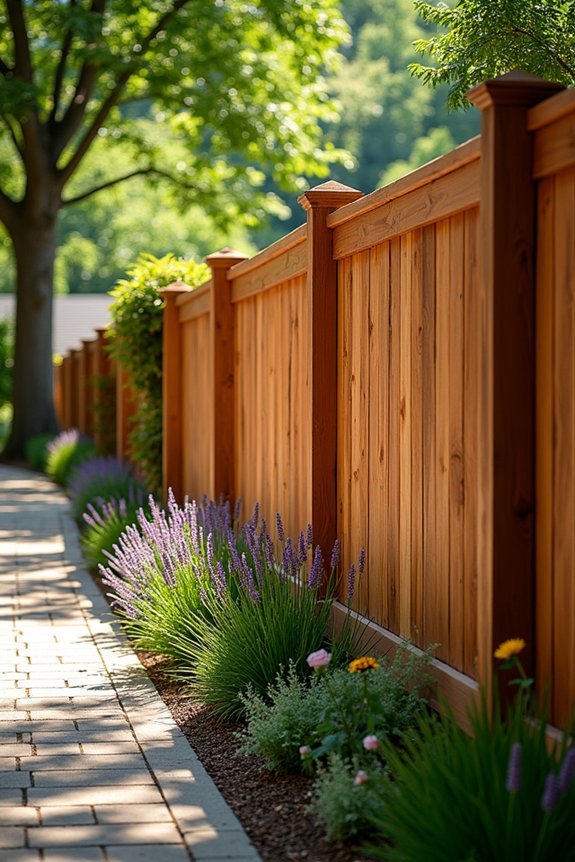
Board-and-batten fencing combines vertical planks with narrower cover strips to create distinctive shadow lines and architectural depth. This traditional pattern offers superior privacy while maintaining visual interest through its layered construction.
When selecting board and batten materials, you’ll need wide base boards (typically 6-8 inches) and narrower battens (2-4 inches) from identical wood species to guarantee uniform weathering. Cedar and redwood provide excellent durability for exterior applications.
For board and batten installation, mount base boards vertically to horizontal rails with 1/4-inch gaps between planks. Position battens to center over these gaps, securing them with corrosion-resistant fasteners. This overlapping technique eliminates sightlines while allowing natural wood expansion. Pre-drill all fastener holes to prevent splitting, and maintain consistent batten spacing for professional results.
[affiai keyword=”board and batten fencing supplies” template=”carousel” count=”3″]
Lattice Top Picket Fence
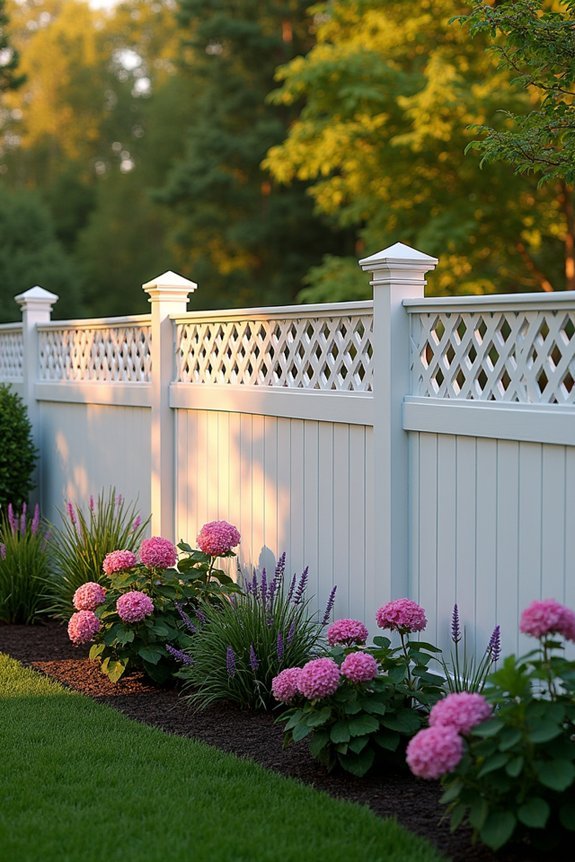
When you’re seeking decorative fencing that balances openness with boundary definition, lattice top picket fences deliver refined Victorian-era aesthetics through their dual-height construction. The lattice design benefits include enhanced air circulation, partial privacy screening, and architectural interest that elevates standard picket installations. You’ll mount diagonal or diamond-pattern lattice panels above solid pickets, typically shifting at 3-4 feet height with horizontal support rails.
For peak installation tips, pre-assemble lattice sections using exterior-grade screws rather than nails, which compromise the delicate crosshatch structure. Secure lattice panels between vertical trim boards to create finished edges and prevent warping. Apply multiple primer coats before painting, as lattice’s increased surface area demands thorough moisture protection. Space your posts at 6-foot intervals maximum to support the lattice’s structural requirements without sagging.
[affiai keyword=”lattice top picket fence” template=”carousel” count=”3″]
Split Rail Rustic Fence
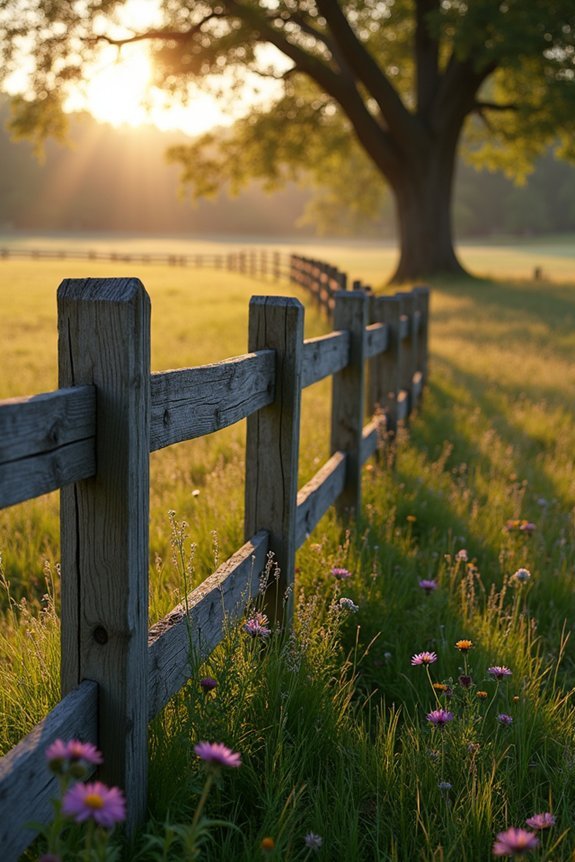
Split rail fences establish quintessential rustic character through their mortise-and-tenon joinery system, where horizontal rails slot directly into vertical posts without fasteners. You’ll typically configure these structures with two or three rails per section, utilizing split rail materials like cedar, locust, or pine that resist decay naturally. The installation demands precise post-hole depth—approximately one-third of the total post height—to guarantee structural stability without concrete anchoring in most applications.
These designs excel at property delineation while maintaining open sightlines across your landscape. The rustic aesthetics complement farmhouse architecture, woodland settings, and naturalistic garden designs effectively. You can enhance functionality by adding wire mesh backing for livestock containment or incorporating the fence into terraced landscaping. Standard eight-foot rail lengths provide ideal dimensional economy while minimizing material waste during construction.
[affiai keyword=”rustic split rail fence” template=”carousel” count=”3″]
Shadowbox Double-Sided Fence
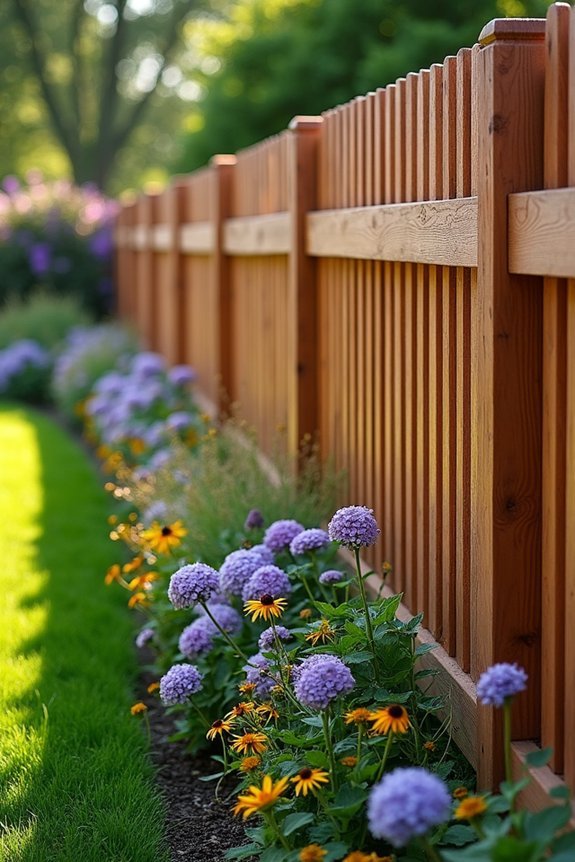
Shadowbox fencing creates visual appeal on both sides through alternating picket placement, where vertical boards attach to opposite faces of the horizontal rails with systematic spacing intervals. This shadowbox design eliminates the traditional “good side/bad side” dilemma while providing partial privacy and controlled airflow.
You’ll need to install three horizontal rails—top, middle, and bottom—to support the alternating board pattern. Space pickets approximately one board width apart on each side, ensuring the gaps on one face align with the boards on the opposite face. Key installation tips include using a spacer jig for consistent gaps, verifying plumb alignment frequently, and securing boards with galvanized screws rather than nails for enhanced durability. The resulting semi-transparent barrier offers aesthetic symmetry while reducing wind resistance compared to solid panel designs.
[affiai keyword=”double-sided fence panel” template=”carousel” count=”3″]
Vertical Cedar Privacy Fence
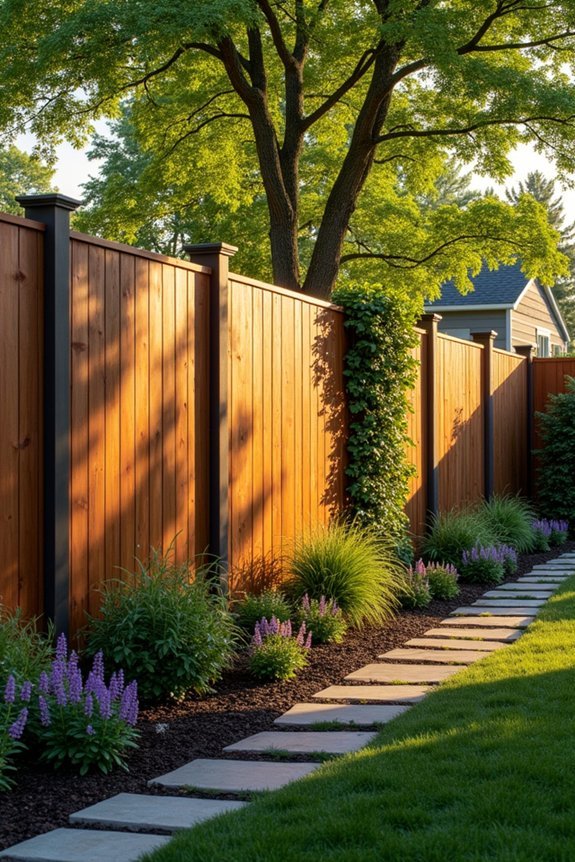
Cedar planks installed vertically deliver maximum privacy coverage while showcasing the wood’s natural grain patterns and inherent rot-resistance properties. You’ll maximize durability by selecting heartwood grades, which contain higher concentrations of natural preservatives than sapwood alternatives. Standard cedar treatment techniques include applying penetrating oil-based sealers that enhance weather protection without obscuring grain characteristics.
For best results, follow these fence installation tips: space posts 6-8 feet apart using concrete footings extending below frost lines, attach 2×4 horizontal rails at top, middle, and bottom positions, and secure planks with corrosion-resistant fasteners. You can achieve seamless aesthetics by positioning boards edge-to-edge or incorporate minimal gaps for enhanced airflow. Pre-staining individual planks before assembly guarantees complete coverage, particularly along edges where moisture penetration typically occurs.
[affiai keyword=”vertical cedar privacy fence” template=”carousel” count=”3″]
Louvered Angled Slat Fence
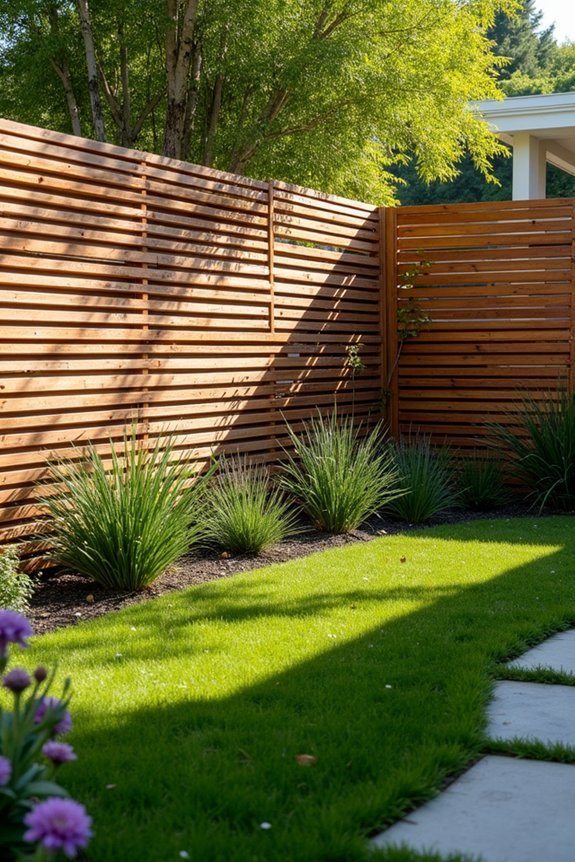
Angled slat configurations create controlled sightlines through strategic plank positioning, delivering privacy from direct angles while permitting airflow and filtered light transmission. You’ll achieve ideal screening by installing boards at 30-45 degree angles, spacing them to overlap visual planes without complete closure. Louvered designs require precise measurements to maintain consistent angles across all sections—use a sliding bevel gauge to replicate angles accurately. Mount slats to horizontal rails with galvanized fasteners, ensuring each board maintains parallel alignment. Angled slats demand more material than vertical installations but compensate through superior ventilation and dimensional interest. Pre-drill attachment points to prevent splitting at angle cuts. Consider alternating slat directions in adjacent panels for dynamic visual patterns while maintaining functional privacy screening throughout your perimeter.
[affiai keyword=”angled slat fencing” template=”carousel” count=”3″]
Chevron Patterned Feature Fence
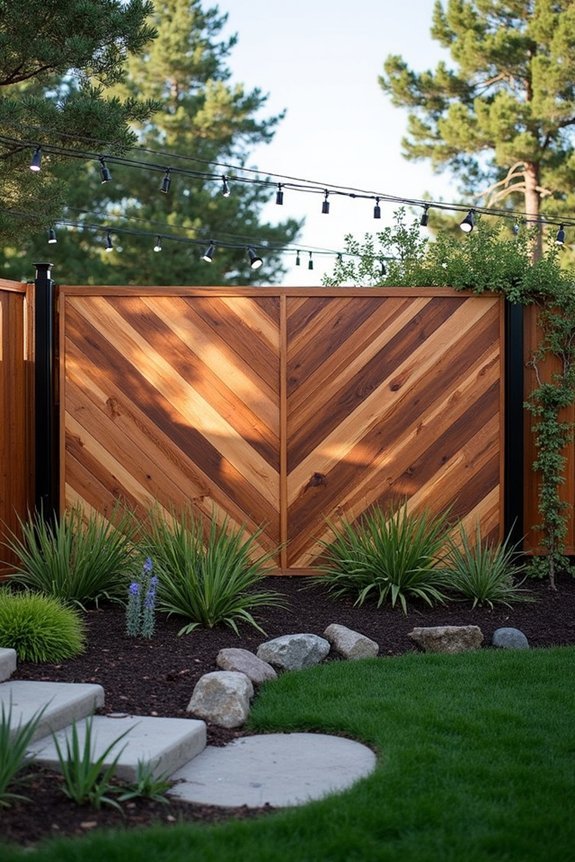
Chevron patterns transform standard fence panels into architectural focal points through V-shaped board arrangements that create striking geometric rhythm across your property line. You’ll need to establish precise 45-degree angles using a miter saw, ensuring each board intersects at consistent points along a central vertical support. Chevron design options include single-direction herringbone, mirrored double-chevron configurations, and alternating color treatments that emphasize the angular geometry. Critical fence installation tips involve pre-drilling screw holes to prevent splitting at angled cuts, maintaining uniform spacing between boards, and securing a robust framework capable of supporting the increased weight from overlapping lumber. Start with a detailed scale drawing to calculate exact material quantities and minimize waste. This pattern works exceptionally well as a partial feature wall rather than full perimeter fencing.
[affiai keyword=”chevron patterned fencing” template=”carousel” count=”3″]
Scalloped Edge Decorative Fence
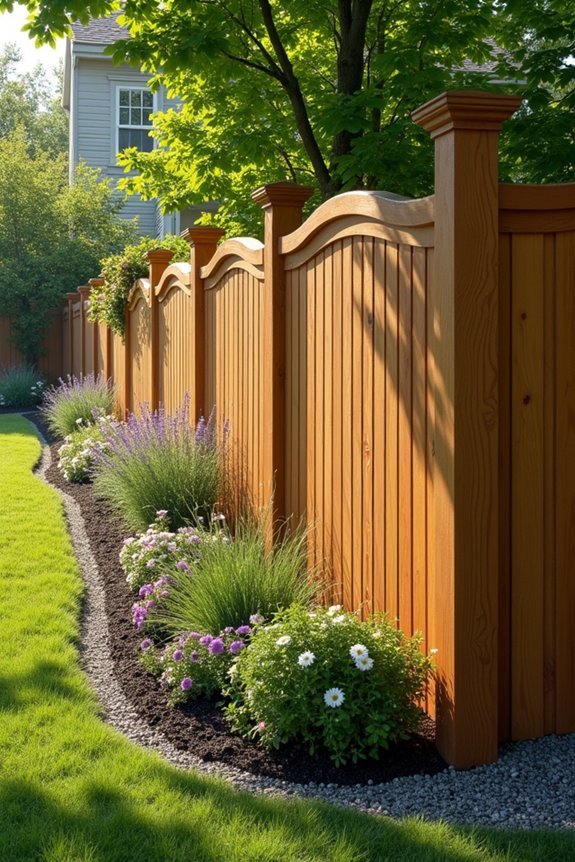
Scalloped edge treatments soften traditional fence designs by introducing gentle curves along the top rail, creating an elegant changeover between your property boundary and the surrounding landscape. You’ll achieve this scalloped design by carefully marking consistent arc patterns across each panel section before cutting with a jigsaw or band saw.
Select fence materials that resist splitting during curved cuts—cedar and redwood provide superior workability while maintaining structural integrity. You’ll need to create a template from cardboard or thin plywood to guarantee uniform scallops throughout your installation. Space each curve 6-8 inches apart for balanced visual rhythm.
The scalloped pattern works exceptionally well for front yard applications where you’re prioritizing aesthetics over maximum privacy. Seal cut edges immediately to prevent moisture infiltration and premature deterioration.
[affiai keyword=”scalloped edge decorative fence” template=”carousel” count=”3″]
Bamboo Panel Privacy Fence
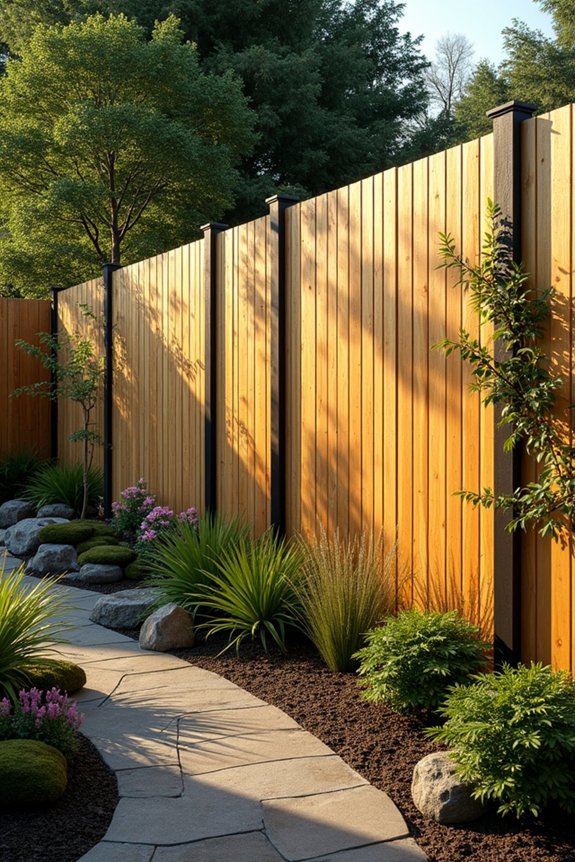
Bamboo panels deliver exceptional privacy screening while establishing a distinct architectural aesthetic that differentiates your outdoor space from conventional wood fencing systems. You’ll achieve ideal results by selecting panels with 1-inch diameter culms positioned vertically or horizontally, creating uniform visual density. Sustainable bamboo sourcing guarantees you’re utilizing rapidly renewable materials with minimal environmental impact—verify your supplier harvests from managed groves with 3-5 year rotation cycles. Installation requires pressure-treated posts spaced 6-8 feet apart with galvanized hardware to prevent corrosion. Bamboo fence maintenance demands annual application of UV-protective sealants to prevent weathering and color degradation. You should inspect panel connections quarterly, tightening fasteners as bamboo naturally contracts during seasonal humidity fluctuations. This system provides 6-8 foot height options for complete sightline obstruction.
[affiai keyword=”bamboo privacy fence panels” template=”carousel” count=”3″]