
You might not realize that modern timber fences function as architectural extensions of your home’s interior design language, establishing spatial boundaries while actively shaping sight lines and microclimates. The strategic placement of horizontal versus vertical elements doesn’t just affect aesthetics—it fundamentally alters how you perceive your yard’s proportions and usable zones. Before you commit to a standard panel system, you’ll need to understand how each configuration manipulates space, privacy gradients, and structural performance in ways that impact your property’s long-term value.
Horizontal Slat Privacy Panels
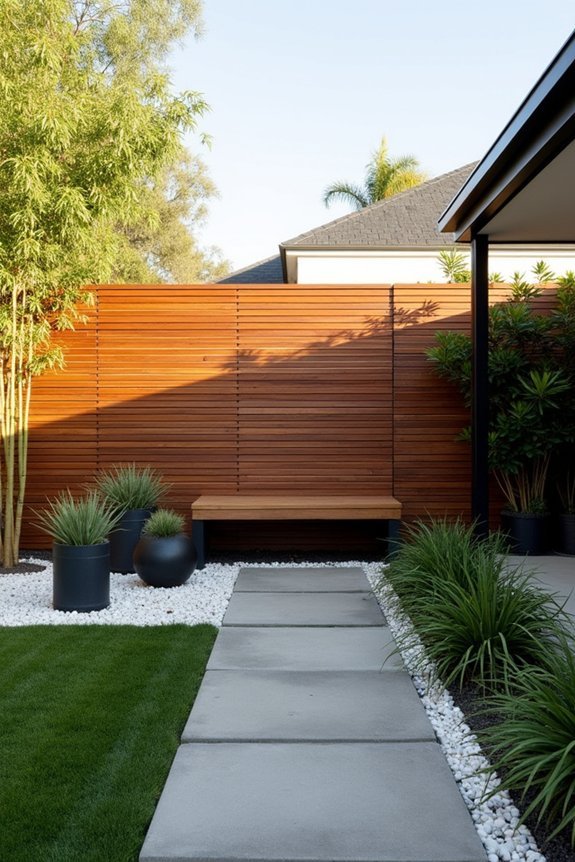
When privacy ranks as your primary concern, horizontal slat panels deliver both visual screening and contemporary aesthetic appeal. You’ll achieve ideal horizontal privacy by spacing slats 10-15mm apart, creating strategic sightline barriers while maintaining airflow. These slat designs work best when mounted to 100x100mm posts at 2400mm intervals, ensuring structural integrity without visual interruption.
Configure your panels between 1800-2100mm height for maximum screening effectiveness. Consider varying slat widths—75mm, 100mm, or 140mm profiles—to manipulate shadow patterns and dimensional depth. You can enhance the design by incorporating contrasting timber species or applying differential staining techniques. Install shadow gaps at panel joints to emphasize horizontal linearity. This configuration transforms standard boundary treatment into architectural expression, balancing functional requirements with clean, stratified geometry.
[affiai keyword=”horizontal slat privacy panels” template=”carousel” count=”3″]
Vertical Board and Batten Style
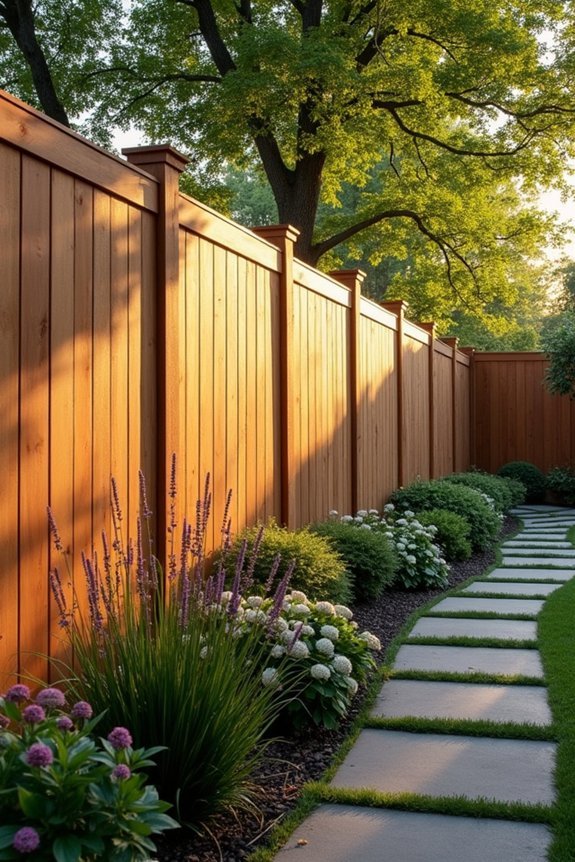
While horizontal configurations emphasize width and groundedness, vertical board and batten fencing creates upward visual momentum through alternating plank depths. You’ll install wide boards as primary surfaces, then overlay narrower battens across seams. This dimensional layering produces strong shadow lines that shift throughout daylight hours.
Vertical orientation benefits include accelerated water runoff, preventing moisture accumulation at horizontal joints where rot typically initiates. The staggered depth arrangement enhances board batten durability by shielding fasteners and vulnerable edge grain from direct weather exposure.
You can manipulate batten spacing ratios—narrow battens create refined rhythms, while wider battens establish bold geometric patterns. The elevated sightlines inherent to vertical compositions make your fence perimeter appear taller without increasing actual height, optimizing privacy while maintaining material economy.
[affiai keyword=”vertical board and batten fencing” template=”carousel” count=”3″]
Mixed Material Modern Combination
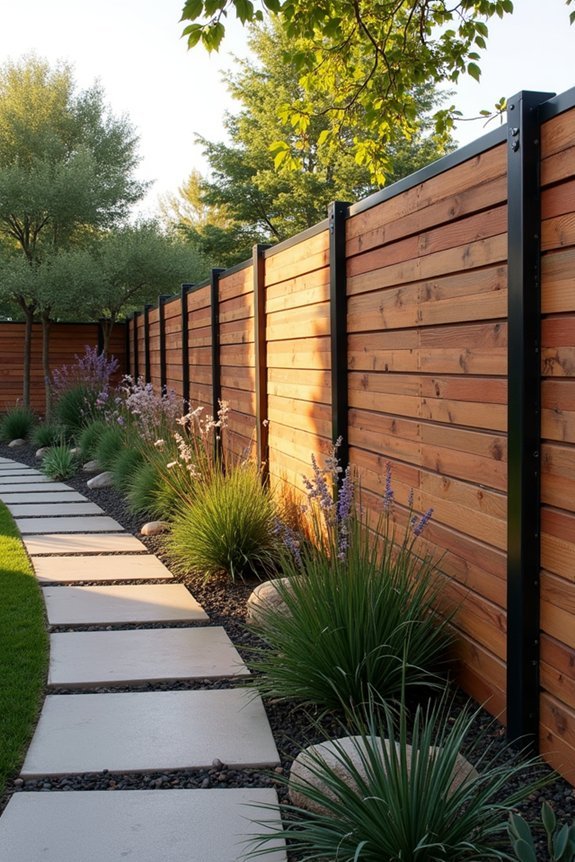
Contemporary fence design increasingly leverages material juxtaposition to create visual tension and functional optimization. You’ll achieve sophisticated mixed material aesthetics by pairing timber with steel frames, aluminum panels, or concrete posts. This approach establishes distinct spatial zones while maintaining permeability and sightlines.
Consider these contemporary fence designs: horizontal cedar slats inserted between powder-coated steel uprights, or timber infill panels anchored by cast concrete columns. You’re creating dimensional depth through contrasting textures—smooth metal against natural wood grain, or rough aggregate beside milled lumber.
The structural hierarchy matters. Position denser materials at stress points while utilizing timber for infill sections. You’ll optimize load distribution and capitalize on each material’s inherent properties. Vertical metal posts provide rigidity; timber panels deliver warmth and visual softness, resulting in balanced architectural expression.
[affiai keyword=”modern mixed material fence” template=”carousel” count=”3″]
Staggered Height Geometric Design
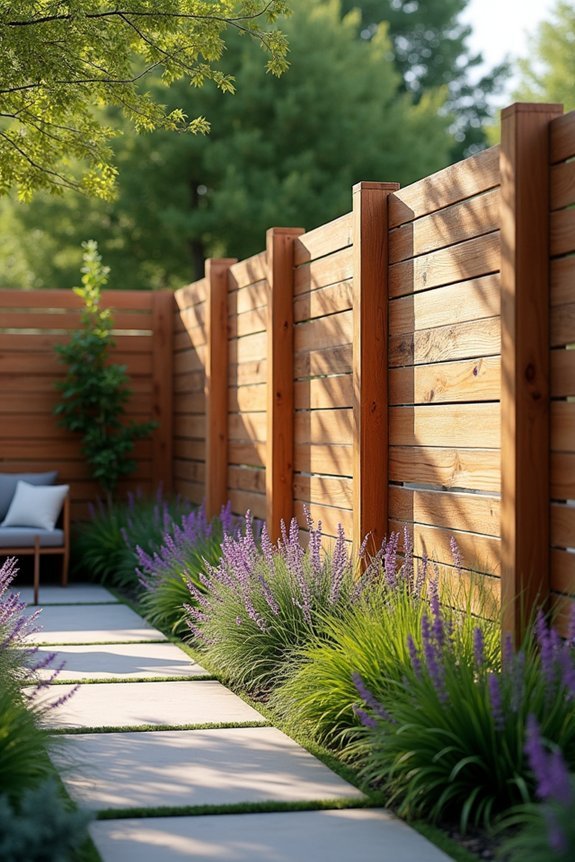
Staggered height applications transform conventional boundary treatments into dynamic sculptural elements that modulate visual rhythm across your property line. You’ll create compelling creative fence patterns by alternating vertical timber sections at predetermined intervals—typically shifting between 4-foot, 6-foot, and 8-foot heights. This dimensional variation establishes sight-line control while maintaining architectural fence aesthetics through calculated negative space.
Position taller segments where privacy demands maximum screening, evolving to lower sections that frame strategic views or encourage air circulation. The geometric interplay generates shadow patterns that shift throughout the day, adding temporal interest to your landscape composition. You can amplify this effect by incorporating horizontal offset alignments, where each height tier projects forward or recedes at measured distances, creating depth perception that challenges traditional planar fence configurations.
[affiai keyword=”staggered height fences” template=”carousel” count=”3″]
Floating Frame Box Sections
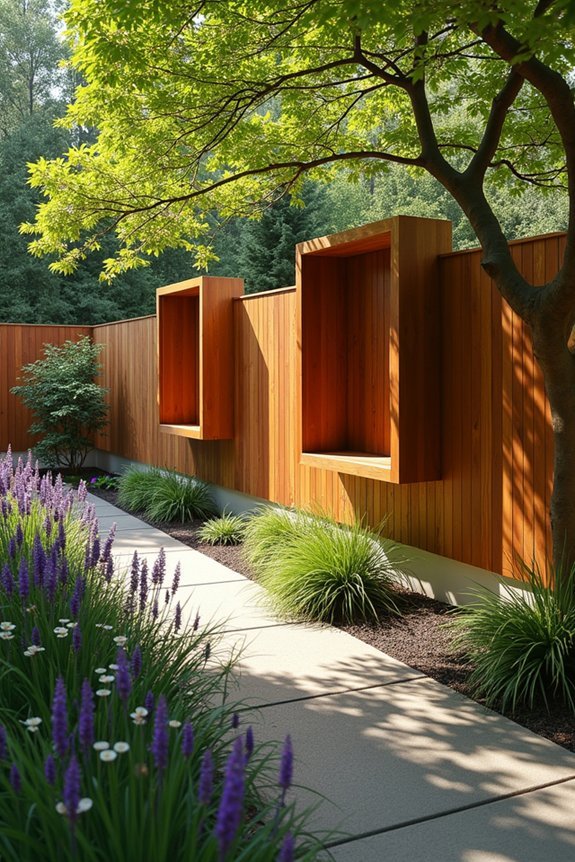
Through strategic suspension of rectilinear timber frames within your fence structure, floating box sections establish three-dimensional depth that separates foreground and background planes with architectural precision. You’ll create visual interest by mounting isolated frames at varying distances from your primary fence plane, generating shadow play and dimensional complexity.
Floating frame advantages include enhanced privacy control through layered screening and improved air circulation between offset sections. You can manipulate sight lines by adjusting frame positioning and spacing intervals.
For ideal floating frame materials, select pressure-treated cedar or composite lumber that resists warping under cantilever stress. Mount frames using concealed steel brackets anchored to structural posts, ensuring each suspended section maintains 2-4 inches of clearance from background surfaces for maximum dimensional effect.
[affiai keyword=”floating fence frames” template=”carousel” count=”3″]
Dark Stained Minimalist Screening
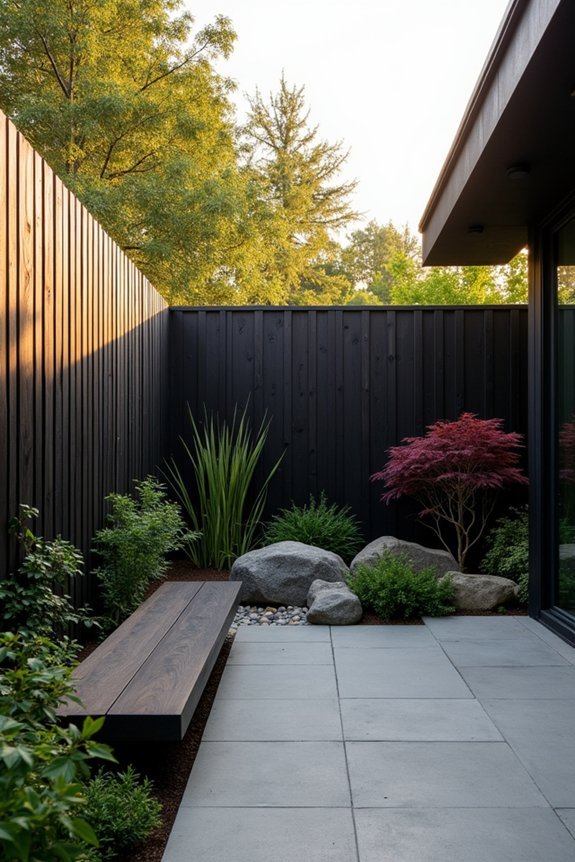
When you apply dark stains to minimalist timber screening, you’ll achieve recessive visual weight that pushes fence planes into the background while amplifying garden foreground elements. This dark wood aesthetics strategy creates depth hierarchy through tonal contrast rather than physical layering.
You’ll maximize privacy enhancement by selecting vertical slat configurations with 15-20mm gaps—narrow enough to obstruct sightlines while maintaining airflow and preventing visual heaviness. The dark finish absorbs light instead of reflecting it, reducing fence prominence in your spatial composition.
Position screening panels perpendicular to primary viewing axes to enhance their recessive qualities. Charcoal, ebony, and deep walnut stains work effectively on cedar and hardwood species. The monochromatic palette establishes clean boundaries without competing with plantings, hardscaping, or architectural features in your outdoor environment.
[affiai keyword=”dark stained timber screens” template=”carousel” count=”3″]
Chevron Pattern Cedar Panels
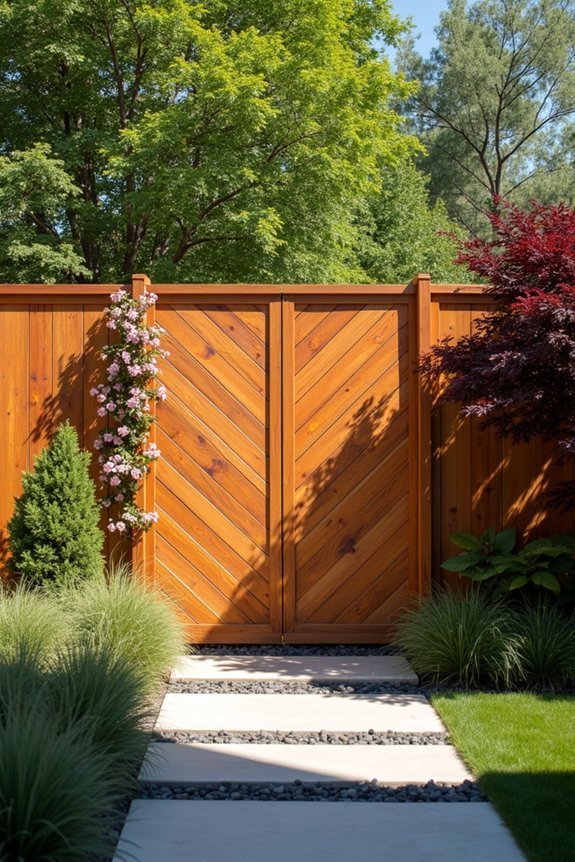
Chevron pattern cedar panels introduce dynamic directionality to vertical surfaces through V-shaped timber arrangements that create optical movement across fence planes. You’ll achieve maximum visual impact by maintaining consistent angles—typically 45 degrees—while alternating board direction at central junction points. Cedar panel durability guarantees these geometric installations withstand weathering without compromising structural integrity, as the wood’s natural oils resist moisture penetration and decay.
For chevron pattern inspiration, consider varying board widths to create rhythm variations, or install panels at alternating heights to generate three-dimensional depth. You’ll need precise miter cuts and alignment jigs for professional-grade execution. Mount panels to horizontal rails using concealed fasteners, making sure each chevron vertex aligns perfectly with adjacent sections. This directional emphasis transforms standard screening into architectural statement pieces that guide sight lines purposefully.
[affiai keyword=”chevron pattern cedar panels” template=”carousel” count=”3″]
Slatted Screen With Integrated Planters
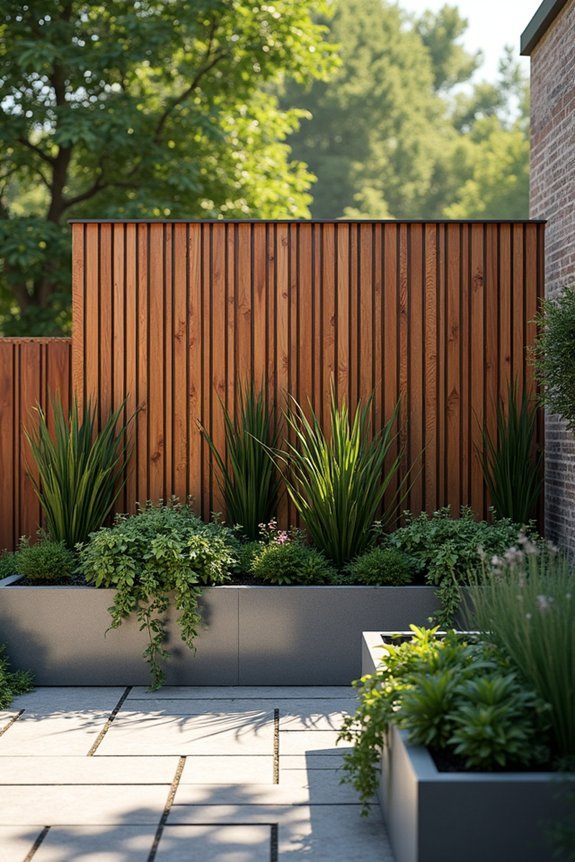
Vertical slats positioned at precise intervals create privacy gradients while integrated planter boxes establish green architecture that merges hardscape boundaries with living elements. You’ll achieve ideal planter integration by constructing 16-24 inch deep boxes that accommodate root systems while maintaining structural integrity. The slatted design functions as both trellis and screen, with 2-4 inch spacing modulating sight lines and airflow. Position planters at alternating heights to break horizontal monotony and create dimensional layering. Select timber species with natural resistance to soil moisture—cedar, redwood, or treated pine—for longevity at soil interfaces. Install waterproof membranes between planters and fence frames to prevent moisture migration. This configuration transforms static barriers into dynamic living walls where vegetation softens architectural rigidity while slats provide climbing support for vines.
[affiai keyword=”slatted garden screens” template=”carousel” count=”3″]
Louvered Angled Slat Sections
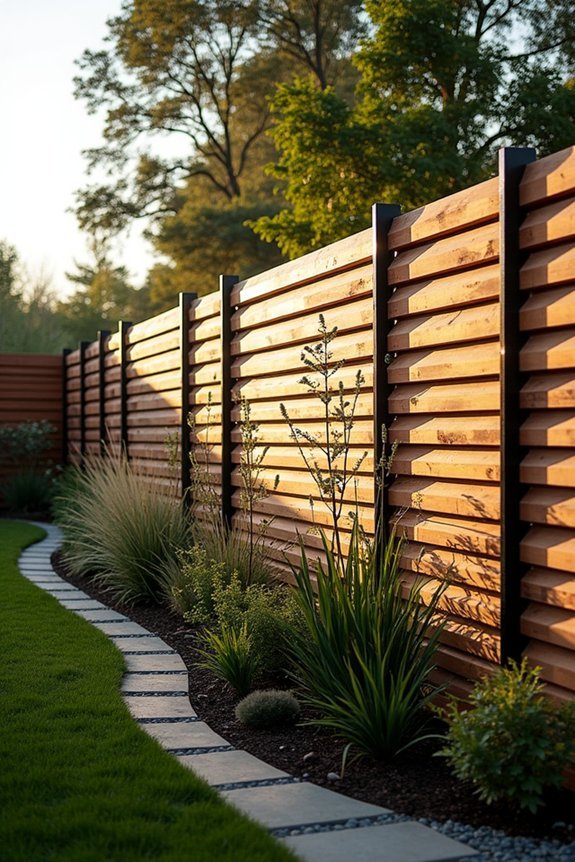
Angled slats set at 15-45 degrees from vertical create controlled visibility corridors that shift opacity based on viewing angles and observer positions. You’ll achieve dynamic privacy zones where sightlines remain blocked from street level while preserving open views from elevated interior spaces. The louvered design benefits include enhanced airflow management, reducing wind load by 40-60% compared to solid panels. Strategic angle selection directs rainfall away from structural posts, extending timber longevity. Angled slat versatility allows you to customize screening intensity per zone—steeper angles for pool areas, gentler slopes for garden boundaries. Mount slats in opposing directions across adjacent sections to create geometric rhythm. This configuration maintains structural integrity while delivering architectural interest through shadow patterns that migrate across fence planes throughout daylight hours.
[affiai keyword=”louvered outdoor privacy screens” template=”carousel” count=”3″]
Natural Wood Lattice Topper
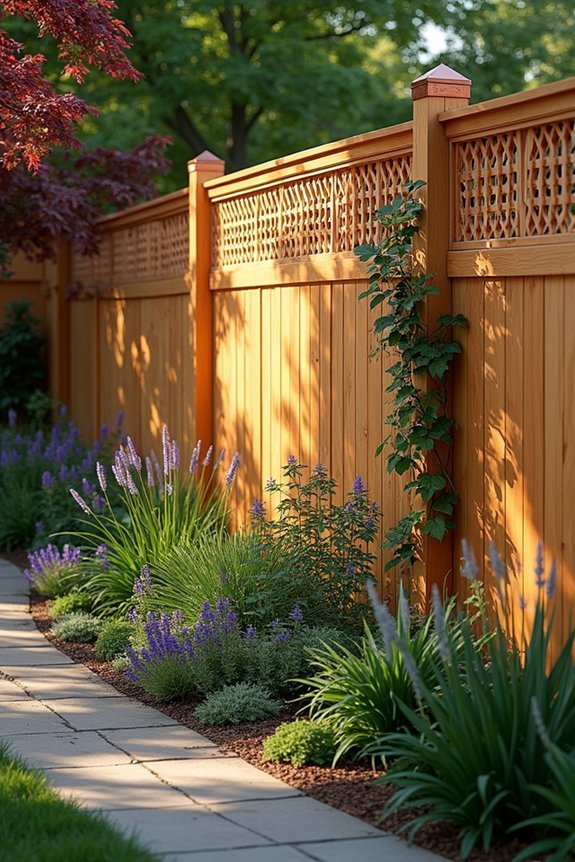
Traditional lattice panels mounted atop solid fence sections deliver 8-12 inches of decorative height while maintaining airflow and partial visibility. You’ll achieve graduated privacy by positioning diagonal or square-grid lattice above 5-6 foot base boards, creating visual interest through geometric contrast. This configuration establishes garden privacy solutions without creating a tunnel effect in narrow yards.
Select cedar or redwood lattice to complement natural wood aesthetics in your fence system. Install lattice with 1.5-inch spacing for moderate screening or 0.75-inch openings for enhanced privacy. Mount panels within framed borders using galvanized fasteners to prevent warping and sagging.
The lattice topper functions as a climbing plant support, integrating vertical gardening opportunities while softening harsh fence lines. You’re adding architectural dimension that flows smoothly between fully enclosed and open sections.
[affiai keyword=”natural wood lattice topper” template=”carousel” count=”3″]
Whitewashed Rustic Picket Design
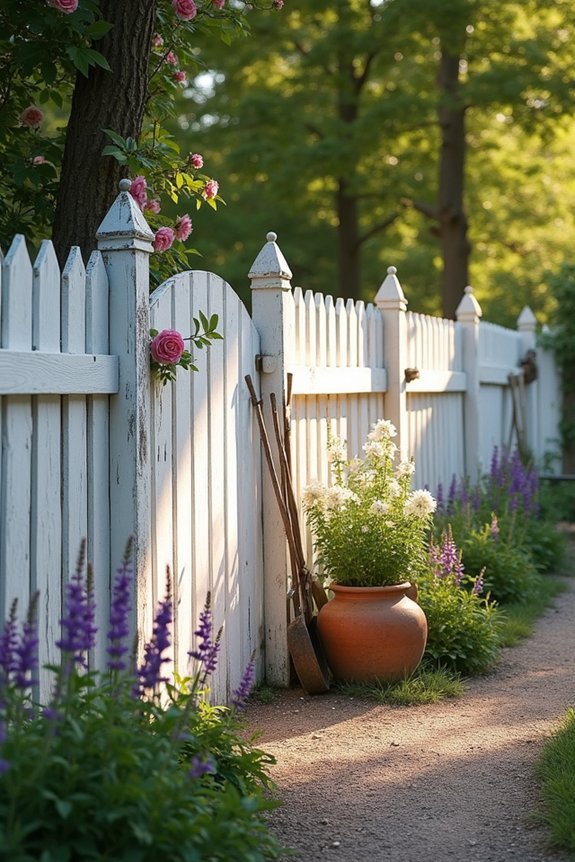
Whitewashed timber pickets create cottage-style boundaries through strategic paint application that reveals underlying wood grain and texture variations. You’ll achieve ideal rustic charm by applying diluted latex paint in thin, irregular coats, allowing natural wood patterns to remain visible beneath the white finish. Position pickets at 3.5-inch intervals with pointed tops set at 36 to 48 inches height for traditional proportions.
The whitewashing technique requires a 3:1 water-to-paint ratio, applied with foam brushes along the grain direction. You can control opacity levels by adjusting dilution ratios and application pressure. This method preserves dimensional lumber characteristics while introducing light-reflective surfaces that expand visual boundaries. Install horizontal rails with mortise-and-tenon joinery to maintain structural integrity while complementing the weathered aesthetic that defines cottage-garden enclosures.
[affiai keyword=”whitewashed rustic picket design” template=”carousel” count=”3″]