You’re standing at the intersection of security and design, where industrial fencing transforms from mere boundary markers into architectural statements. Modern homes demand solutions that won’t compromise on perimeter protection while elevating your property’s visual language. The challenge lies in balancing material weight ratios, sight-line considerations, and spatial flow—all while maintaining that raw, industrial aesthetic. Here’s how you’ll navigate mesh density, panel configurations, and structural load requirements to achieve both.
Introduction to Industrial Fencing Styles
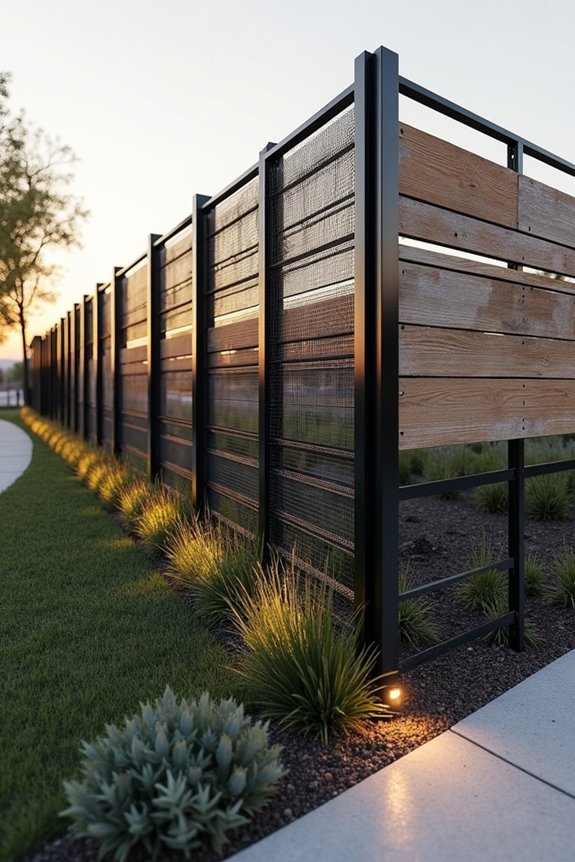
When you’re selecting industrial fencing for your property, you’ll encounter three primary material categories: steel, aluminum, and hybrid composite systems. Each material delivers distinct structural performance and fencing aesthetics suited to specific urban landscaping contexts.
Steel frameworks offer maximum load-bearing capacity with modular panel configurations, ideal for perimeter security applications. You’ll find hot-dipped galvanized finishes provide superior corrosion resistance in coastal environments.
Aluminum systems present lightweight alternatives with powder-coated surfaces in architectural-grade finishes. These installations integrate seamlessly with contemporary residential elevations while maintaining minimal site footprints.
Hybrid composites combine metal framework with infill materials—such as composite slats or mesh panels—creating visual depth. You’ll achieve layered spatial boundaries that define property lines without compromising sightlines or airflow patterns essential to modern site planning.
[affiai keyword=”industrial fencing materials” template=”carousel” count=”3″]
Material Selection and Durability
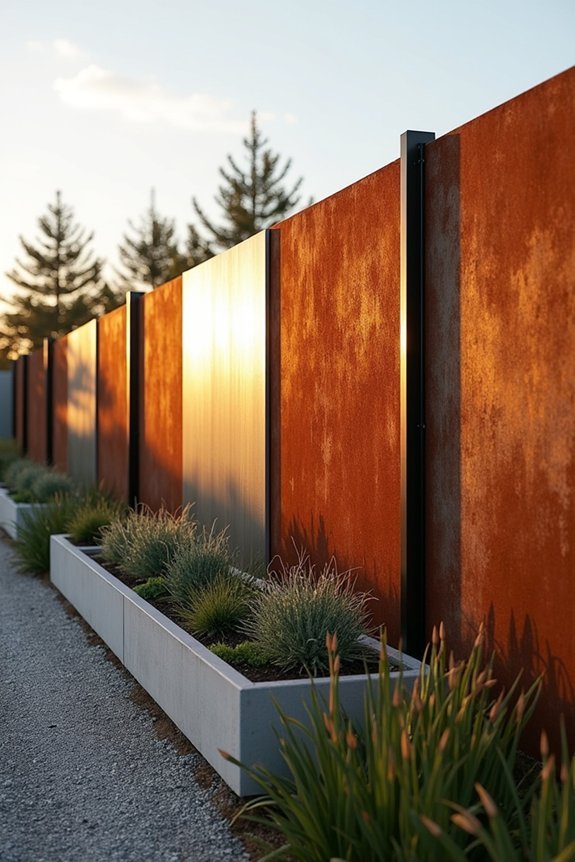
Although material longevity depends on multiple environmental factors, you’ll find that proper specification directly impacts your fence’s service life and lifecycle costs. Steel components require hot-dip galvanization or powder coating to guarantee weather resistance in coastal or industrial zones. Aluminum offers superior corrosion resistance without protective finishes, though it’s less impact-resistant than steel alternatives.
Consider material durability when selecting substrates: corten steel develops protective patina while maintaining structural integrity; stainless steel grades 304 and 316 provide maximum longevity in harsh climates. You’ll need to evaluate thermal expansion coefficients, particularly for panel spans exceeding twelve feet. Chain-link configurations with vinyl-coated galvanized wire extend service intervals considerably. Frame thickness, welding specifications, and fastener quality determine overall system performance under dynamic loads and environmental stress conditions.
[affiai keyword=”fence material durability” template=”carousel” count=”3″]
Metal and Wire Combinations
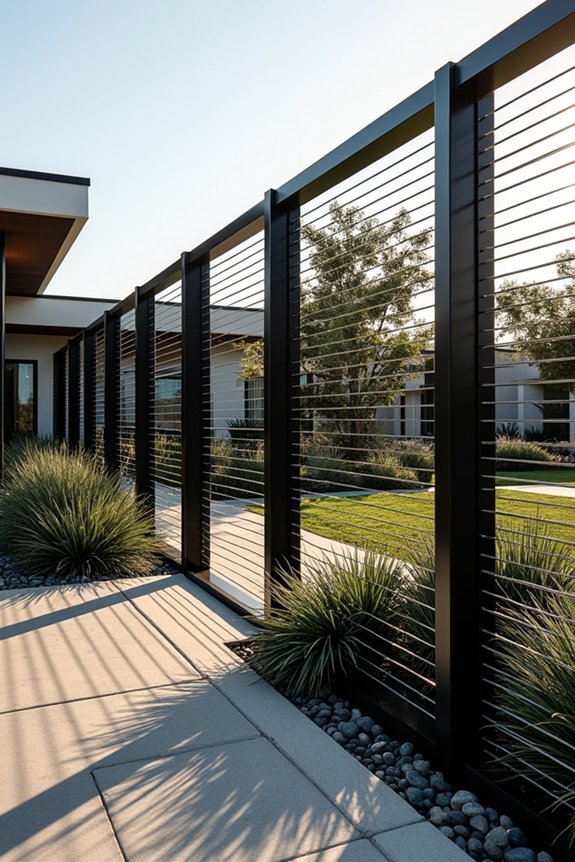
Metal and wire combinations create dimensionality through layered transparency, allowing you to manipulate visual depth while maintaining security specifications. You’ll achieve superior results by pairing structural steel frames with high-tensile wire mesh, where wire strength becomes integral to the design’s architectural expression rather than merely functional necessity.
Consider galvanized cable systems tensioned between powder-coated aluminum posts—this configuration delivers metal aesthetics while addressing load-bearing requirements. You can specify welded wire fabric in various gauges, calibrating security levels to site conditions. Horizontal wire runs at calculated intervals establish rhythm and proportion, while vertical posts define spatial boundaries.
The interplay between solid metal components and woven wire panels produces shadow patterns that evolve throughout daylight hours, transforming your perimeter into a dynamic architectural element that responds to environmental conditions.
[affiai keyword=”metal wire security fencing” template=”carousel” count=”3″]
Corrugated Panel Privacy Solutions
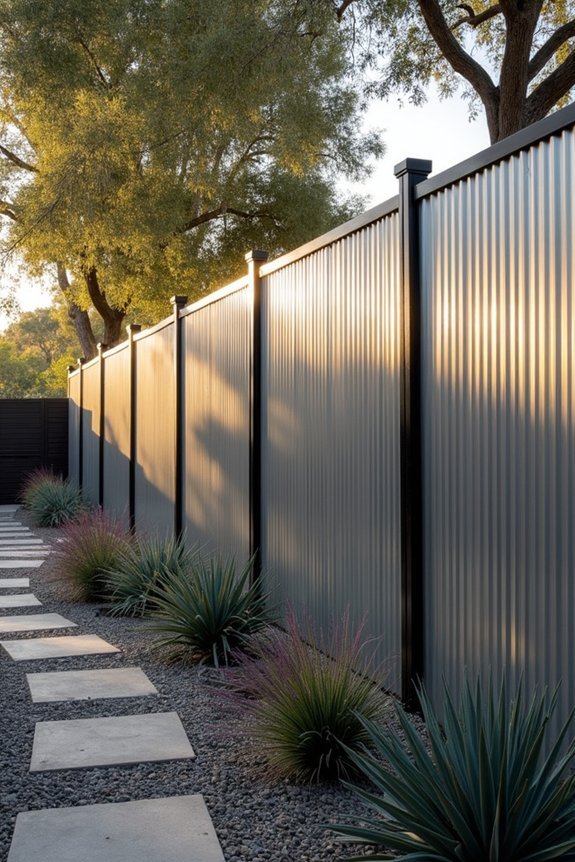
Corrugated metal panels shift the privacy equation from transparent screening to complete visual separation while introducing textural relief that activates your fence plane. These industrial elements deliver robust privacy screening through their opaque construction, eliminating sight lines while creating dynamic shadow patterns across rippled surfaces.
You’ll find corrugated panels in galvanized steel, aluminum, or Corten varieties, each offering distinct weathering characteristics. Standard profiles include 2.67-inch corrugations for residential applications, though deeper ribs amplify the aesthetic appeal through pronounced dimensionality.
Install panels vertically to emphasize height or horizontally to extend perceived width. Strategic orientation affects water drainage patterns—vertical installation prevents moisture accumulation in panel valleys. Consider powder-coated finishes for color customization while maintaining the material’s inherent industrial character. Panel thickness typically ranges from 26 to 22 gauge for ideal structural integrity.
[affiai keyword=”corrugated metal privacy panels” template=”carousel” count=”3″]
Geometric Pattern Integration Techniques
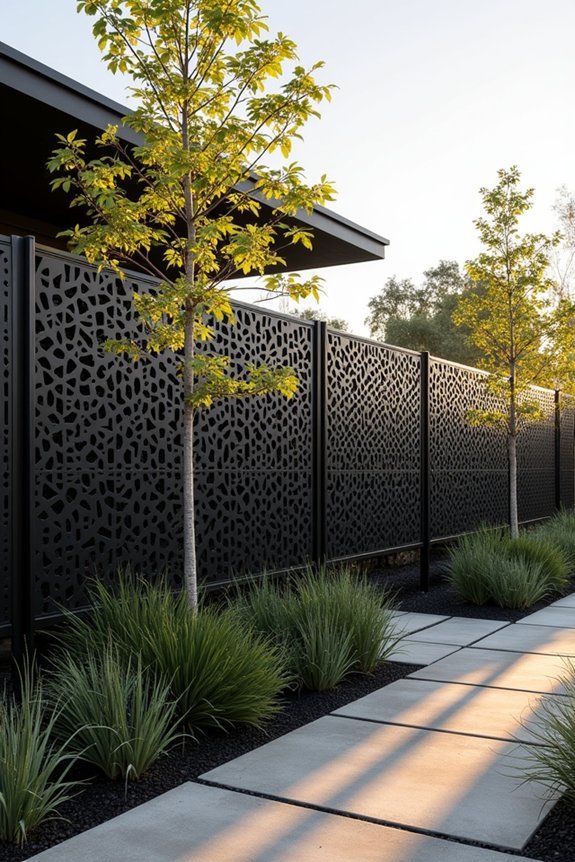
While traditional fencing relies on solid barriers, geometric pattern integration transforms your industrial fence into a three-dimensional architectural element that balances privacy with visual permeability. You’ll need to analyze sight lines and spatial requirements before selecting pattern density. Consider hexagonal perforations, laser-cut triangular arrays, or offset rectangular modules that create rhythm across your property line. Pattern balance determines functionality—tighter geometric configurations near living spaces provide seclusion, while open patterns along boundaries maintain airflow and natural light penetration. Incorporate geometric color blocking through powder-coated panels in contrasting tones to emphasize dimensional depth. Your pattern selection should complement existing architectural features, ensuring the fence functions as an integrated design component rather than an afterthought. Strategic alignment with building axes reinforces spatial coherence throughout your site.
[affiai keyword=”geometric fencing patterns” template=”carousel” count=”3″]
Mixed Material Texture Approaches
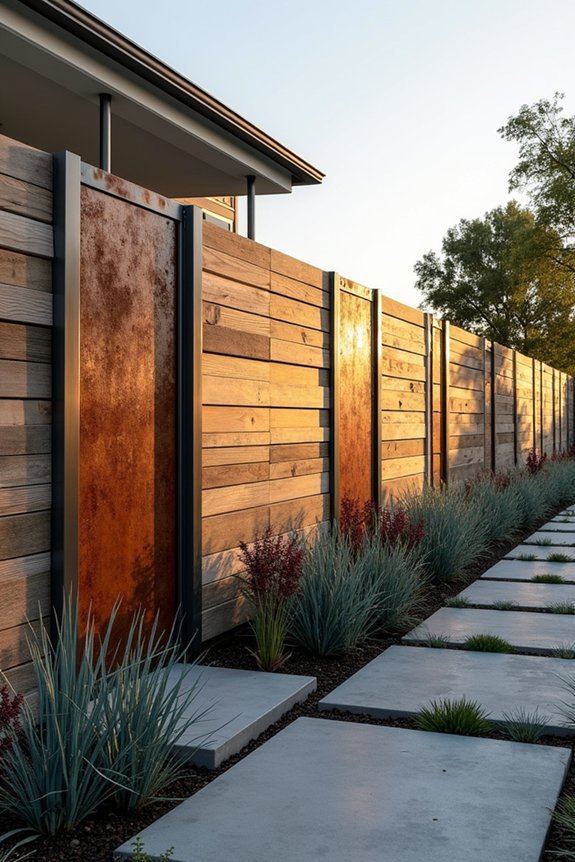
Because industrial fencing succeeds through deliberate material contrast, you’ll maximize visual impact by pairing weathered steel’s oxidized patina against smooth concrete panels or combining reclaimed timber planks with powder-coated aluminum frames. Wood metal contrast creates dimensional depth when you position rough-sawn cedar against brushed stainless steel verticals, establishing tactile variation across fence planes.
Texture layering requires strategic material placement—install corrugated metal behind horizontal wood slats to generate shadow patterns, or alternate matte-finished aluminum with wire mesh sections. You’ll achieve superior results by maintaining 60-40 proportions between primary and accent materials. Consider thermal expansion coefficients when mounting dissimilar materials; use isolation gaskets between metal and wood connections. Surface treatments matter: sandblasted concrete offers visual weight against perforated steel’s industrial lightness, while maintaining cohesive aesthetic through consistent color temperatures.
[affiai keyword=”mixed material fencing” template=”carousel” count=”3″]
Sustainable Rust Finish Options
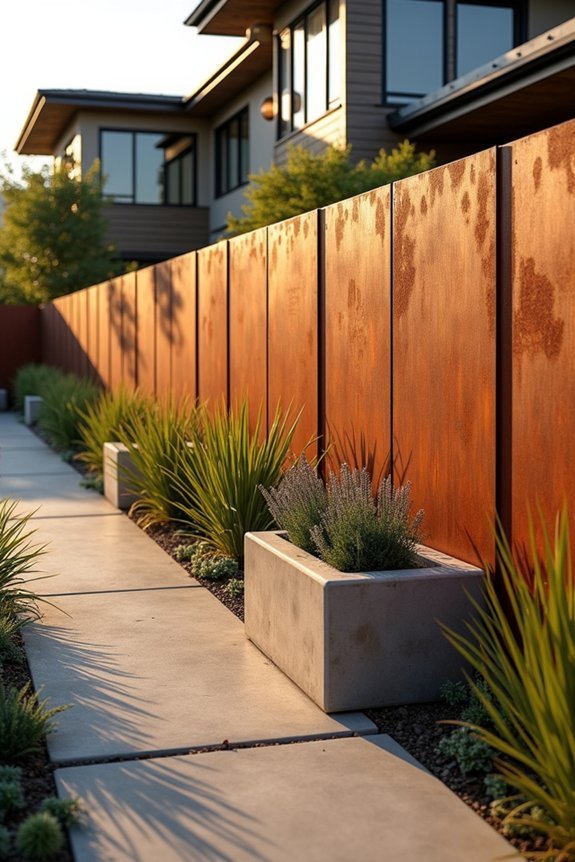
When specifying weathering steel for industrial fencing applications, you’ll need to differentiate between controlled patina systems and unmanaged oxidation processes. Corten steel represents the industry standard for sustainable finishes, developing a self-protecting oxide layer that eliminates ongoing maintenance requirements. You’ll achieve excellent rust aesthetics by selecting pre-weathered panels or accelerating patination through acidic treatments.
Site drainage patterns critically impact finish uniformity—runoff staining adjacent surfaces requires careful detailing. Install weep edges and specify adequate clearance from paving materials. You can pair weathering steel with galvanized framework for dimensional stability while maintaining industrial character.
Alternative approaches include powder-coated rust-effect finishes offering color consistency without substrate reactivity. These synthetic patinas suit urban contexts where runoff management proves challenging, delivering authentic industrial aesthetics with predictable performance characteristics.
[affiai keyword=”weathering steel fencing” template=”carousel” count=”3″]
Industrial Lighting Fixture Pairings
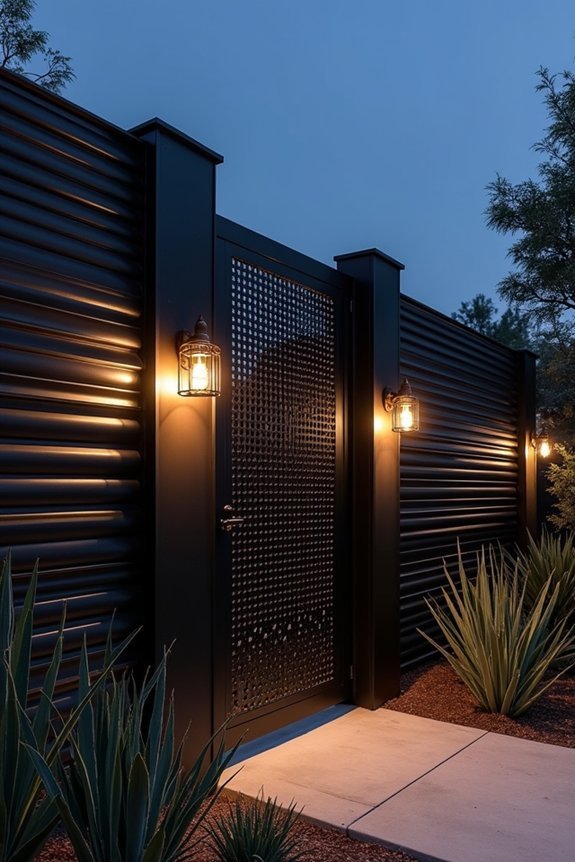
Industrial fencing systems require complementary illumination strategies that reinforce material authenticity and spatial definition. You’ll want to integrate linear LED strips along fence rails to emphasize horizontal geometries while maintaining visibility after dark. Wall-mounted sconces with exposed conduit and metal cages enhance lighting aesthetics through intentional materiality rather than concealment.
Consider adjustable track fixtures for highlighting textural variations in corrugated metal or perforated panels. Fixture versatility becomes critical when accommodating multiple design objectives—security, ambiance, and architectural emphasis. You can install pendant lights with Edison bulbs above gated entries to establish welcoming thresholds without compromising industrial character.
Bollard lighting along fence perimeters provides ground-level illumination while respecting vertical design elements. Select fixtures featuring raw brass, blackened steel, or weathered bronze finishes that’ll develop patina consistent with fence materials.
[affiai keyword=”industrial fencing lighting fixtures” template=”carousel” count=”3″]
Vertical Garden Integration Methods
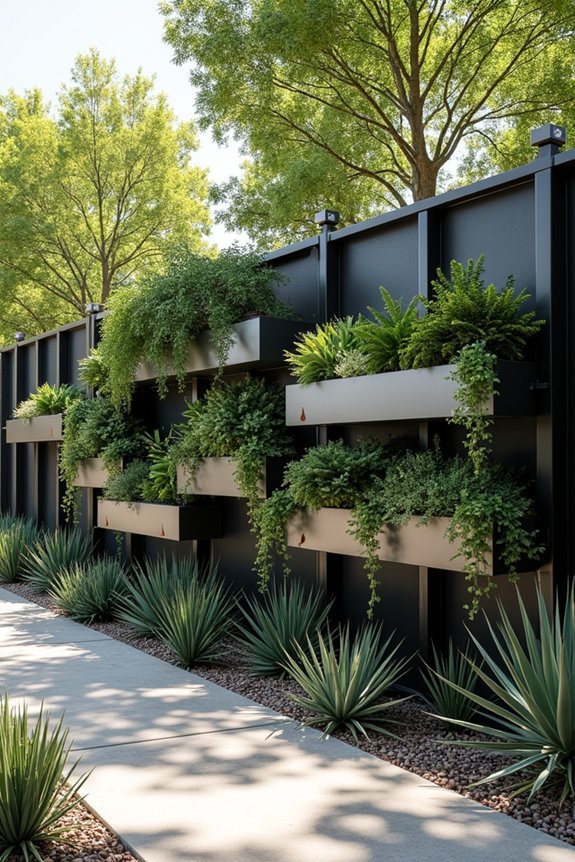
While vertical gardens soften industrial fencing‘s rigid geometries, you’ll need structural integration planning before plant installation begins. Assess your fence’s load-bearing capacity—steel frames accommodate modular planter systems, while welded mesh supports climbing species directly.
For vertical space usage optimization, install galvanized mounting rails at 24-inch intervals. You’ll achieve maximum coverage by combining pocket planters with trellis-trained vines. Consider plant selection based on your fence’s sun exposure and material properties. Metal conducts heat, requiring drought-tolerant species like succulents or ornamental grasses.
Integrate drip irrigation systems within the fence framework before planting. You’ll prevent water damage by routing lines through hollow posts or mounting them behind vertical members. This approach maintains the industrial aesthetic while ensuring proper plant hydration.
[affiai keyword=”vertical garden fencing” template=”carousel” count=”3″]
Gate Hardware Selection Tips
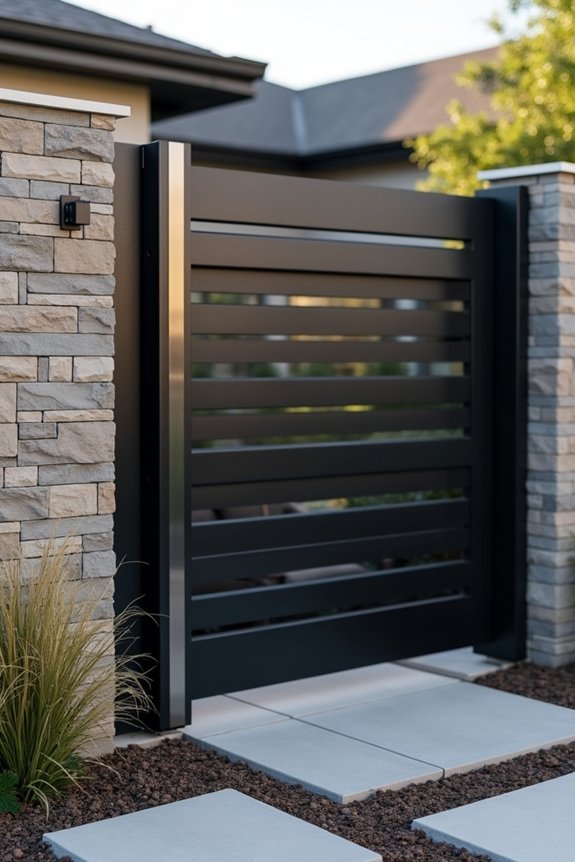
Your gate’s functionality depends entirely on selecting hardware that matches both structural demands and aesthetic requirements. Heavy-gauge steel gates require industrial-strength hinges rated for their specific weight load, while aluminum gate materials need corrosion-resistant fasteners to prevent galvanic reactions.
Consider pin-and-barrel hinges for commercial-grade applications, offering superior load distribution and longevity. Self-closing mechanisms integrate seamlessly with modern industrial designs when you’re prioritizing security without compromising accessibility.
For locking mechanisms, evaluate magnetic locks for automated systems or heavy-duty deadbolts for manual operation. Powder-coated finishes on hardware components guarantee weather resistance while maintaining visual cohesion with your fence profile. Specify mounting hardware that accommodates thermal expansion in metal gate materials, preventing operational failures during temperature fluctuations.
[affiai keyword=”gate hardware commercial industrial” template=”carousel” count=”3″]