You’ll find that your front yard fence serves dual purposes: defining property lines while establishing your home’s architectural character. The right material—whether it’s pressure-treated cedar, powder-coated aluminum, or kiln-dried hardwood—directly impacts longevity and maintenance requirements. Before you commit to a design, you’ll need to evaluate structural specifications, local building codes, and how each option complements your existing landscaping. The ten approaches ahead offer distinct advantages worth considering.
Classic White Picket Fence
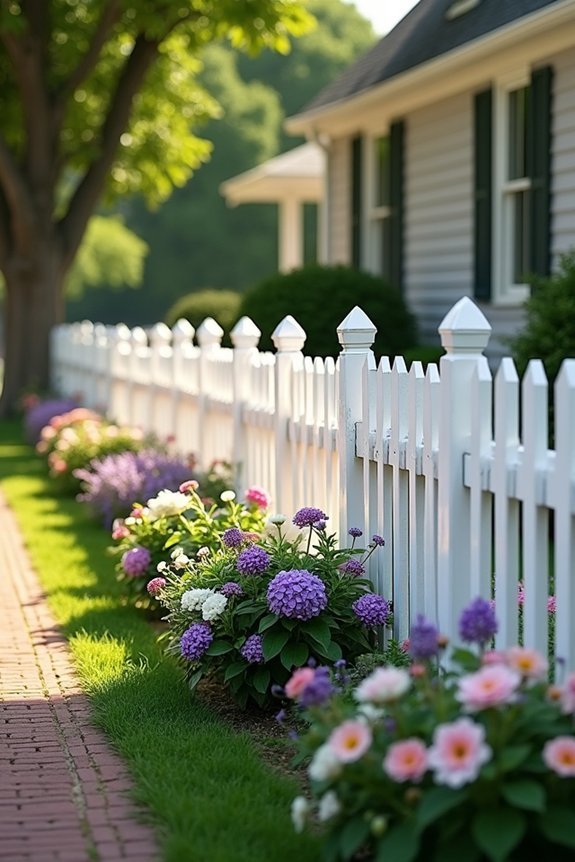
The classic white picket fence remains the quintessential front yard boundary, defined by vertical pickets spaced 2-3 inches apart and mounted to horizontal rails. You’ll find standard heights range from 36 to 48 inches, making them ideal for delineating property lines without blocking sightlines. Modern materials include traditional cedar, pressure-treated pine, or low-maintenance vinyl composites that replicate wood’s texture. The white picket nostalgia you’re seeking requires proper preparation: prime bare wood with exterior-grade primer before applying two coats of semi-gloss acrylic paint for durability. For timeless charm, consider pointed, rounded, or squared picket tops to match your home’s architectural style. Installation requires posts set 6-8 feet apart in concrete footings extending below frost lines.
[affiai keyword=”white picket fence” template=”carousel” count=”3″]
Modern Horizontal Slat Design
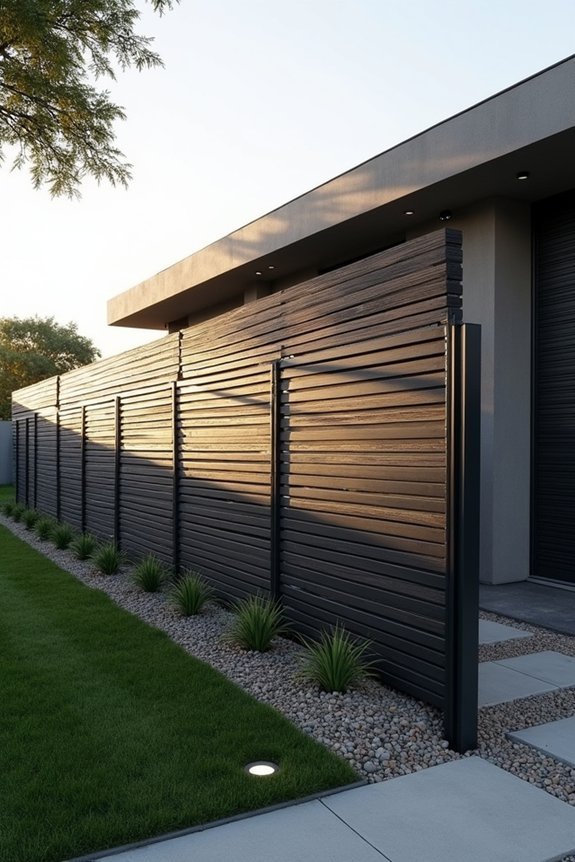
While vertical pickets evoke traditional aesthetics, horizontal slat fencing delivers contemporary minimalism through clean lines and geometric precision. You’ll achieve striking visual impact by selecting from diverse horizontal slat materials: composite boards resist weathering without maintenance, cedar develops distinguished patina over time, and metal panels provide industrial-grade durability. Spacing determines transparency—tight gaps maximize privacy while wider intervals maintain sight lines and airflow.
Design customization extends beyond material selection. You can specify slat width from sleek 4-inch profiles to substantial 8-inch planks, adjusting visual weight accordingly. Mounting orientation varies: face-mount installation creates uniform planes, while board-on-board arrangements introduce dimensional depth. Color choices range from natural wood tones to powder-coated blacks and grays. Frame systems require engineered posts capable of supporting horizontal spans without sagging.
[affiai keyword=”modern horizontal slat fence design” template=”carousel” count=”3″]
Natural Stone Wall Border
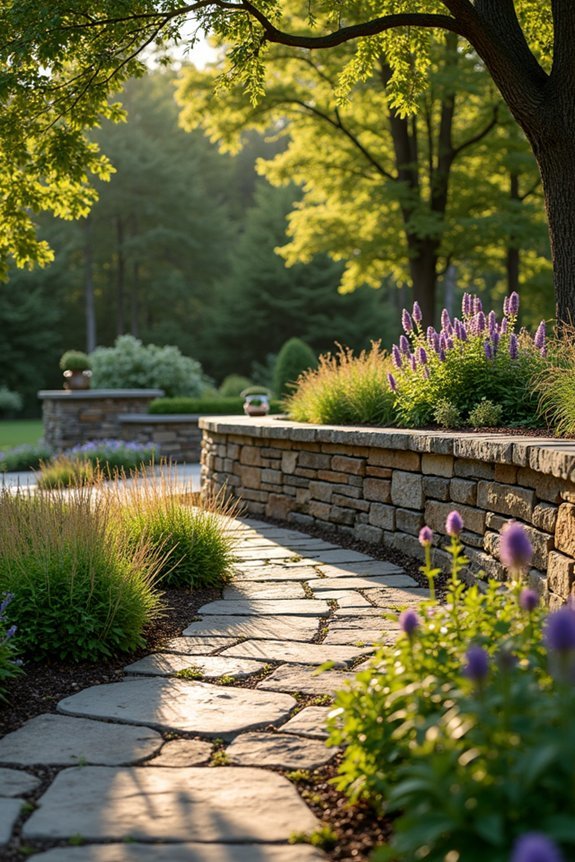
Stone walls establish permanent boundaries through geological materials that weather gracefully across decades. You’ll achieve timeless curb appeal by selecting fieldstone, limestone, or granite based on your region’s architectural vernacular. Stone texture variations—from rough-hewn quarry cuts to tumbled river rock—dictate your wall’s visual impact and installation methodology.
Stack dry-laid walls for rustic charm, or choose mortared construction for structural integrity on sloped terrain. The natural color palette of indigenous stone integrates seamlessly with existing landscape elements while requiring zero maintenance beyond occasional moss removal.
Consider wall height carefully: 18-24 inches creates subtle definition, while 36-48 inches provides substantial privacy screening. Cap stones finish the installation professionally, preventing water infiltration and protecting the wall’s interior structure. You’ll invest notably upfront, but stone walls appreciate aesthetically while outlasting all alternative materials.
[affiai keyword=”natural stone wall border” template=”carousel” count=”3″]
Rustic Split Rail Fencing

Although horizontal rails appear deceptively simple, split rail fencing delivers authentic rural character through post-and-rail construction that’s remained functionally unchanged since Colonial America. You’ll find cedar and locust wood perform best, resisting rot for 15-20 years without chemical treatment. The two-rail configuration works for decorative boundaries, while three-rail installations provide livestock containment.
This fencing style excels at nature integration—you can plant climbing roses, clematis, or honeysuckle directly against the rails to create living borders. The open design doesn’t block sightlines, making it ideal for properties with landscaped backdrops you’ll want visible. Standard eight-foot sections require posts set 24-36 inches deep in gravel-filled holes. For enhanced rustic charm, select rails with natural splits and weathered gray patina rather than freshly milled lumber.
[affiai keyword=”rustic split rail fencing” template=”carousel” count=”3″]
Wrought Iron With Scrollwork
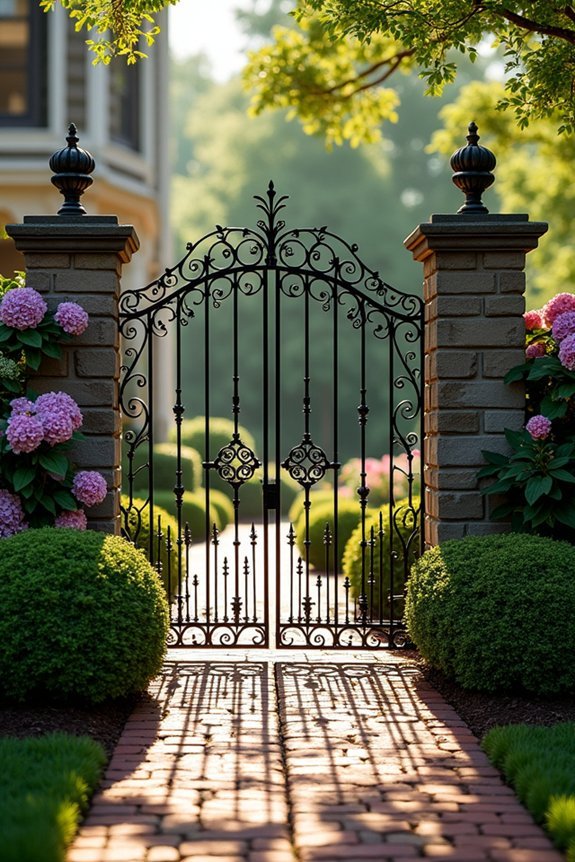
Where split rail fencing celebrates organic simplicity, wrought iron scrollwork introduces architectural sophistication through hand-forged metalwork that transforms front yard boundaries into decorative statements. Your wrought iron design creates visual interest through ornamental patterns—C-scrolls, S-curves, and rosettes—forged at 2,200°F for precise detailing. You’ll find these panels typically stand 36-48 inches tall, combining 5/8-inch vertical pickets with decorative scrollwork inserts. The material’s durability stems from hot-dip galvanization followed by powder-coating, preventing rust for 15-20 years. You can customize spacing between pickets (typically 4 inches) while maintaining security. Consider mounting posts in concrete footings 30 inches deep to support the metalwork’s weight. This decorative scrollwork style complements Victorian, Colonial, and Mediterranean architecture, offering transparency that preserves sight lines while establishing property definition.
[affiai keyword=”wrought iron decorative scrollwork” template=”carousel” count=”3″]
Bamboo Privacy Screen Panel
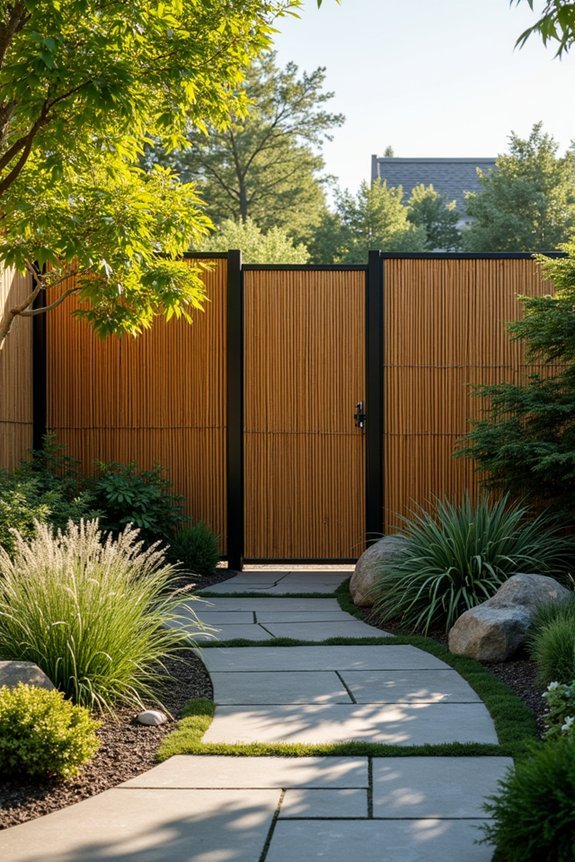
Natural bamboo screening offers sustainable privacy through densely-woven culms that create visual barriers while maintaining organic aesthetic appeal in contemporary front yard designs. You’ll find pre-fabricated panels measuring 6-8 feet in height, featuring ¾-inch diameter poles secured with galvanized wire or UV-resistant synthetic binding. Bamboo durability depends on species selection—Tonkin and Moso varieties resist weathering better than standard Phyllostachys. Install panels with pressure-treated posts and stainless steel hardware to prevent premature deterioration. Privacy aesthetics improve when you maintain 1-2 inch gaps between culms, allowing controlled airflow while blocking sightlines. Treat screens annually with penetrating oil sealants to prevent splitting and UV degradation. You can mount panels horizontally or vertically, depending on your architectural requirements and desired visual rhythm.
[affiai keyword=”bamboo privacy screen panels” template=”carousel” count=”3″]
Living Hedge Fence Option
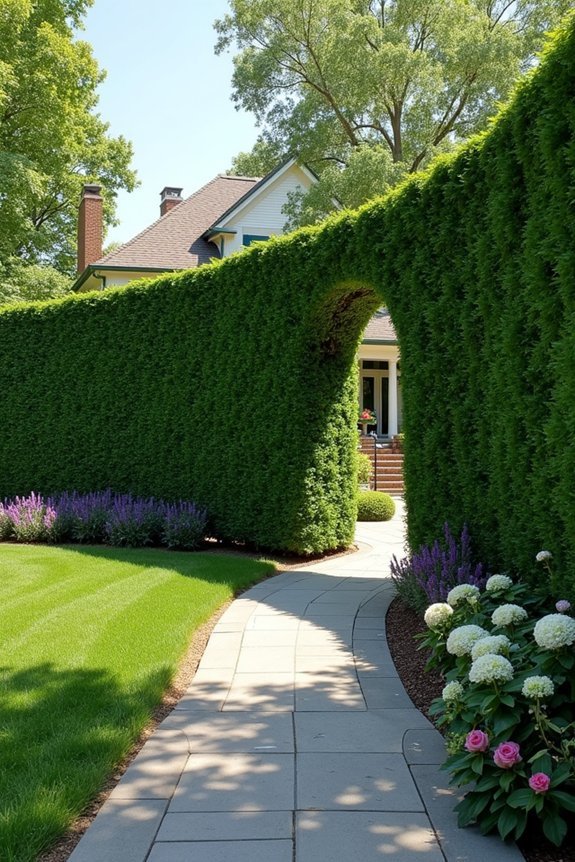
Living hedge fences transform property boundaries into functional green architecture through strategic placement of densely-growing shrubs that establish natural privacy barriers over 18-36 months. You’ll select species based on climate zone compatibility, soil drainage capacity, and mature width specifications—boxwood, privet, or arborvitae remain ideal choices for formal applications requiring precise geometry. Hedge height considerations directly impact municipal compliance, with most jurisdictions restricting front yard installations to 36-48 inches maximum. Living hedge maintenance demands quarterly shearing sessions using sharp hedge trimmers at 10-15 degree angles to promote lateral density while preventing woody gaps. You’ll implement drip irrigation systems positioned 6 inches from root zones, delivering 1-2 inches weekly during establishment phases. Space individual plants at two-thirds their mature width measurement to achieve seamless visual continuity without overcrowding root systems.
[affiai keyword=”living hedge fence supplies” template=”carousel” count=”3″]
Wire Mesh Geometric Pattern
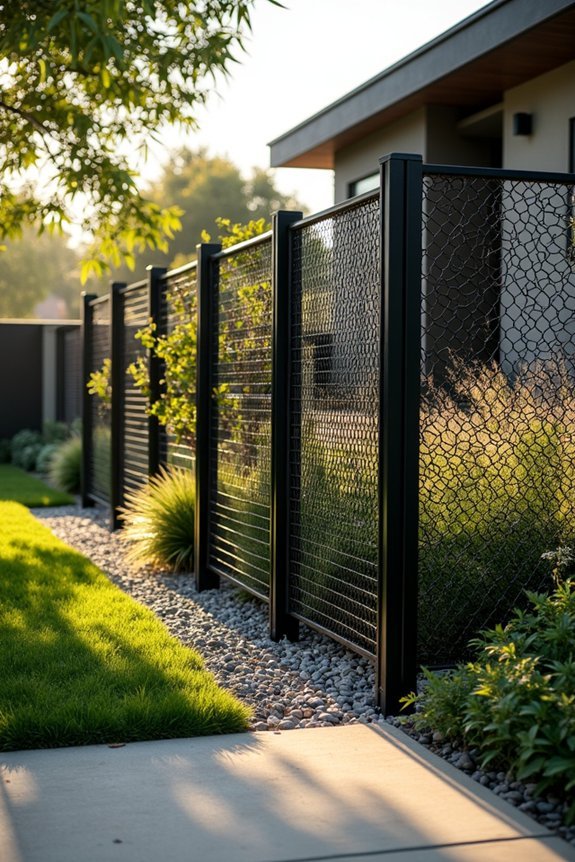
Wire mesh geometric patterns introduce architectural dimensionality to front yard perimeters through welded steel grids configured in hexagonal, diamond, or triangular formations that balance transparency with boundary definition. You’ll find these panels manufactured from galvanized or powder-coated steel wire ranging from 3mm to 6mm diameter, ensuring wire durability against environmental degradation. The geometric design creates visual rhythm while maintaining sightlines—particularly effective for properties requiring security without visual enclosure. Install panels within steel tube frames using concealed fasteners for seamless integration. Consider bronze, black, or copper finishes to complement your home’s exterior palette. These systems excel in contemporary landscapes where clean lines and structural repetition enhance minimalist aesthetics. Pair with ornamental grasses or climbing vines for biophilic contrast against industrial materiality.
[affiai keyword=”wire mesh geometric panels” template=”carousel” count=”3″]
Colorful Painted Pallet Fence
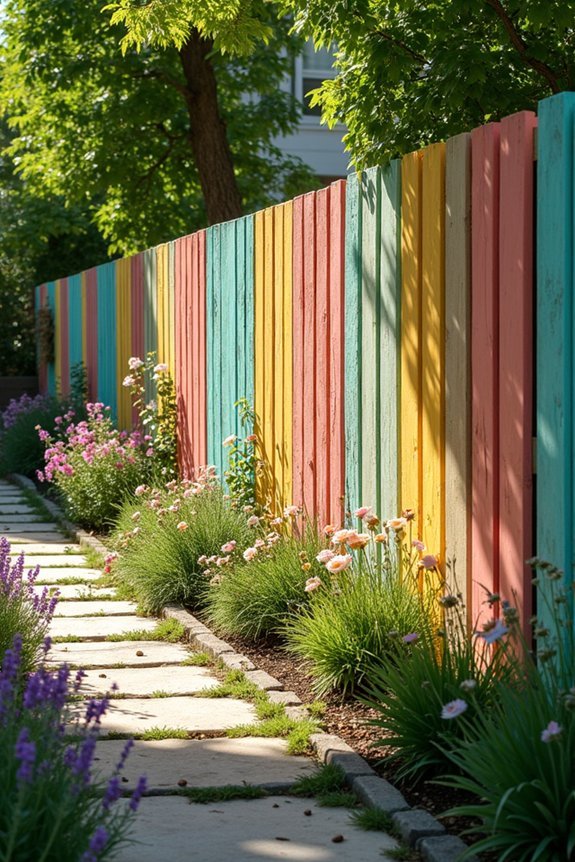
Reclaimed wooden pallets transform into budget-conscious fencing solutions when disassembled, sanded, and reconfigured into vertical picket arrangements that accommodate bold chromatic applications. You’ll maximize pallet fence benefits through proper surface preparation—power-washing removes contaminants while 120-grit sanding creates ideal paint adhesion. Exterior-grade acrylics in saturated hues deliver superior UV resistance and moisture protection compared to standard formulations.
Your colorful fence ideas expand beyond single-tone applications. Consider alternating slat colors in complementary schemes, ombré gradients from ground to top rail, or geometric color-blocking patterns that emphasize architectural rhythm. You can apply marine-grade sealants post-painting to extend chromatic longevity by preventing chalking and fading. Stagger pallet board widths intentionally—mixing 3.5-inch and 5.5-inch dimensions creates visual texture while maintaining structural integrity through galvanized fastener connections.
[affiai keyword=”reclaimed wooden pallet fencing” template=”carousel” count=”3″]
Decorative Vinyl Lattice Panels
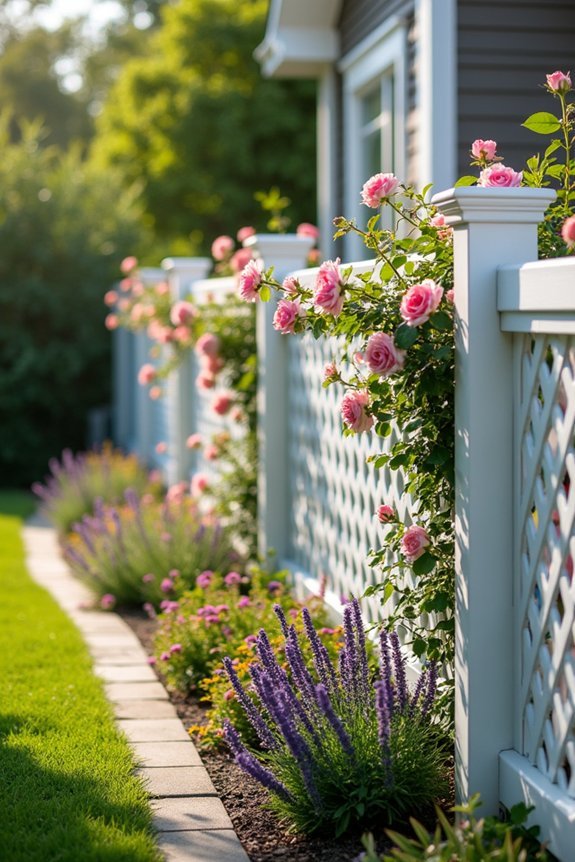
Decorative vinyl lattice panels provide semi-transparent boundary definition while eliminating the maintenance cycles required by traditional wood latticework. You’ll find these panels manufactured in diagonal, square, and privacy-grade configurations, with UV-stabilized PVC resisting color degradation and structural warping. Installation requires vinyl-compatible fasteners and minimal framework since each lattice panel maintains rigidity through interlocking cross-members.
Consider diagonal patterns for climbing roses or clematis integration, creating vertical garden displays along your property line. Square-pattern decorative vinyl works effectively for contemporary home designs, offering geometric precision that complements modern architectural elements. Privacy-grade panels feature tighter spacing, providing 70-80% visual screening while maintaining airflow.
Select colors matching your home’s trim palette—white, almond, or clay tones coordinate with most exterior schemes. These panels won’t splinter, rot, or require annual staining, delivering long-term performance through simple hosing for maintenance.
[affiai keyword=”decorative vinyl lattice panels” template=”carousel” count=”3″]