
You don’t need to sacrifice your garden’s visual flow to establish defined outdoor zones. Strategic fence dividers solve spatial challenges while reinforcing your landscape’s architectural intent—whether you’re screening utilitarian areas, creating microclimates for specific plantings, or delineating functional zones without hard barriers. The right partition responds to your site’s sun exposure, drainage patterns, and existing materials while addressing both immediate privacy needs and long-term maintenance realities.
Living Bamboo Screen Panels
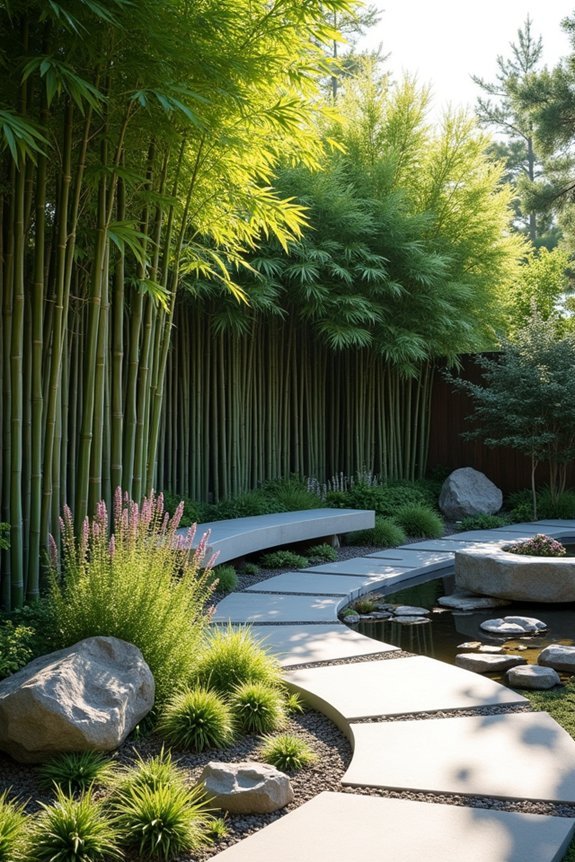
While traditional fencing creates hard visual boundaries, living bamboo screen panels establish permeable divisions that shift with seasonal growth patterns and light conditions. You’ll need to select clumping varieties like Fargesia or Bambusa multiplex to prevent aggressive spreading that compromises adjacent plantings.
Bamboo care requires consistent moisture during establishment and annual removal of dead culms to maintain density. Install root barriers extending 24 inches deep when planting running species near property lines.
Bamboo aesthetics transform throughout seasons—spring shoots emerge vertically, summer foliage creates dappled shadows, and winter canes reveal structural geometry. You can manipulate spacing between plants from 18 to 36 inches depending on desired opacity. Strategic pruning of lower branches exposes distinctive node patterns while maintaining upper canopy screening.
[affiai keyword=”living bamboo screen panels” template=”carousel” count=”3″]
Vertical Wooden Slat Partitions
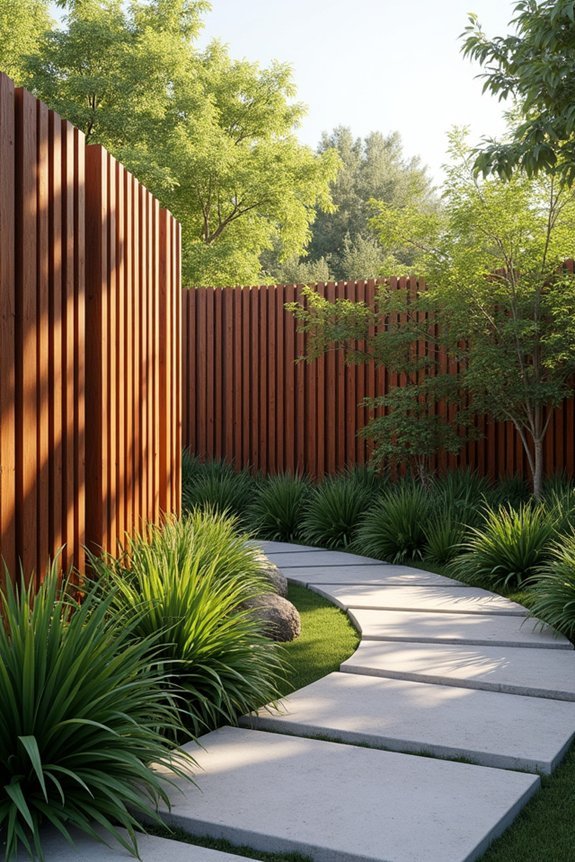
Vertical wooden slat partitions offer precise control over sightlines and airflow through calculated spacing ratios. You’ll determine slat width, gap dimensions, and overall height based on your site’s microclimate and privacy requirements. Cedar, redwood, and thermally-modified timber provide durability with minimal maintenance protocols.
Configure spacing from tight 1-inch gaps for maximum screening to 4-inch intervals that maintain visual permeability while defining zones. Mount slats to horizontal rails using concealed fasteners for clean aesthetic continuity. Color variations extend beyond natural wood tones—charcoal stains, graphite grays, and white-washed finishes integrate with contemporary hardscaping palettes.
Apply decorative finishes strategically: weather-resistant sealants on windward exposures, UV-protective coatings where sun intensity peaks. Orientation matters—north-facing installations require different treatment schedules than southern exposures. Modular panel systems enable reconfiguration as landscape needs evolve.
[affiai keyword=”vertical wood slat partitions” template=”carousel” count=”3″]
Lattice Trellis With Climbing Vines
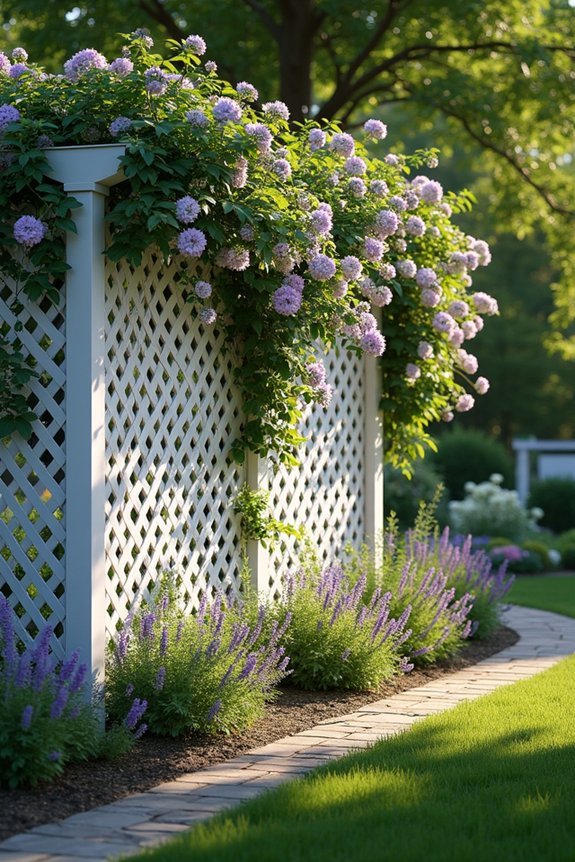
Lattice trellis systems function as structural frameworks that support vertical plant growth while creating semi-permeable garden boundaries. You’ll achieve ideal coverage by selecting climbing plant varieties matched to your site conditions—jasmine and clematis for sun-exposed areas, climbing hydrangea for shade. Install cedar or pressure-treated lattice panels at 6-8 feet heights, securing posts 24 inches deep in concrete footings.
Your design density determines privacy levels: diagonal patterns with 2-inch spacing provide moderate screening, while 1-inch spacing creates denser barriers. Follow essential trellis maintenance tips: inspect joints annually, reinforce weak connections, and prune plants before winter to prevent structural stress. You’ll need 18-24 months for full vine establishment, though fast-growing varieties like honeysuckle accelerate coverage timelines considerably.
[affiai keyword=”lattice trellis with climbing vines” template=”carousel” count=”3″]
Metal Panel Privacy Screens
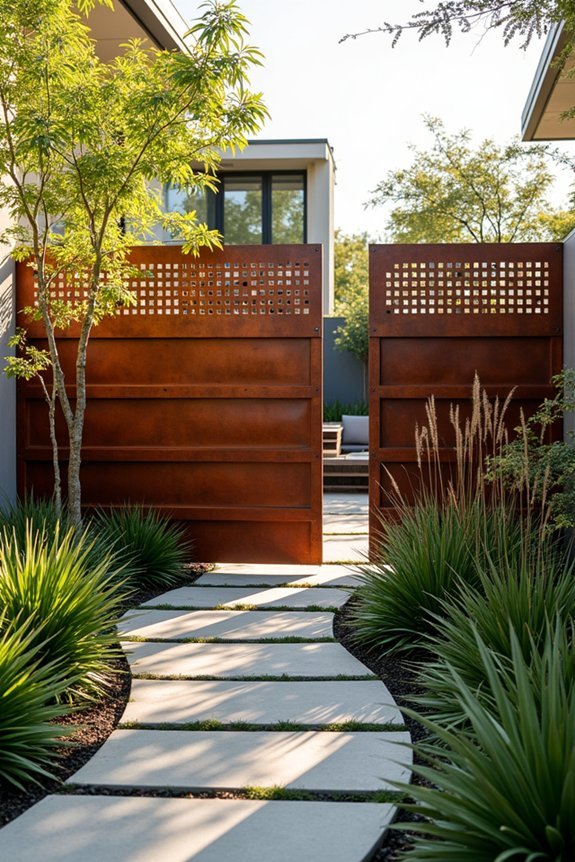
Metal panel privacy screens deliver immediate visual separation without the establishment period required for living barriers. You’ll find these installations excel in contemporary landscapes where clean lines and architectural definition matter. The metal screen benefits include durability against weather exposure, minimal maintenance requirements, and resistance to pest damage that compromises wood alternatives.
Select decorative metal designs featuring laser-cut geometric patterns, organic motifs, or custom artwork that filters light while maintaining enclosure. Corten steel panels develop attractive rust patinas, aluminum resists corrosion in coastal environments, and powder-coated finishes offer color permanence. Install screens using embedded posts in concrete footings or surface-mount them to existing hardscape. Consider panel orientation—vertical slats emphasize height, horizontal elements extend perceived width. Strategic placement controls sight lines while preserving air circulation throughout your garden spaces.
[affiai keyword=”metal privacy screens” template=”carousel” count=”3″]
Gabion Wall Stone Dividers
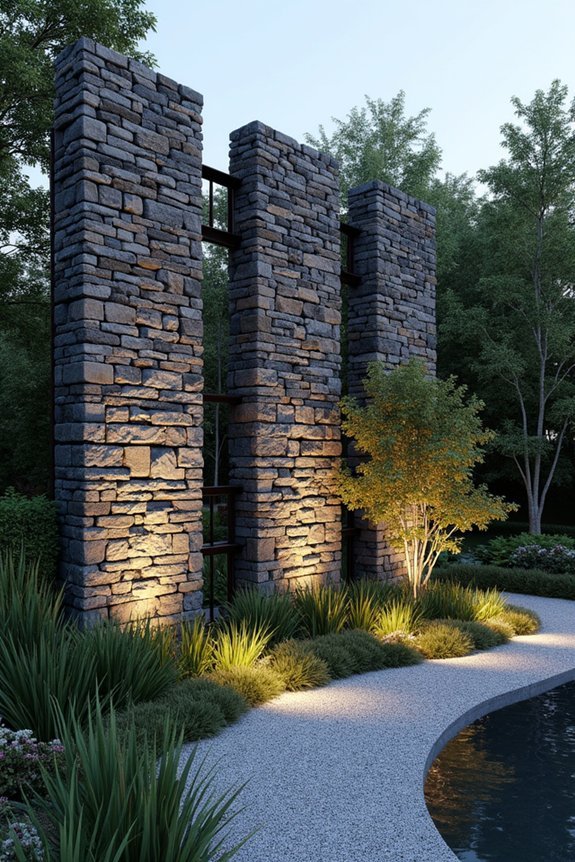
When you need structural mass combined with natural texture, gabion wall stone dividers provide engineered containment that transforms loose rock into cohesive architectural elements. These wire mesh cages filled with stone create barriers that excel in both structural stability and visual weight, anchoring garden spaces with deliberate permanence.
You’ll configure gabion wall aesthetics by selecting stone types—limestone chunks deliver light neutrality, basalt fragments provide dark contrast, while mixed river rock introduces organic variation. The metal cage framework requires proper tensioning and anchoring to maintain structural stability under lateral earth pressure and seasonal ground movement.
Install these dividers where retaining capabilities matter—sloped sites, grade changes, or boundaries requiring sound dampening. The permeable nature allows drainage while the thermal mass moderates temperature fluctuations in adjacent planting zones.
[affiai keyword=”gabion wall stone dividers” template=”carousel” count=”3″]
Corrugated Metal Sheet Dividers
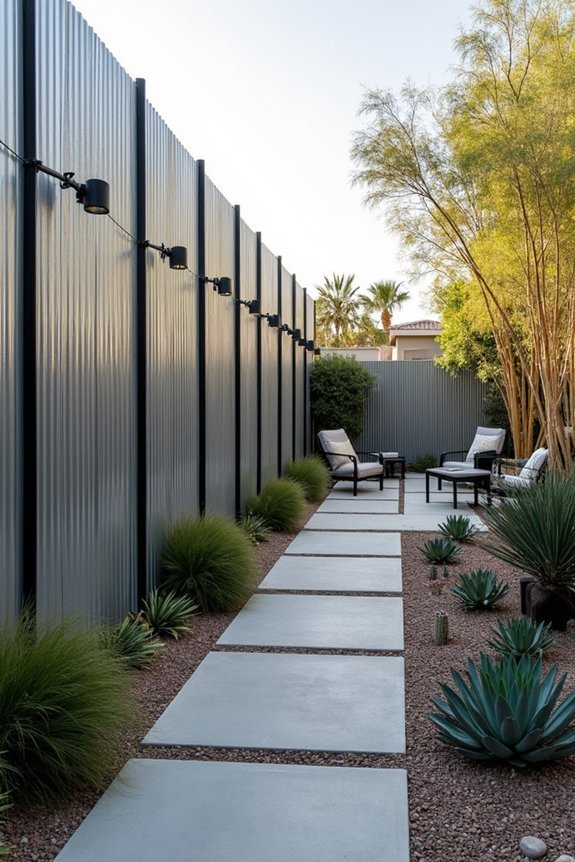
Industrial aesthetics meet functional separation when corrugated metal sheet dividers introduce vertical planes that define garden boundaries with minimal footprint and maximum visual impact. You’ll find corrugated metal delivers structural rigidity through its ribbed profile while reflecting light differently throughout the day, creating dynamic shadow patterns across your landscape. The material’s inherent weather resistance requires minimal maintenance—simply install posts at appropriate intervals and secure panels with concealed fasteners.
Configure your layout vertically for privacy or horizontally to emphasize width and modern sensibility. The industrial aesthetic complements contemporary plantings particularly well: ornamental grasses, sculptural succulents, and architectural perennials create compelling contrasts against metallic surfaces. You can specify galvanized, Corten, or powder-coated finishes to control oxidation and color progression, tailoring the installation to your site’s specific design requirements.
[affiai keyword=”corrugated metal garden dividers” template=”carousel” count=”3″]
Recycled Pallet Fence Dividers
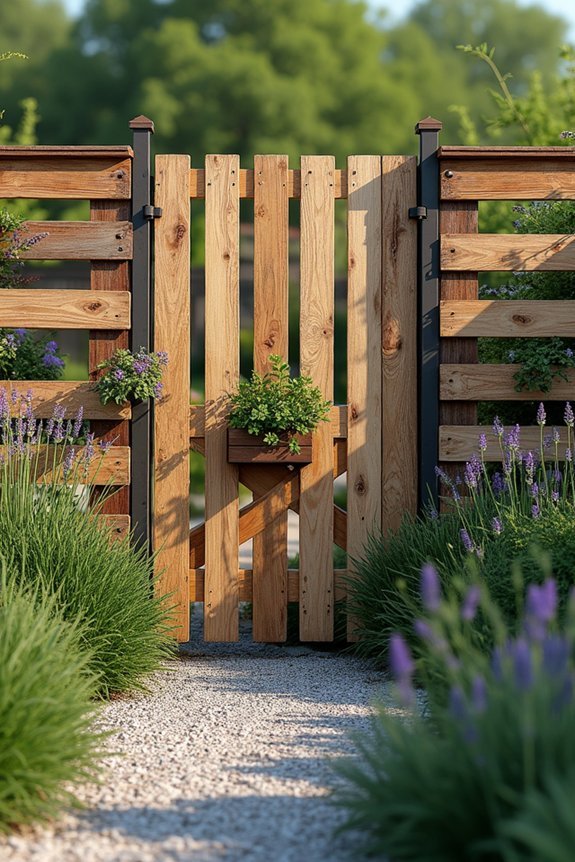
Reclaimed wooden pallets transform into cost-effective garden dividers through straightforward disassembly and reconfiguration, offering you dimensional flexibility that manufactured panels can’t match. You’ll sand rough surfaces to prevent splinters while maintaining the material’s authentic character. Pallet upcycling requires minimal tools—a pry bar, circular saw, and drill handle most configurations. Stack pallets horizontally for instant privacy screens, or extract individual slats for custom spacing patterns that balance sightlines with airflow.
Pre-treat wood with exterior-grade sealant to extend lifespan in moisture-exposed conditions. You can integrate vertical planting pockets between slats, merging functional division with living elements. The inherent modularity supports phased installation—add sections as your garden aesthetics evolve. Mount pallets to steel posts for stability, ensuring proper ground clearance prevents soil contact and premature rot.
[affiai keyword=”recycled pallet garden fence” template=”carousel” count=”3″]
Glass Panel Modern Dividers
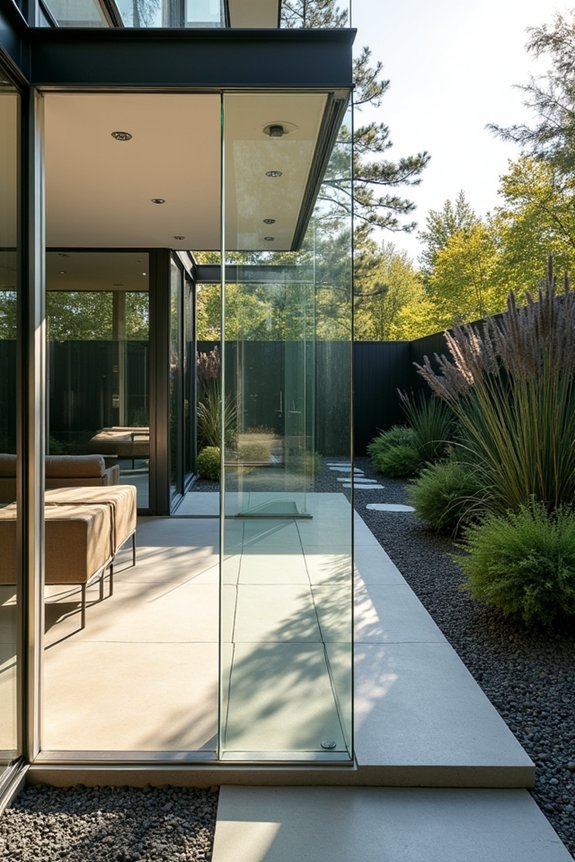
Frameless tempered glass panels deliver unobstructed sightlines while establishing spatial boundaries that preserve your garden’s visual continuity. You’ll maintain transparency between zones while creating distinct functional areas—ideal for separating entertaining spaces from cultivation beds without visual fragmentation.
Install 10-12mm tempered safety glass in stainless steel or aluminum channel systems anchored to concrete footings. These glass aesthetics complement modern landscaping schemes, particularly when paired with minimalist hardscaping and architectural plantings. Consider frosted or tinted panels for graduated privacy levels while retaining light transmission.
Position panels perpendicular to prevailing winds to minimize lateral stress loads. You’ll need professional installation to guarantee proper drainage clearances and structural integration. Mount alongside gravel paths or concrete pavers—glass dividers demand clean-lined surroundings that reinforce their contemporary character rather than competing with ornamental complexity.
[affiai keyword=”modern glass garden dividers” template=”carousel” count=”3″]
Living Wall Planter Dividers
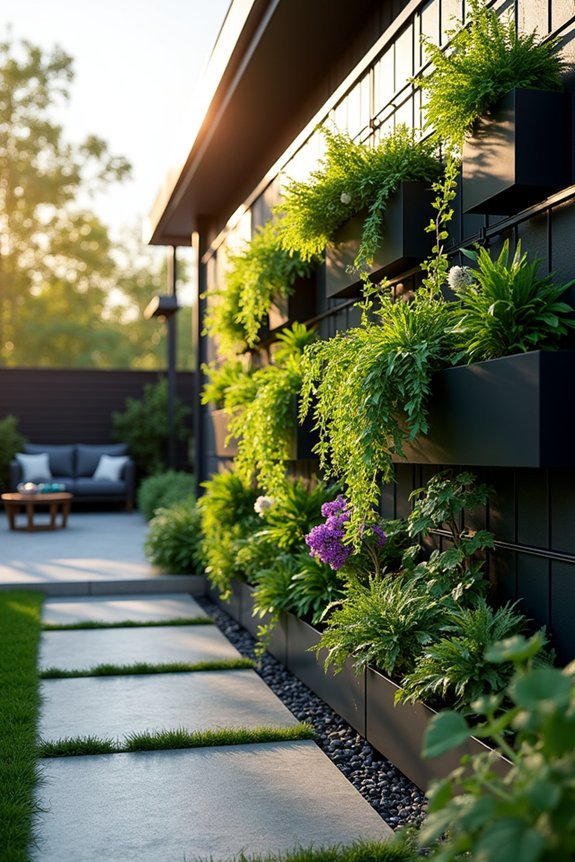
Vertical planter systems transform your fence into productive growing surfaces while creating textured privacy screens that soften property boundaries. You’ll maximize limited garden space by stacking modular planters vertically, establishing dense foliage walls that absorb sound and filter air particulates. Living wall benefits include microclimate regulation—plant transpiration cools surrounding areas by 3-5°F while increasing ambient humidity.
Select your planter style based on existing fence load capacity. Lightweight felt pocket systems suit standard wood fences, supporting herbs and shallow-rooted perennials. Metal grid frameworks with removable containers allow seasonal plant rotation and accommodate heavier specimens. Install drip irrigation behind planter rows to maintain consistent moisture without manual watering.
Consider sun exposure patterns when selecting plants—shade-tolerant ferns for north-facing installations, drought-resistant succulents for western exposures receiving intense afternoon heat.
[affiai keyword=”living wall planter dividers” template=”carousel” count=”3″]
Woven Willow Branch Screens
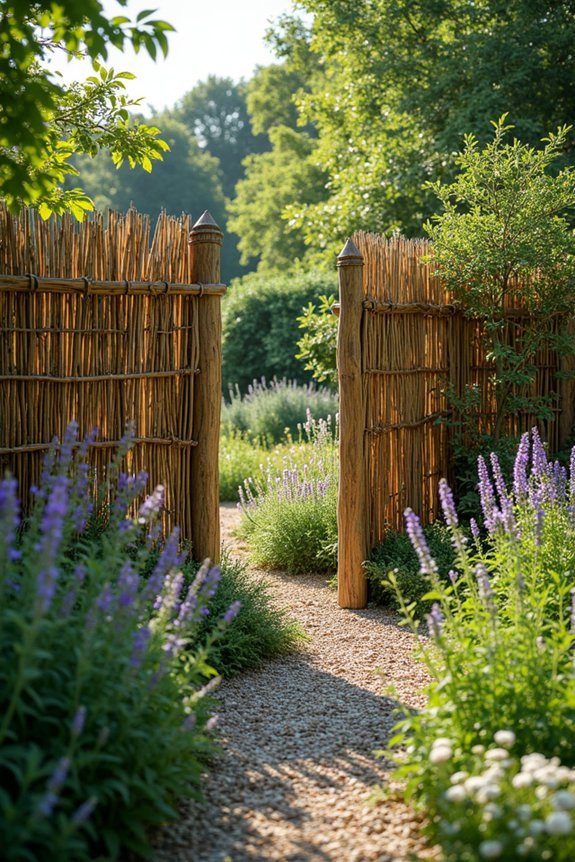
Traditional woven willow screens create semi-permanent fence partitions that develop character as living branches root and sprout seasonal growth. You’ll construct these dividers by weaving fresh willow rods horizontally through vertical stakes driven 18-24 inches into soil. Willow branch benefits include natural flexibility during installation, rapid regeneration capabilities, and inherent rot resistance that extends screen longevity to 5-10 years.
The woven aesthetics transform throughout seasons—bare architectural frameworks in winter evolve into leafy privacy barriers by summer. You’ll achieve ideal results by harvesting willow varieties like Salix viminalis or Salix purpurea during dormant periods. Maintain consistent weave tension and 4-6 inch spacing between uprights. These screens adapt particularly well to cottage gardens, permaculture designs, and shifting zones requiring biodegradable materials that eventually decompose, enriching surrounding soil.
[affiai keyword=”woven willow screens” template=”carousel” count=”3″]
Horizontal Cable Wire Dividers
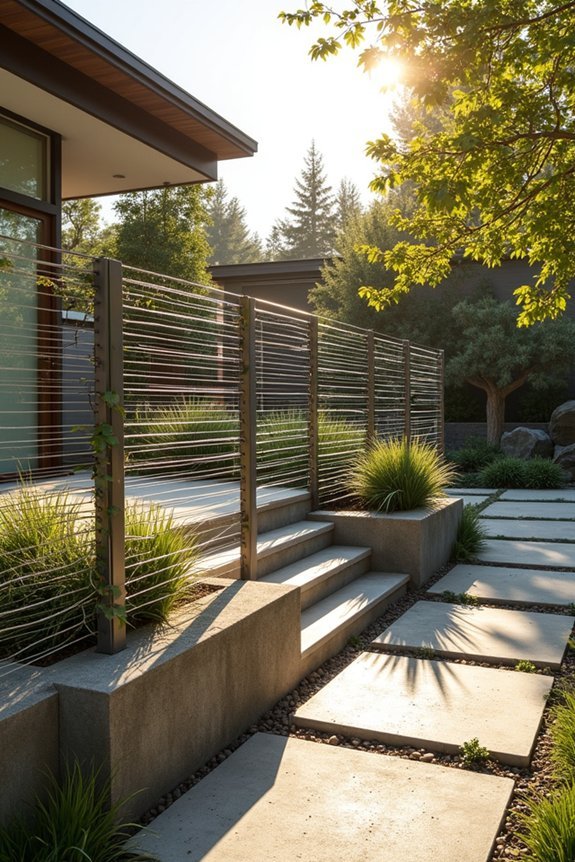
Sleek horizontal cable wire systems establish minimalist fence divisions through parallel steel lines tensioned between structural posts at precise vertical intervals. You’ll maintain proper cable wire tension using turnbuckles and tensioners, preventing sagging while creating clean sight lines. The stainless steel cables resist corrosion and require minimal maintenance compared to traditional materials.
Configure spacing between cables based on your privacy needs—tighter intervals provide greater screening, while wider gaps maximize views and airflow. You’ll find this system particularly effective on sloped terrain where conventional fencing proves challenging. The sleek modernity of cable railings complements contemporary architecture and doesn’t compete with plantings. Install posts at maximum 8-foot centers to prevent excessive cable deflection under lateral loads.
[affiai keyword=”horizontal cable wire fencing” template=”carousel” count=”3″]