You’re facing escalating material costs and contractor fees that can push a basic perimeter fence well beyond $5,000. Yet achieving functional privacy and property definition doesn’t require maxing out your credit limit. Strategic material selection—from reclaimed architectural salvage to agricultural components—combined with straightforward construction techniques can reduce your expenses by 60-70%. The following approaches prioritize structural integrity and design cohesion while working within modest budgets, proving that resourcefulness often yields more distinctive results than unlimited spending.
Pallet Wood Fence Installation
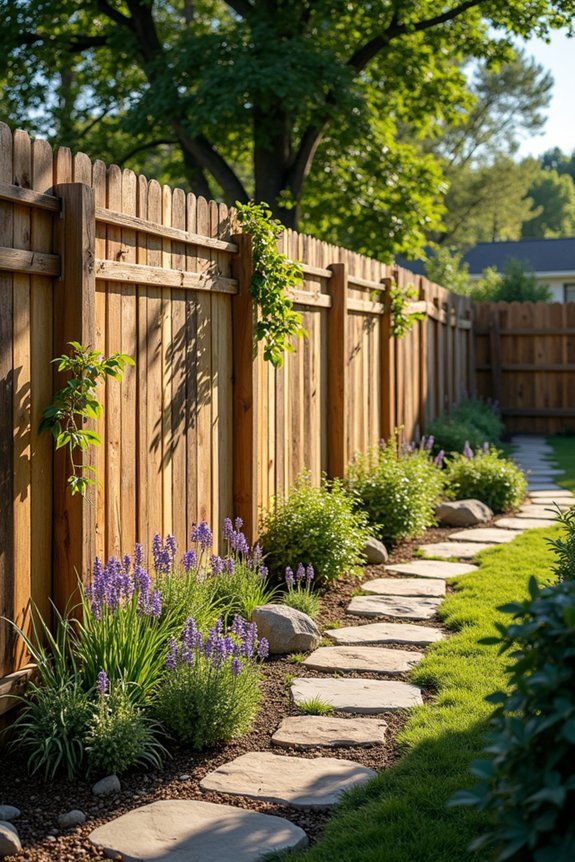
When repurposing pallet wood for fence construction, you’ll need to source heat-treated (HT-stamped) pallets rather than chemically treated alternatives to assure material safety and longevity. Understanding pallet wood treatments guarantees you’re selecting materials free from harmful methyl bromide contamination.
Begin by disassembling pallets using a reciprocating saw or pry bar, preserving board integrity. Remove all fasteners and sand surfaces to eliminate splinters. Assess pallet fence durability by inspecting boards for rot, warping, or structural compromise.
Install posts at 8-foot intervals, setting them in concrete for stability. Attach horizontal rails between posts, then secure pallet boards vertically using exterior-grade screws. Apply weatherproof sealant to enhance moisture resistance and UV protection, extending your fence’s serviceable lifespan while maintaining aesthetic consistency.
[affiai keyword=”pallet wood fence materials” template=”carousel” count=”3″]
Corrugated Metal Panel Fencing
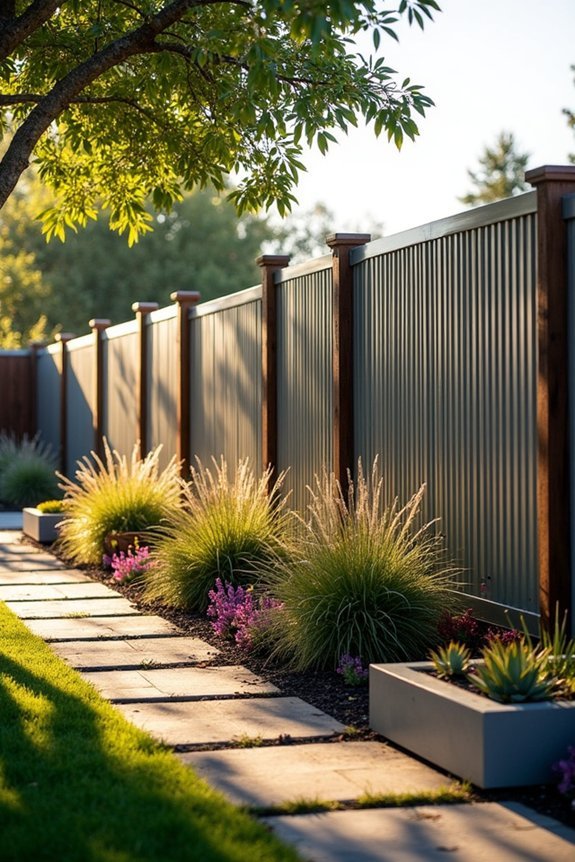
Because corrugated metal panels offer exceptional durability at minimal cost, they’ve become increasingly popular for contemporary fence installations. You’ll find these panels in 26-gauge to 29-gauge steel, with galvanized or powder-coated finishes providing superior weather resistance.
When planning your fence design, you’ll need to install 4×4 wooden or metal posts at 6-8 foot intervals, ensuring they’re plumb and properly anchored. Attach horizontal rails between posts, then secure corrugated metal panels using self-drilling screws with rubber washers to prevent water infiltration.
The vertical ribs in corrugated metal provide structural rigidity while minimizing material thickness. You can orient panels vertically for modern aesthetics or horizontally for industrial appeal. Consider overlapping panels by one corrugation to maintain water-shedding capabilities and structural integrity throughout your installation.
[affiai keyword=”corrugated metal fencing panels” template=”carousel” count=”3″]
Bamboo Screen Privacy Fence
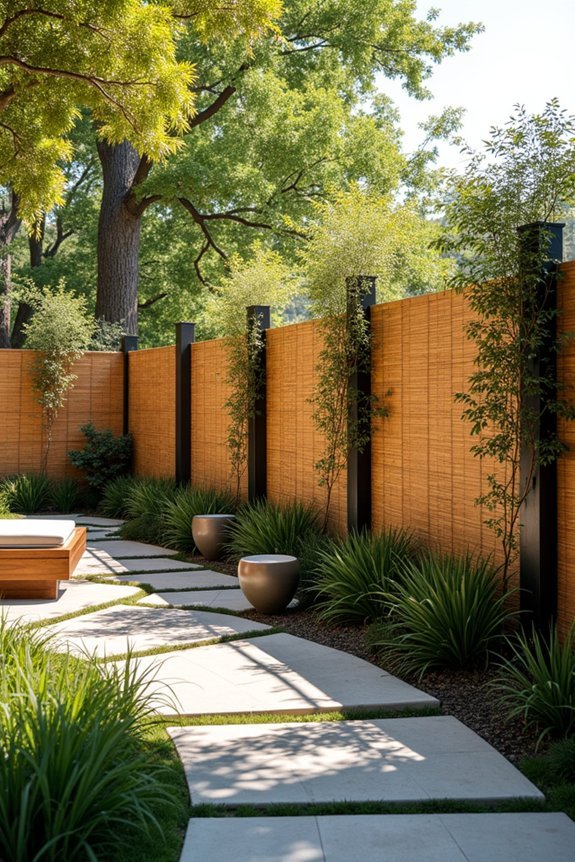
Bamboo screen fencing delivers natural privacy with sustainable materials while maintaining cost efficiency through simple installation methods. You’ll mount pre-fabricated bamboo panels directly to existing posts or frames using galvanized hardware, eliminating complex construction requirements. The material provides 80-90% visual obstruction while allowing airflow, preventing wind loading issues common with solid barriers.
Your installation process involves measuring post spacing, securing horizontal support rails, and attaching rolled bamboo screens with UV-resistant wire ties. These privacy solutions integrate seamlessly with contemporary landscape designs while offering rapid deployment—complete installation typically requires 4-6 hours for standard residential applications.
Proper bamboo care extends longevity markedly. You’ll apply water-based sealant annually to prevent UV degradation and moisture damage. The natural material weathers gracefully, developing a silvered patina that enhances aesthetic appeal while maintaining structural integrity for 5-8 years with minimal maintenance intervention.
[affiai keyword=”bamboo privacy screen” template=”carousel” count=”3″]
Living Willow Fence Border
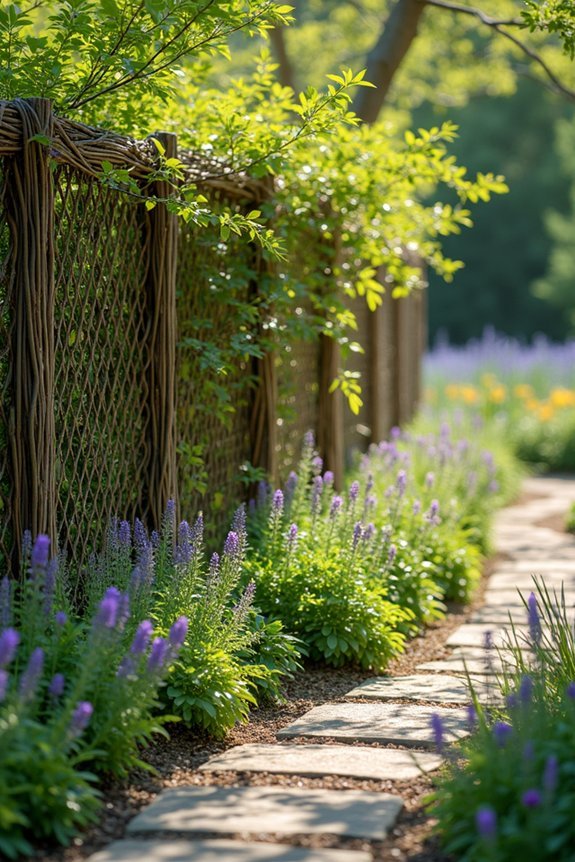
Living willow fences transform traditional boundary markers into dynamic biotecture through vegetative propagation techniques that merge horticultural practices with structural fencing applications. You’ll harvest dormant willow rods during winter months, inserting them directly into prepared soil at predetermined intervals. Willow weaving techniques incorporate horizontal rods between vertical stakes, creating diagonal or lattice patterns that densify as growth progresses. The cuttings root within weeks, establishing a self-sustaining barrier that strengthens annually. Living willow maintenance requires consistent irrigation during establishment phases and strategic pruning to control horizontal expansion while encouraging vertical density. You’ll trim new growth biannually to maintain architectural form and prevent woody overgrowth. This bioengineered solution provides erosion control, wildlife habitat, and carbon sequestration while delivering cost-effective privacy screening through natural regeneration cycles.
[affiai keyword=”living willow fence” template=”carousel” count=”3″]
Recycled Tire Wall Barrier
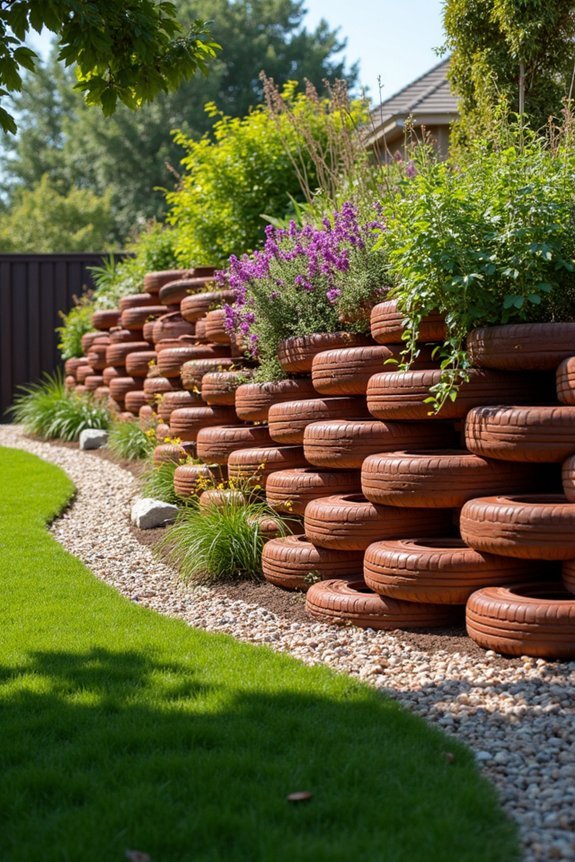
Repurposed automotive tires constitute a durable, load-bearing material for retaining wall construction through strategic stacking and anchoring methodologies that convert waste streams into functional boundary structures. Your tire wall design requires earth-filled units positioned in running-bond patterns, secured with galvanized fasteners or rebar penetrating multiple layers. You’ll achieve peak structural integrity through compacted backfill integration and proper drainage channels. These eco friendly materials withstand extreme weather conditions while diverting landfill waste into productive applications. You can enhance visual appeal through exterior painting with UV-resistant coatings or vegetative camouflage using climbing species. The configuration supports terraced landscaping on slopes, providing erosion control and grade separation. Installation demands minimal specialized equipment, making this approach accessible for budget-conscious property owners seeking sustainable boundary solutions with documented longevity exceeding conventional timber alternatives.
[affiai keyword=”repurposed tires for retaining walls” template=”carousel” count=”3″]
Rope and Post Perimeter
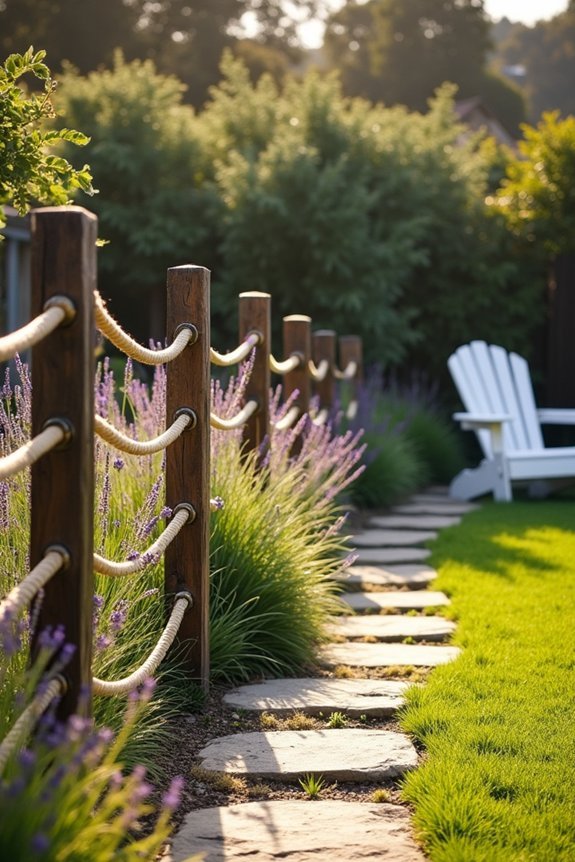
When horizontal tensioning systems meet vertical anchor points, you create economical perimeter demarcation through nautical-grade rope installations that define property boundaries without visual mass. You’ll select from three primary rope types: manila for natural aesthetics, polyester for weather resistance, or nylon for superior elasticity. Install treated wooden or metal posts at 6-8 foot intervals, incorporating eye bolts at staggered heights. Thread your chosen rope through these attachment points, maintaining consistent tension using turnbuckles. You can enhance the installation’s visual appeal through decorative knots positioned at regular intervals—Turk’s head or Matthew Walker knots provide dimensional interest. This configuration delivers semi-permanent boundary definition at approximately 60% less material cost than traditional panel fencing while maintaining easy modification capabilities.
[affiai keyword=”rope and post perimeter systems” template=”carousel” count=”3″]
Wire Mesh Garden Fence
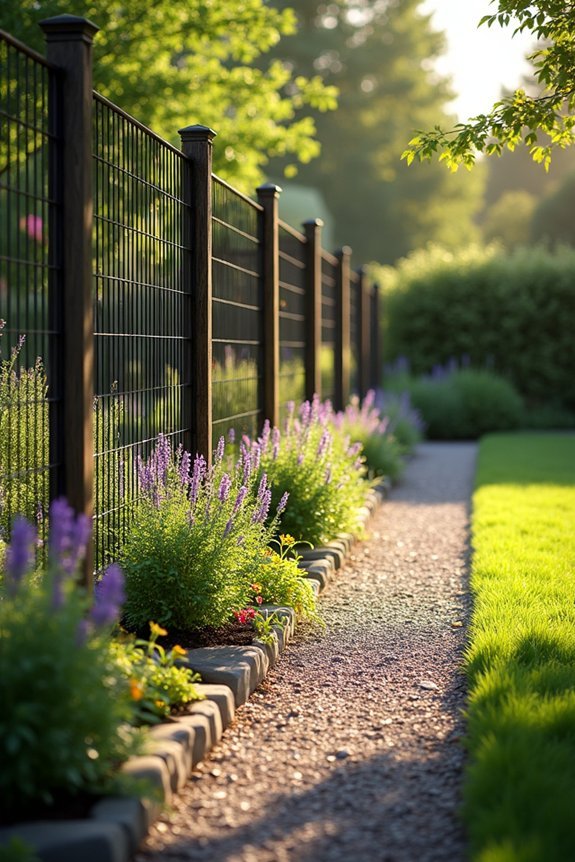
Wire mesh fencing transforms perimeter protection through its welded grid construction, offering superior visibility retention while establishing physical barriers against small wildlife intrusions. You’ll appreciate the wire mesh advantages: galvanized steel panels resist corrosion while maintaining structural integrity across seasons. Install posts at 8-foot intervals, securing mesh panels with zip ties or U-clips for rapid deployment.
Standard 4×4-foot panels cost approximately $15-25, delivering exceptional value per linear foot. You can enhance aesthetics by selecting decorative wire patterns or coating options in black, green, or bronze finishes. The open-grid design permits sunlight penetration for adjacent plantings while deterring rabbits and ground-dwelling pests. For climbing plant integration, you’ll find the grid structure provides ideal support without additional trellising investments.
[affiai keyword=”wire mesh garden fencing” template=”carousel” count=”3″]
Reclaimed Door Panel Fence
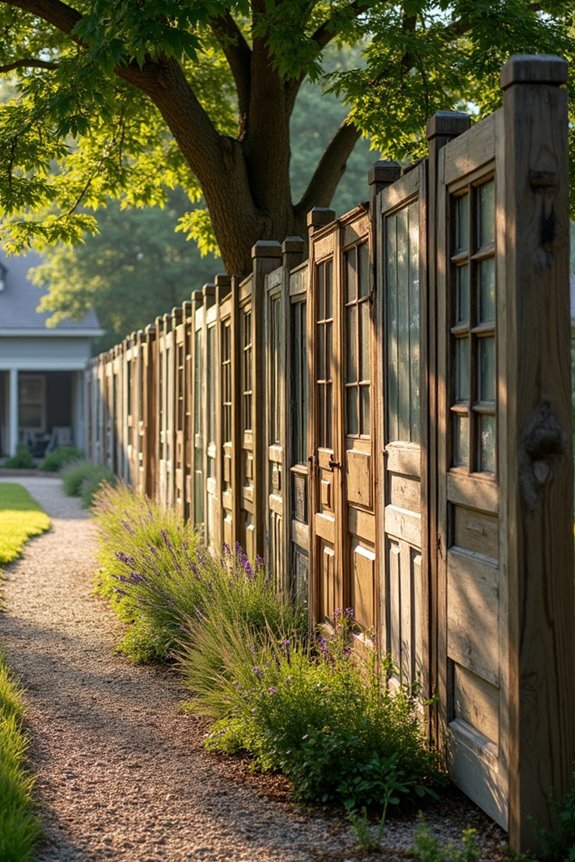
Salvaged door panels deliver architectural character to fence installations while diverting functional materials from landfill streams. You’ll find these sustainable materials at demolition sites, architectural salvage yards, and renovation projects. Select panels with consistent heights between 60-80 inches for uniform installation, though varied widths create dynamic visual interest. Strip existing hardware and sand surfaces to 120-grit smoothness before treatment. Apply exterior-grade sealant or stain to protect against moisture penetration and UV degradation. Mount panels vertically to 4×4 pressure-treated posts using galvanized lag screws, spacing supports every 6-8 feet for structural integrity. The inherent imperfections, weathered finishes, and diverse panel designs produce a rustic aesthetic that complements cottage gardens and farmhouse landscapes. This approach transforms discarded building components into distinctive boundary solutions.
[affiai keyword=”reclaimed door panel fence” template=”carousel” count=”3″]
Concrete Block Stacked Fence
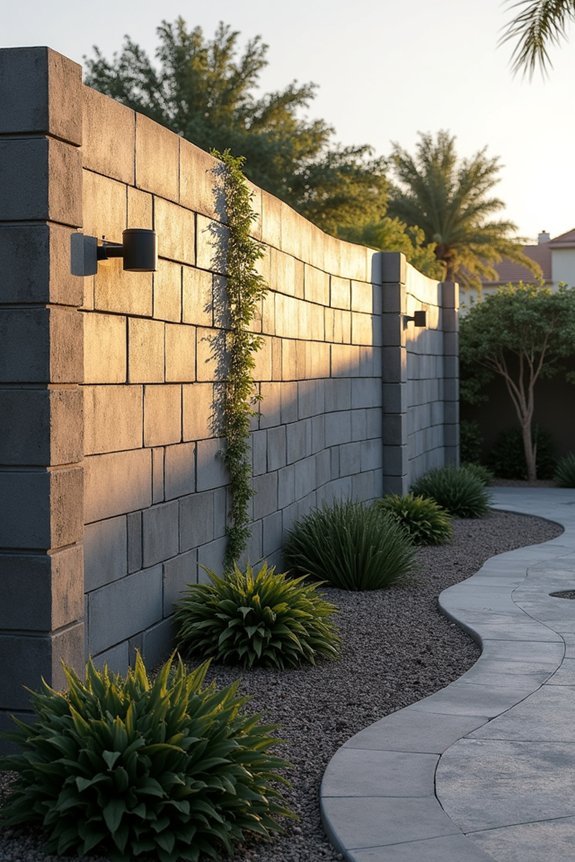
Standard concrete masonry units provide structural stability and modern minimalism for fence construction at remarkably lower costs than traditional materials. You’ll achieve exemplary results through proper concrete positioning—establish a level foundation using compacted gravel and verify vertical alignment with a plumb line. Stack blocks in running bond pattern, offsetting each course by half-block increments to maximize structural integrity. You can incorporate rebar through block cores, filling voids with concrete for enhanced stability.
Block finishes considerably impact aesthetics and durability. Split-face blocks deliver textured surfaces, while smooth-finished units create contemporary clean lines. You’ll protect installations by applying concrete sealant, preventing moisture penetration and efflorescence. Consider decorative caps for top courses, providing finished appearance while shedding water. This method requires minimal specialized tools—you’ll need only basic masonry equipment.
[affiai keyword=”concrete block fence” template=”carousel” count=”3″]
Natural Branch Lattice Fence
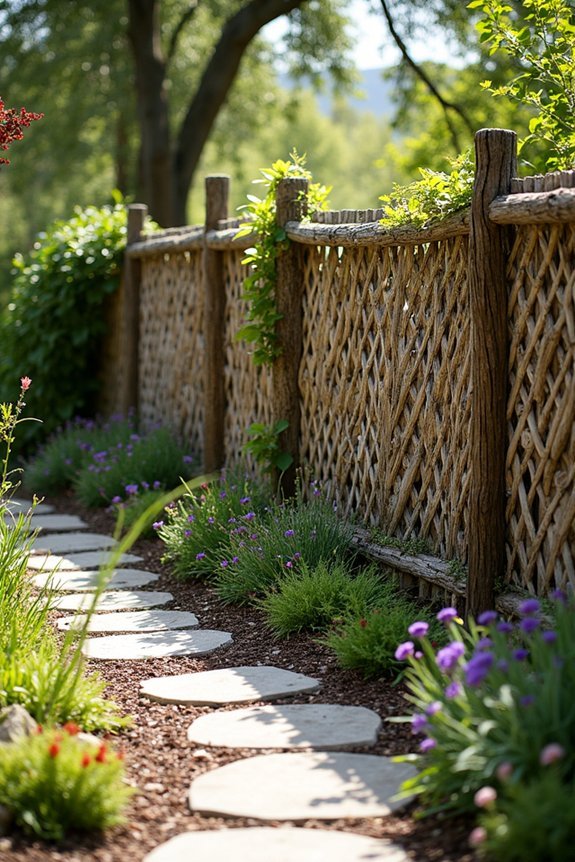
While masonry construction offers industrial aesthetics, organic materials provide rustic charm through resourceful harvesting of fallen branches and saplings. You’ll achieve maximum structural integrity by selecting branches 1-3 inches in diameter with minimal decay or insect damage. Key branch selection tips include choosing hardwood varieties like oak or maple for superior longevity and examining bark adhesion to guarantee health.
Your lattice design ideas can range from diagonal crosshatching at 45-degree angles to vertical-horizontal grid patterns with 6-8 inch spacing. Secure intersections using galvanized wire, exterior-grade screws, or traditional mortise joints for advanced craftsmanship. Install pressure-treated posts at 6-foot intervals to anchor your lattice panels. Apply exterior wood sealant to extend service life while maintaining natural coloration and texture throughout seasonal weather exposure.
[affiai keyword=”natural wood lattice fence” template=”carousel” count=”3″]