Your home’s entrance might be experiencing a few weather-related challenges that a well-designed overhang can address. You’ll find that successful front door canopies depend on precise load calculations, proper pitch angles between 4:12 and 6:12, and maintaining proportions where the overhang depth measures roughly one-third of the door’s height. The structural integrity of your chosen design—whether you’re drawn to traditional timber-framed porticos or contemporary cantilever systems—determines both longevity and visual impact, but selecting the right style requires understanding specific architectural relationships.
Portico Styles for Entryways
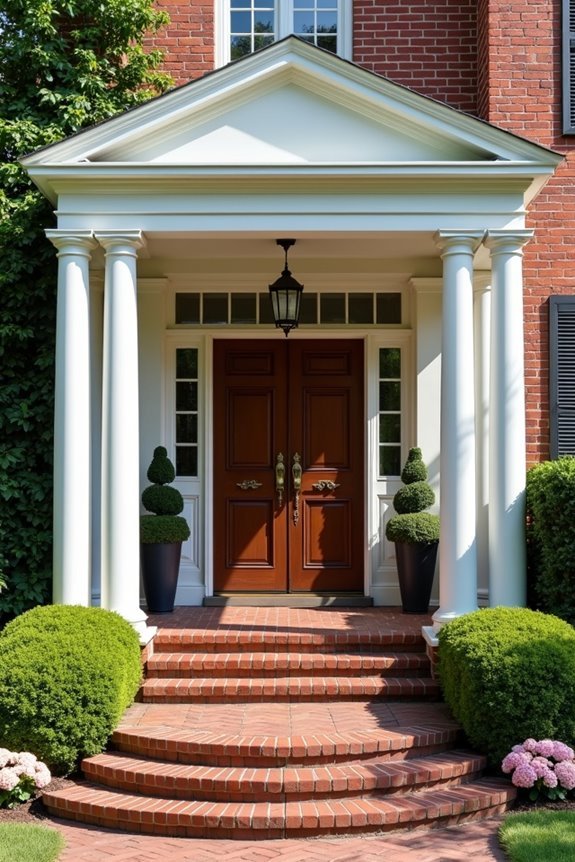
When selecting a portico style for your entryway, you’ll need to balance structural requirements with architectural proportion. The portico’s depth should measure at least 4-6 feet to provide adequate weather protection, while its width must extend 12-18 inches beyond the door frame on each side.
Portico materials directly impact both longevity and visual cohesion. Wood offers traditional warmth but requires maintenance, while composite materials provide durability with minimal upkeep. Steel and aluminum deliver superior structural capacity for larger spans.
Portico placement determines the structure’s integration with your home’s façade. Front-gable porticos suit colonial designs, while side-gable configurations complement craftsman styles. Calculate roof pitch to match existing angles, ensuring proper water runoff and architectural harmony.
[affiai keyword=”portico styles for entryways” template=”carousel” count=”3″]
Traditional Colonial Portico Features
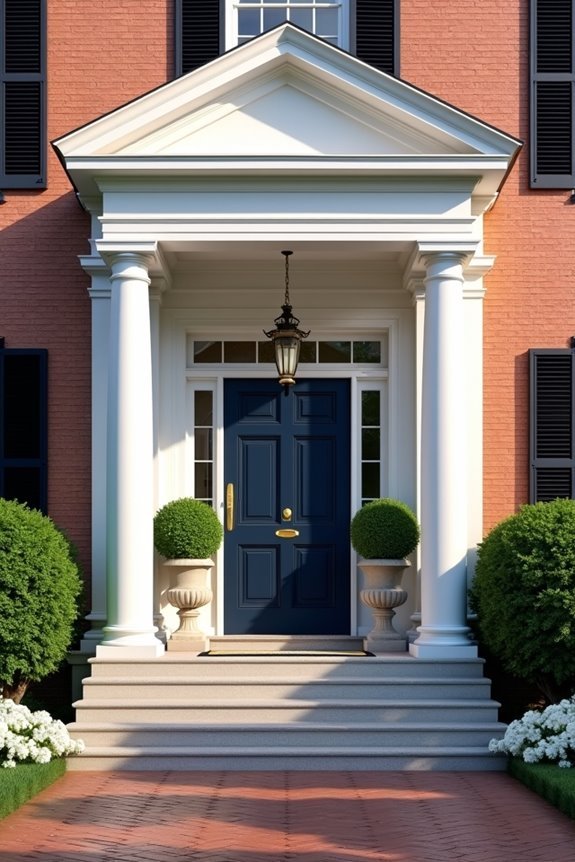
Traditional colonial porticos rely on a formula of classical proportion: column height-to-diameter ratios of 8:1 or 10:1, pediment slopes between 22-30 degrees, and entablature depths measuring one-fifth of total column height. You’ll find these mathematical relationships create visual harmony in colonial architecture.
Your column selection matters greatly. Tuscan or Doric orders suit modest homes, while Ionic or Corinthian capitals elevate formal entries. Portico materials traditionally include painted wood columns with composite lumber or cedar for longevity. The frieze typically measures 40% of entablature height, with architrave and cornice splitting the remainder equally.
Spacing follows strict guidelines: intercolumniation ranges from 1.5 to 2.5 column diameters. This guarantees structural integrity while maintaining proportional balance. Your pediment return should measure 6-8 inches, creating proper shadow lines that define the entryway’s architectural character.
[affiai keyword=”traditional colonial portico” template=”carousel” count=”3″]
Modern Minimalist Overhang Designs
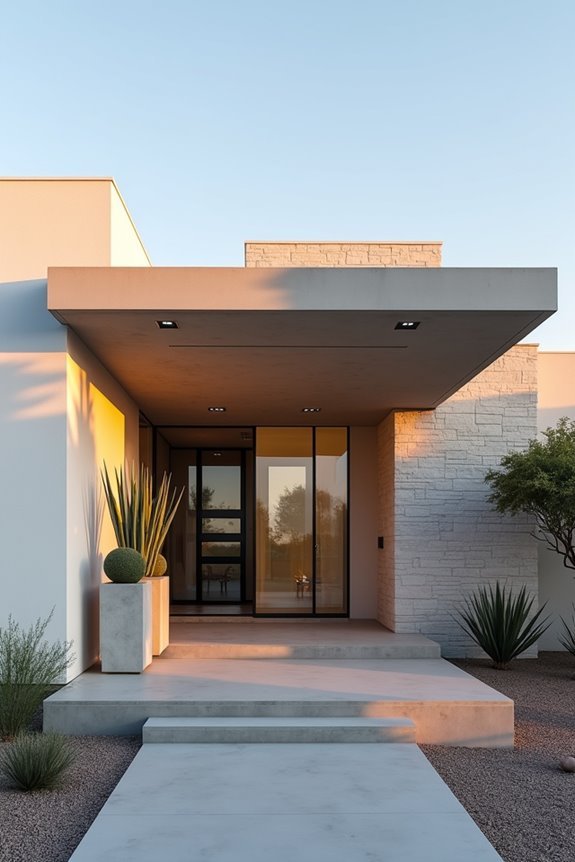
Unlike their classical counterparts, modern minimalist overhangs strip away ornamental details to emphasize pure geometric form and structural expression. You’ll achieve ideal visual impact through cantilevered slabs that project 3-5 feet without visible support brackets. Steel, concrete, and aluminum comprise your primary minimalist materials, selected for their inherent strength-to-weight ratios.
Sleek lines define these structures—horizontal planes intersecting vertical walls at precise 90-degree angles. You’ll want to maintain overhang depth between one-third and one-half of your door’s height to establish proper proportional relationships. Thickness typically ranges from 6-10 inches, creating shadow lines that accentuate the design’s geometric clarity.
Consider integrating recessed LED strips within the overhang’s underside for functional illumination that reinforces the structure’s linear character. Material continuity between overhang and façade strengthens architectural cohesion.
[affiai keyword=”modern minimalist overhang designs” template=”carousel” count=”3″]
Rustic Farmhouse Canopy Elements
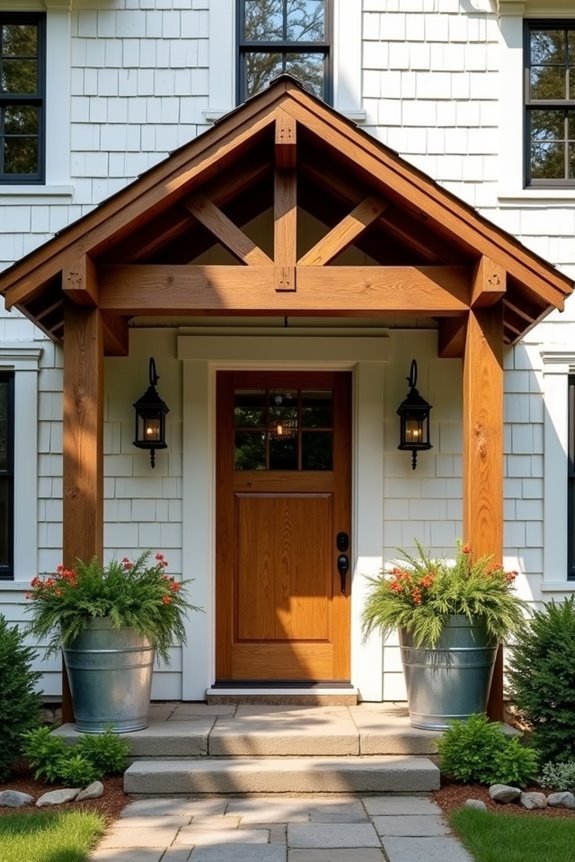
Rustic farmhouse canopies prioritize exposed structural components and natural materials that showcase construction methods rather than concealing them. You’ll want to incorporate weathered wood beams sized proportionally to your door width—typically 6×6 or 8×8 timbers for spans exceeding 6 feet. Knee braces connect at 45-degree angles, transferring vertical loads effectively while adding barn style accents.
Configure rafter spacing at 24 inches on-center for visual rhythm and structural integrity. Your timber dimensions should maintain a 1:12 ratio between depth and span length. Exposed mortise-and-tenon joinery creates authentic farmhouse character while ensuring load distribution. Consider applying natural oil finishes rather than paint to preserve wood grain visibility. Mount metal brackets using lag bolts rated for your canopy’s dead load plus snow accumulation calculations specific to your region.
[affiai keyword=”rustic farmhouse canopy elements” template=”carousel” count=”3″]
Craftsman Style Entry Covers
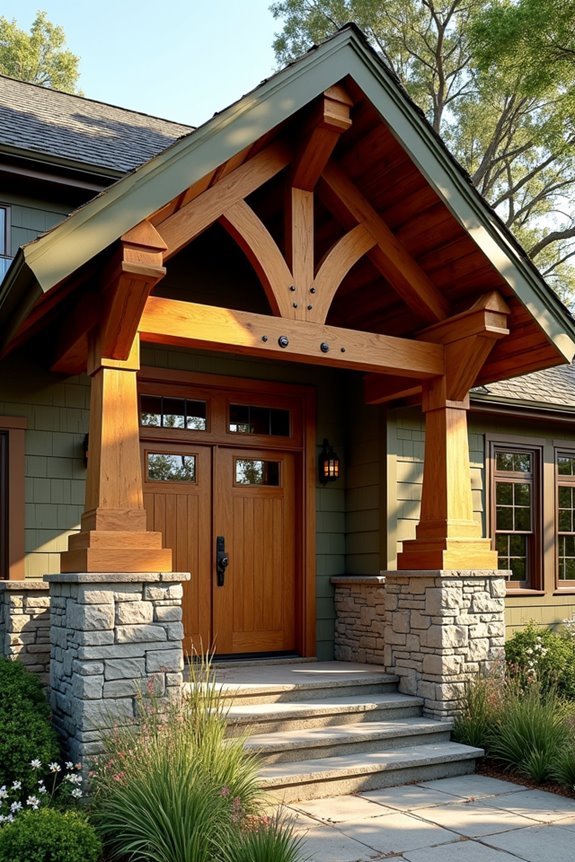
Characterized by deep eave projections and exposed rafter tails, Craftsman entry covers demand precise proportional relationships between bracket size and roof extension. You’ll need knee braces positioned at 45-degree angles, sized proportionally to support overhangs extending 24-36 inches beyond your doorway. The structural integrity relies on engineered connections between vertical posts and horizontal beams, creating the signature bungalow aesthetic.
Your craftsman woodwork should feature quarter-sawn oak or Douglas fir with visible joinery details. Tapered columns typically measure 8-10 inches square at the base, tapering to 6-8 inches at the capital. Apply craftsman color palettes using earth tones: warm browns, mossy greens, and terracotta reds. These authentic finishes protect exposed wood elements while maintaining period-appropriate visual weight and architectural coherence.
[affiai keyword=”craftsman style entry cover” template=”carousel” count=”3″]

Wear resistant: made from sturdy plastic, coin slot is built to last, can be used for a long time,vertical coin slot mechanism,coin bank coin slot

Size Included:3/8 inch metric socket kit: including 10 mm;11 mm;12 mm;13 mm;14 mm; 15 mm;16 mm;17 mm;19 mm;21 mm. It also comes with a plastic rack to place the sockets in an orderly and non cluttered manner. There is a socket mounting bracket in the plastic rack to securely secure the sockets

**IP67 Waterproof & Dustproof Protection**: This electrical enclosure is fully IP67 rated, guaranteeing complete protection against dust ingress and temporary immersion in water up to 1 meter deep. It safeguards your valuable routers, switches, and electrical connections from harsh outdoor conditions like rain, snow, and high-pressure wash-downs, eliminating the hassle and cost of water damage replacements.
Mediterranean Arched Entry Designs
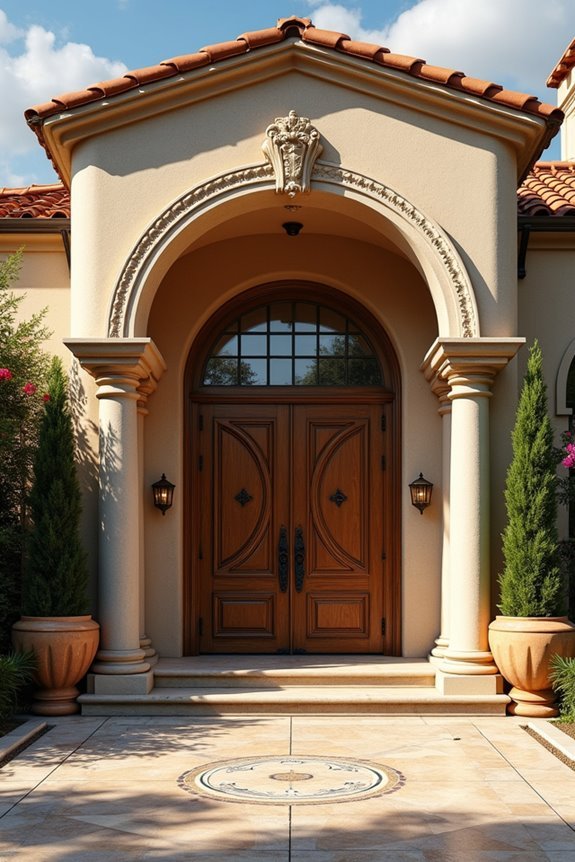
Mediterranean arched entry designs require careful calculation of arch radius and spring point height to achieve structural stability and visual balance. You’ll need to determine the span-to-rise ratio, typically 2:1 for semicircular arches or 3:1 for segmental variations. The keystone’s position marks the apex where compressive forces converge.
Your arch’s structural integrity depends on proper voussoir alignment and adequate abutment support. Position decorative tiles along the arch’s extrados to emphasize the curve while maintaining a 3:4 proportion between doorway width and total arch span. Install terracotta or ceramic elements at the spring line where vertical supports meet the arch.
For arched doorways exceeding eight feet in width, you’ll require steel reinforcement embedded within the masonry. Calculate the thrust angle to guarantee lateral forces transfer correctly to supporting columns.
[affiai keyword=”mediterranean arched entry designs” template=”carousel” count=”3″]
Gabled Roof Entry Structures
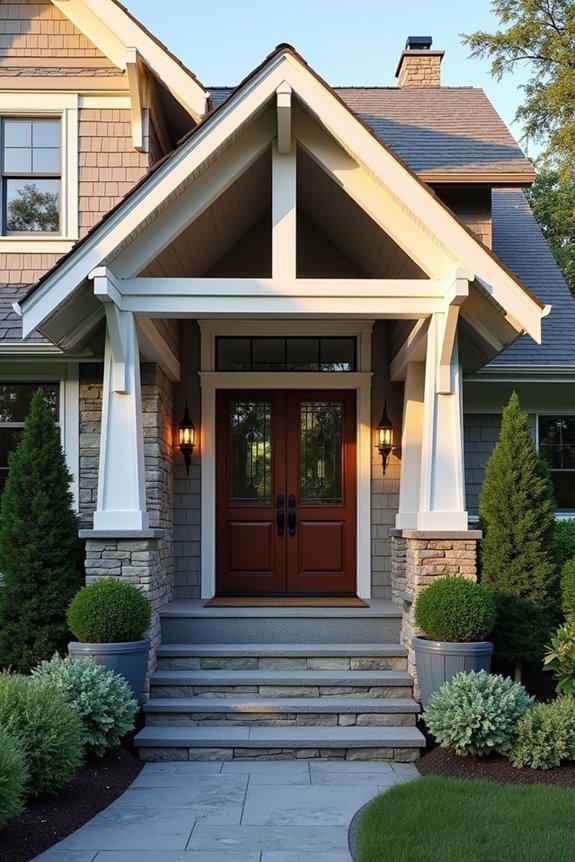
When designing gabled roof entry structures, you’ll establish the pitch angle between 4:12 and 8:12 to guarantee proper water drainage while maintaining proportional scale with your home’s primary roofline. The gabled roof benefits include superior snow load distribution and enhanced ventilation potential compared to flat alternatives.
You’ll select gabled roof materials based on structural requirements: engineered lumber for spans exceeding 8 feet, dimensional lumber for smaller applications, and metal fasteners rated for your climate zone. Match the fascia thickness to your main roof’s trim profile, typically ranging from 1×6 to 1×8 boards. Calculate the overhang projection at 24-36 inches to protect your entryway adequately while maintaining visual balance with your home’s facade width.
[affiai keyword=”gabled roof entry structure materials” template=”carousel” count=”3″]
Flat Contemporary Canopy Styles

While flat contemporary canopies eliminate traditional pitch requirements, you’ll need to engineer a minimum 1:12 slope (1 inch per foot) to prevent water pooling and guarantee proper drainage toward designated scuppers or edge channels. Your flat roof canopy should extend 36-48 inches from the door’s face, maintaining proportions of 1:1.5 to 1:2 relative to door width. Contemporary materials like powder-coated aluminum, tensioned fabric membranes, or steel-reinforced glass panels require cantilever calculations based on span-to-depth ratios of 10:1 for steel, 8:1 for aluminum. Install structural members at 24-inch centers minimum, with fascia depths of 6-12 inches providing visual weight while concealing drainage systems. Edge detailing—whether flush, recessed, or projecting—determines your canopy’s shadow lines and architectural expression.
[affiai keyword=”flat contemporary canopy styles” template=”carousel” count=”3″]
Pergola-Style Open Roof Entries
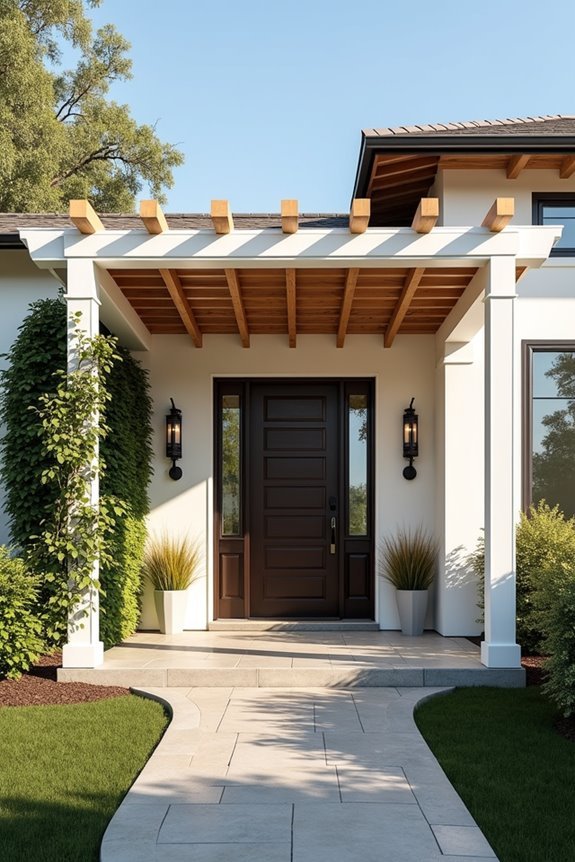
Pergola-style entry structures function as semi-permeable passages, filtering 40-60% of overhead light while establishing vertical datum points through repetitive beam spacing. You’ll achieve ideal proportions when your header beams span 8-12 feet with cross-members positioned at 12-18 inch intervals. This pergola installation creates a graduated shift zone between your outdoor living areas and interior spaces.
The structural rhythm depends on maintaining a 1:3 ratio between rafter depth and spacing. You can specify 2×6 or 2×8 lumber for rafters, with 4×4 posts supporting beams at 6-8 foot centers. This framework establishes strong shadow patterns while maintaining sight lines to your entrance. Consider cedar or composite materials for durability. The open configuration permits air circulation while defining your entry’s spatial boundaries without creating visual barriers.
[affiai keyword=”pergola entry structures” template=”carousel” count=”3″]
Victorian Decorative Bracket Overhangs

Victorian decorative bracket overhangs operate through ornamental load distribution, where carved wooden corbels transfer roof weight through compound angles rather than simple vertical support. You’ll find these brackets typically project 18-36 inches from your facade, with depth-to-projection ratios maintaining 1:1.5 for structural integrity. The ornate carvings serve dual purposes: aesthetic enhancement and increased surface area for load distribution across multiple grain directions. Your overhang depth should match bracket size proportionally—shallow 12-inch brackets support minimal projection, while substantial 24-inch versions handle deeper coverage. Install intricate trim along fascia edges to conceal structural connections and create visual continuity. Proper bracket spacing occurs at 24-48 inch intervals, depending on roof load calculations and your chosen lumber species’ compression strength ratings.
[affiai keyword=”victorian decorative brackets” template=”carousel” count=”3″]
Coastal Beach House Canopies
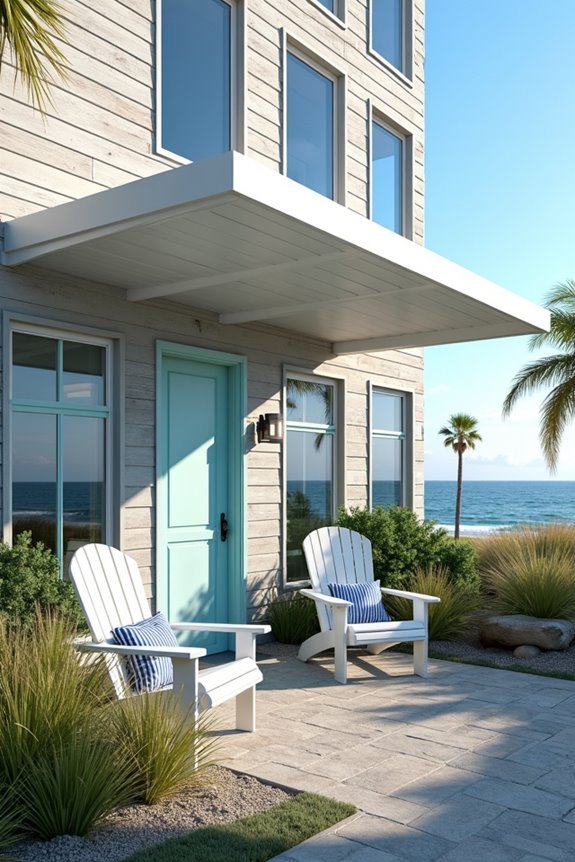
Because salt air accelerates metal corrosion at rates 4-5 times faster than inland environments, coastal canopy designs prioritize marine-grade aluminum extrusions and stainless steel fasteners over traditional steel frameworks. You’ll want projection depths of 36-48 inches to shield your entry from wind-driven rain while maintaining unobstructed ocean views. Consider raised-seam standing seam roofing at minimum 3:12 pitch for ideal water drainage. White or light-colored finishes reflect solar heat gain by 60-70% compared to darker alternatives. Position structural posts at 72-96 inch centers using galvanized anchor bolts embedded 8 inches into concrete footings. Louvered side panels enhance cross-ventilation while protecting against sandy shores’ abrasive particulates. Calculate wind load resistance for minimum 140 mph sustained gusts in hurricane-prone regions.
[affiai keyword=”coastal canopy design” template=”carousel” count=”3″]
Metal Standing Seam Overhangs
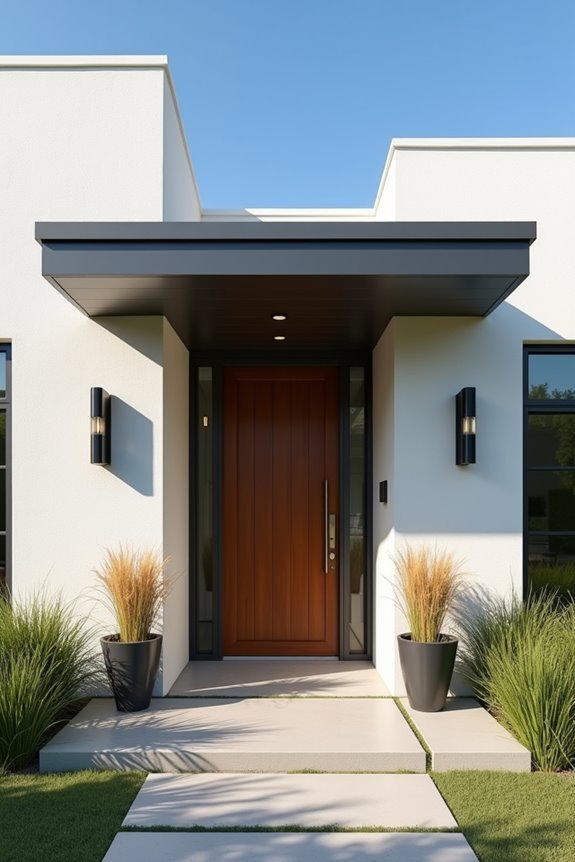
Metal standing seam panels deliver superior waterproofing through continuous interlocking ribs that eliminate horizontal fastener penetrations across your overhang’s weather surface. You’ll appreciate how the vertical seams create pronounced shadow lines that complement modern and industrial architectural styles while maintaining structural integrity.
The metal overhang benefits include exceptional durability, minimal maintenance requirements, and thermal expansion accommodation through concealed clip systems. Design considerations focus on proper pitch ratios—typically 3:12 minimum—to guarantee adequate water runoff and prevent ice damming. You’ll need to calculate panel width relative to overhang depth, maintaining proportional relationships between 1:3 and 1:4 for visual balance. Consider integrating drip edges that extend 1.5 inches beyond fascia boards, creating clean termination details while protecting underlying wood components from moisture infiltration.
[affiai keyword=”metal standing seam overhangs” template=”carousel” count=”3″]
Glass and Steel Canopies
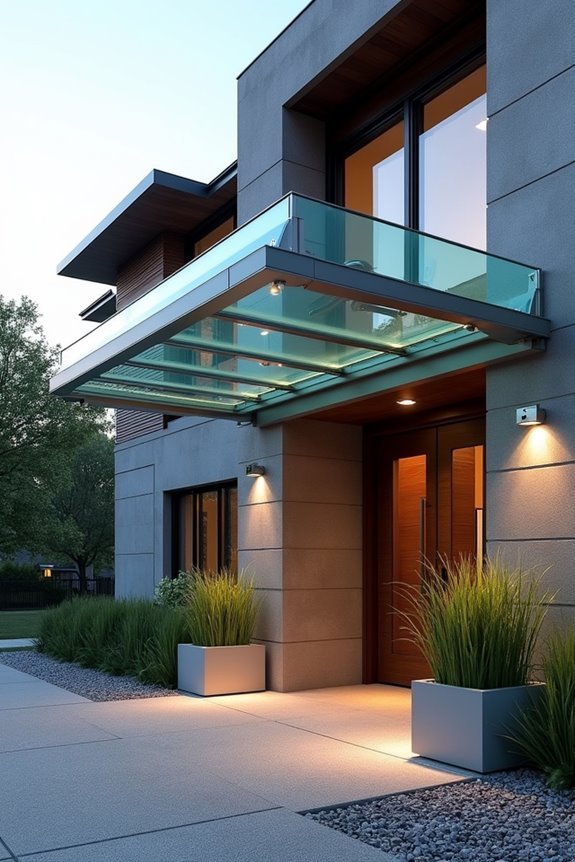
Glass and steel canopies combine structural transparency with engineering precision, requiring load calculations that account for both dead loads (12-15 lbs/sq ft for tempered glass) and live loads including snow accumulation up to 40 lbs/sq ft in northern climates. You’ll need steel framework members sized proportionally—typically 3×3-inch tubes for spans under 6 feet, 4×4-inch for longer extensions. The glass structure demands 10-12mm tempered or laminated panels with 1:12 minimum pitch for drainage. Your mounting system should integrate stainless steel standoffs at 24-inch centers maximum, transferring loads directly to wall studs or masonry anchors rated for 500+ lbs each. Consider thermal expansion joints every 10 feet on spans exceeding standard residential dimensions. This transparency-meets-strength approach delivers weather protection without visual weight.
[affiai keyword=”glass and steel canopies” template=”carousel” count=”3″]