

You’re looking at your fence as more than a boundary marker—it’s an architectural element that defines your outdoor space. The battens you select will establish rhythm, control sight lines, and manipulate light penetration across your property. Whether you’re drawn to precision-engineered spacing patterns or organic material combinations, each design decision affects both visual weight and functional performance. Here’s how strategic batten configuration transforms ordinary perimeter fencing into dimensional facades.
Horizontal Vs Vertical Batten Styles
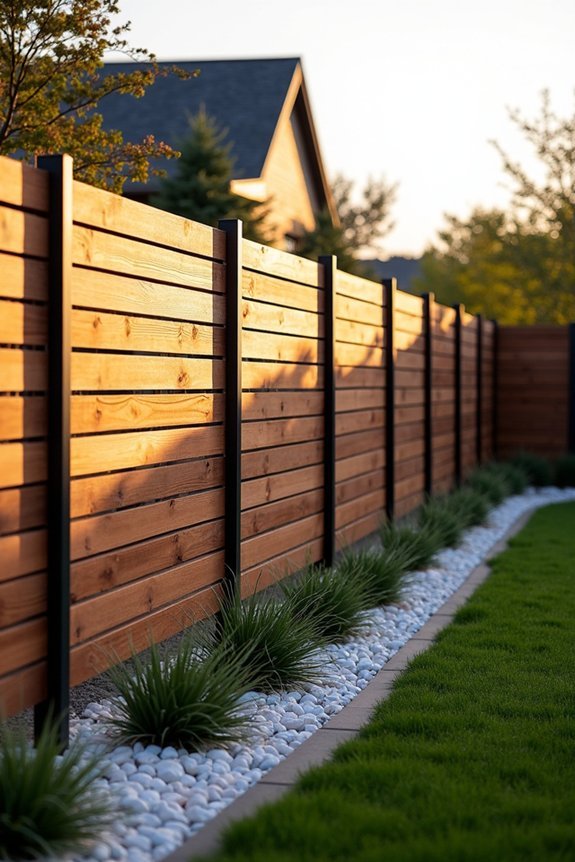
When selecting your batten orientation, you’ll find that horizontal and vertical configurations create distinctly different visual and structural effects on fence design. Horizontal battens emphasize width, making compact spaces appear more expansive while offering horizontal versatility in mounting options and installation flexibility. This orientation requires robust structural support at closer intervals to prevent sagging over time. Vertical battens deliver clean lines that accentuate height, creating an illusion of taller boundaries. The vertical appeal suits contemporary architecture, requiring fewer rails while providing superior drainage capabilities as water naturally runs downward. Your choice impacts spacing requirements: horizontal installations need battens every 400-600mm for stability, whereas vertical configurations allow rail spacing up to 1800mm. Consider sight lines, architectural style, and maintenance accessibility when determining your best batten orientation for long-term performance.
[affiai keyword=”fence batten systems” template=”carousel” count=”3″]
Spacing Patterns and Width Variations

While batten width determines the fence’s visual weight, the spacing intervals between battens fundamentally control privacy levels, light filtration, and aesthetic rhythm. You’ll achieve ideal spatial dynamics by calibrating gap-to-batten ratios: narrow 10-20mm gaps create solid screens, while 50-100mm intervals establish semi-transparent barriers that maintain visual continuity with surrounding landscapes.
Consider alternating batten widths—combining 75mm and 150mm profiles—to generate compelling visual patterns. Equal spacing at 100mm centers produces geometric uniformity, whereas staggered intervals (50mm, 75mm, 100mm sequences) introduce organic movement. For contemporary installations, you can specify progressive spacing gradients that change from dense configurations at ground level to increasingly open patterns above, balancing security requirements with atmospheric transparency. Shadow play intensifies with wider gaps, creating dynamic depth throughout daily sun cycles.
[affiai keyword=”wooden fence panels” template=”carousel” count=”3″]
Mixed Material Batten Combinations
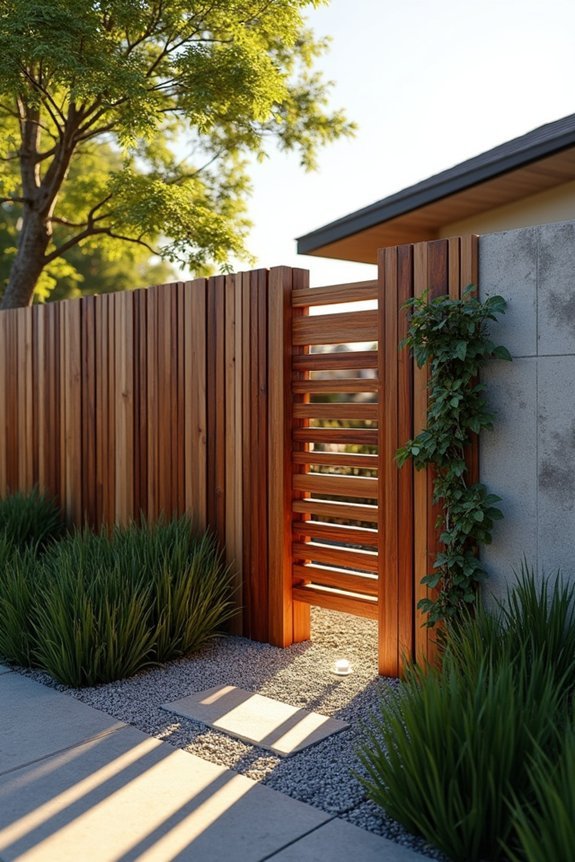
Beyond spatial configurations, material integration expands batten fence design into multi-dimensional territory. Wood metal combinations deliver structural contrast through alternating aluminum or steel battens with timber profiles. You’ll achieve distinct visual weight distribution by positioning metal battens at 600mm intervals between wooden segments. This approach establishes defined vertical rhythms while capitalizing on each material’s inherent properties—metal’s durability paired with wood’s organic warmth.
Concrete wood blends introduce robust textural dialogue to your fence system. Install precast concrete panels as primary surfaces, then overlay wooden battens at strategic intervals. You can reverse this configuration by embedding metal channels within concrete substrates to receive removable timber inserts. This methodology provides maintenance flexibility and seasonal aesthetic adjustments. Material shifts require precise joint detailing—employ reveals, shadow gaps, or contrasting fasteners to emphasize compositional boundaries rather than conceal them.
[affiai keyword=”batten fence material combination” template=”carousel” count=”3″]
Color and Stain Contrasts
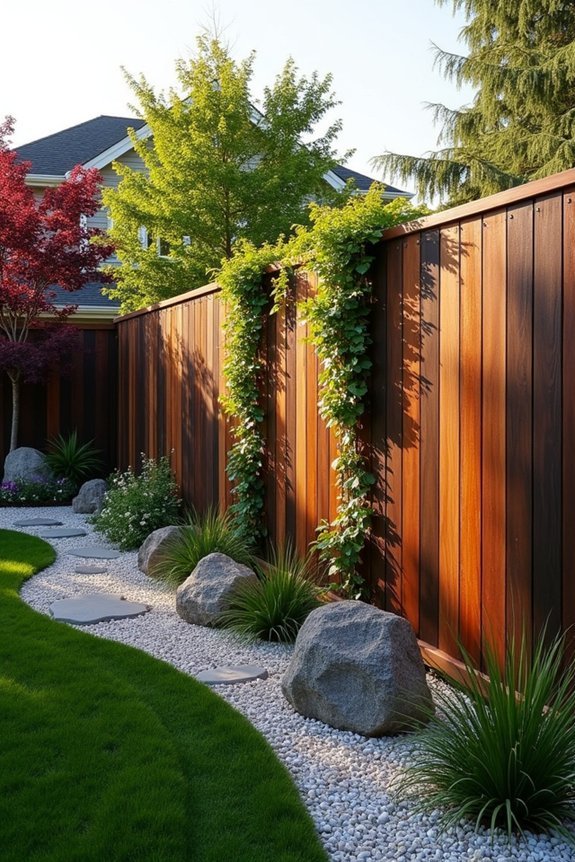
Color manipulation through stain application generates dimensional depth within uniform batten installations. You’ll achieve striking visual hierarchy by alternating dark and light-stained battens in calculated patterns—every third batten, gradient shifts, or geometric sequences. Consider color psychology when selecting your palette: warm walnut tones create inviting perimeters, while charcoal grays establish contemporary boundaries.
Stain durability varies greatly across formulations. Semi-transparent stains require reapplication every 2-3 years but showcase natural grain patterns. Solid-color stains offer 4-6 year protection with enhanced UV resistance. You can combine horizontal battens in contrasting finishes—charred timber against natural cedar creates dramatic linear emphasis. Vertical installations benefit from ombré techniques, shifting from saturated base tones to weathered upper sections, establishing visual weight distribution that anchors your fence design within the landscape composition.
[affiai keyword=”wood stain for fences” template=”carousel” count=”3″]
Geometric Batten Arrangement Techniques
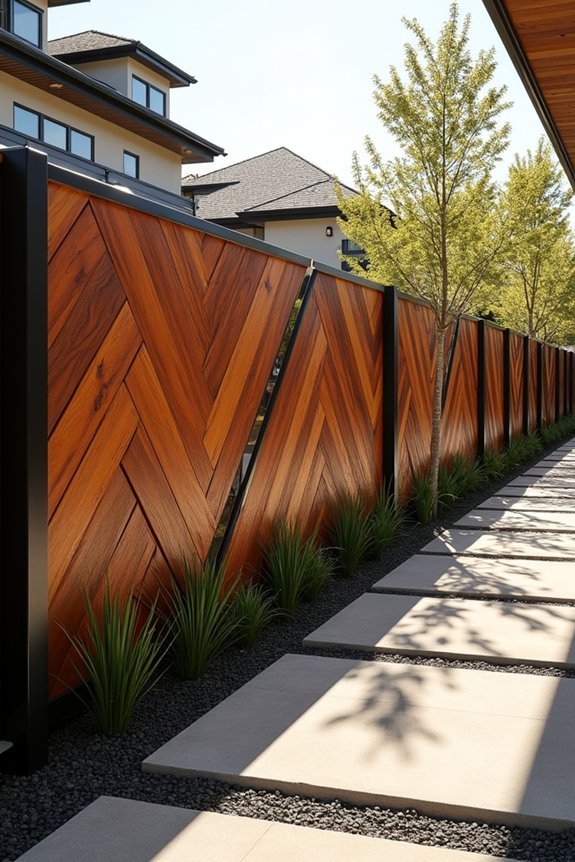
Strategic batten positioning transforms standard fence panels into architectural focal points through calculated angular placement and modular repetition. You’ll achieve dynamic visual effects by implementing diagonal cross-patterns at 45-degree intervals or creating chevron formations that direct sight lines vertically. Asymmetrical batten layouts introduce deliberate irregularity—alternating spacing ratios of 2:1 or 3:1 generates rhythmic tension across horizontal planes.
Overlapping batten designs add dimensional depth through layered installation. You can position secondary battens perpendicular to primary elements, creating grid matrices that cast complex shadow patterns. Consider vertical-to-horizontal shifts at panel junctions, establishing geometric boundaries that define spatial zones. Square and diamond configurations work effectively for courtyard enclosures, while triangular assemblies suit contemporary architectural contexts. Precision measurement guarantees pattern consistency—use laser levels for alignment verification across extended fence runs.
[affiai keyword=”fence batten panels” template=”carousel” count=”3″]
Lighting Integration With Battens
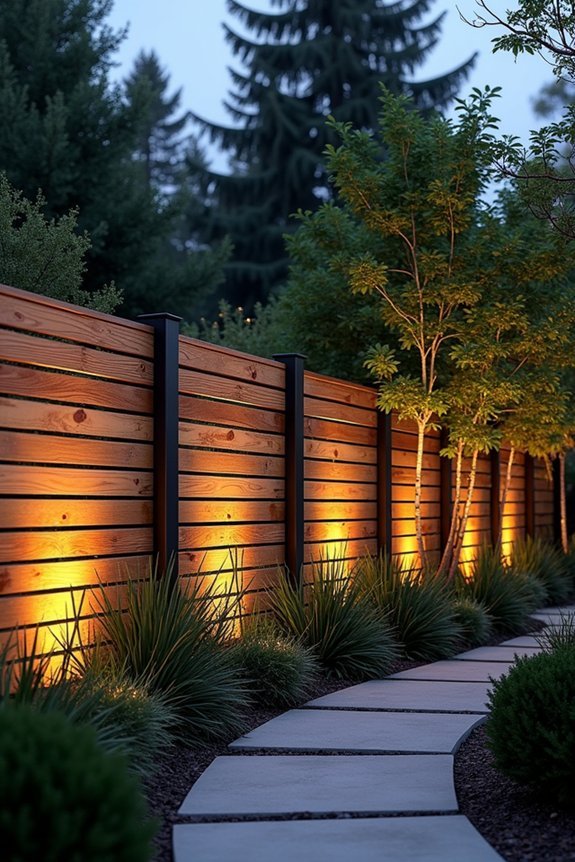
When incorporating illumination into batten fence systems, you’ll optimize visual impact through recessed LED channels positioned between vertical members or backlighting installations that create silhouette effects. Energy efficient lighting strips mounted within horizontal rails distribute uniform illumination while minimizing power consumption. You can achieve ambient lighting effects by installing low-voltage fixtures at regular intervals along the fence line, creating rhythmic light patterns that emphasize the batten spacing geometry.
Strategic placement of uplights at the fence base accentuates vertical elements and generates dramatic shadow play across adjacent surfaces. Consider motion-activated systems for enhanced security functionality, or integrate color-temperature adjustable fixtures that shift from warm whites (2700K) during evening hours to cooler tones (4000K) for task-oriented applications. Weatherproof junction boxes concealed behind battens guarantee clean cable management.
[affiai keyword=”batten fence lighting” template=”carousel” count=”3″]
Decorative Batten Cap Toppers
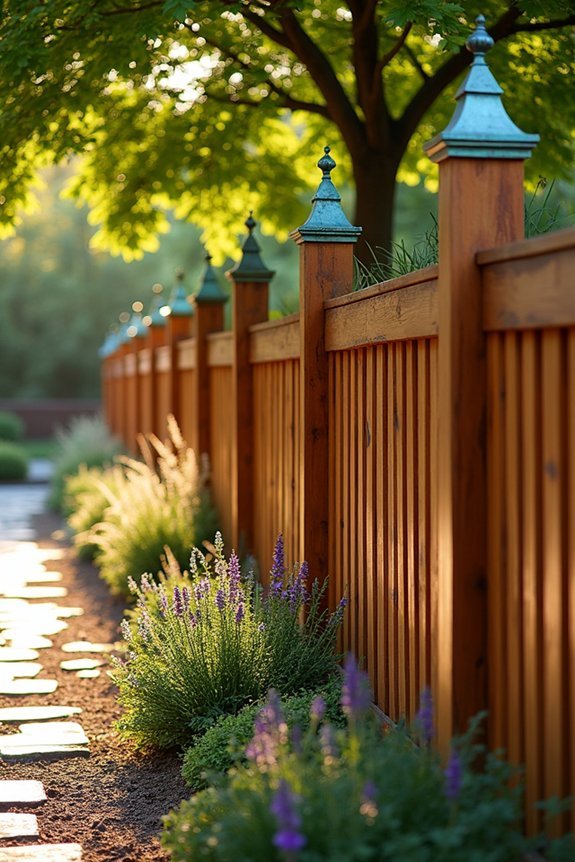
Architectural finials and custom cap profiles transform standard batten terminations into refined design statements that protect timber end-grain while establishing vertical rhythm along your fence line. You’ll find decorative toppers manufactured in aluminum, copper, or composite materials that resist weathering while introducing dimensional interest at critical sightlines. Pyramid caps deliver classical geometry, while chamfered profiles create contemporary angularity. Ball finials establish period-appropriate detailing for heritage contexts, whereas flat-top caps with integrated drip edges prioritize functional minimalism. Consider how these batten styles interact with your roofline silhouettes and neighboring architectural elements. Matching cap profiles across multiple fence sections creates visual continuity, while alternating designs between wide and narrow battens introduces calculated variation. Powder-coated finishes maintain color consistency throughout seasonal temperature fluctuations.
[affiai keyword=”decorative batten cap toppers” template=”carousel” count=”3″]
Curved and Wavy Batten Profiles
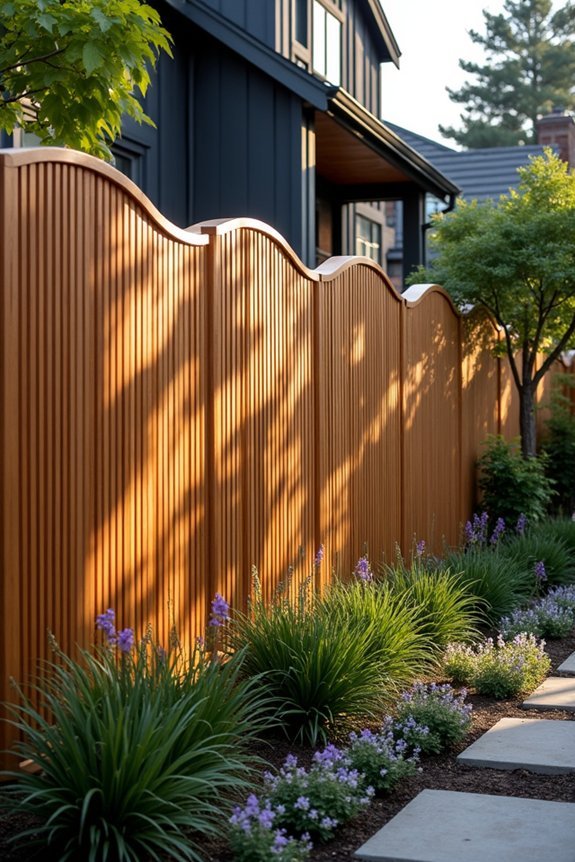
Flowing geometries introduce kinetic energy to fence elevations through battens that deviate from strict vertical alignment, creating rhythmic undulations that capture light differently throughout the day. You’ll achieve curved profiles by steam-bending timber battens or utilizing flexible composite materials that maintain structural integrity while conforming to sinuous forms. Wavy designs establish visual movement across horizontal planes, transforming static barriers into dynamic architectural elements. Consider parametric spacing patterns where batten intervals vary according to curve amplitude, reinforcing the geometric expression. Machine-cutting techniques enable precise replication of complex wave patterns across multiple battens, ensuring dimensional consistency. For ideal performance, specify materials with appropriate flexibility ratings—typically bamboo composites or specially treated cedar—that resist splitting during installation while maintaining their sculptural form under thermal expansion cycles.
[affiai keyword=”curved and wavy batten profiles” template=”carousel” count=”3″]
Laser-Cut Pattern Batten Inserts
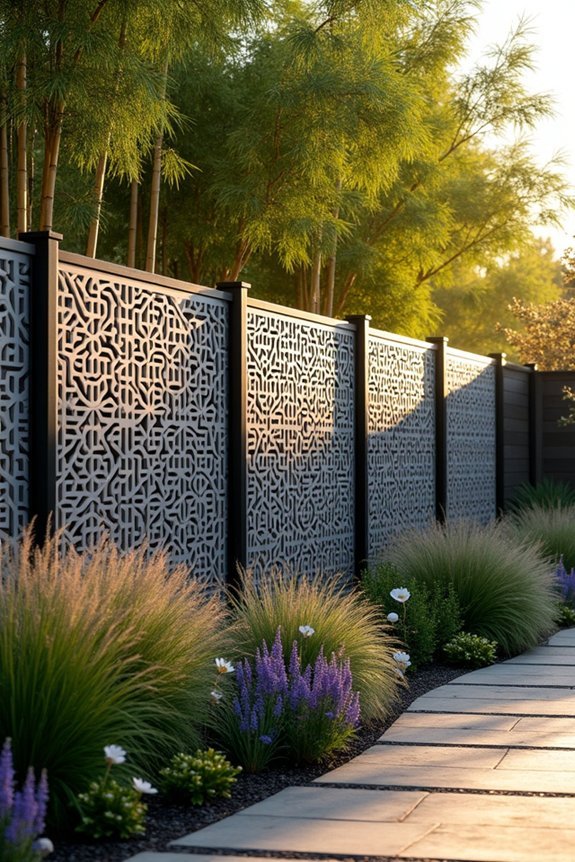
Through digital fabrication technologies, laser-cut pattern batten inserts transform conventional fence components into intricate screening elements that balance privacy with controlled transparency. You’ll achieve precise geometric compositions—from Islamic tessellations to parametric gradients—that traditional manufacturing methods can’t replicate. Laser cut materials like aluminum, steel, and bamboo plywood accommodate designs ranging from 3mm to 25mm thickness, determining structural integrity and shadow casting properties.
Pattern customization allows you to modulate visual density across fence sections, creating strategic sightlines while maintaining security. You can specify perforation ratios between 30-70% to control airflow and light filtration. Consider file preparation in vector formats, with kerf width adjustments ensuring dimensional accuracy. CNC precision eliminates human error in repetitive patterns, producing consistent aperture dimensions that influence both aesthetic rhythm and functional performance across extended installations.
[affiai keyword=”laser cut pattern batten inserts” template=”carousel” count=”3″]
Sustainable Recycled Batten Materials

When environmental considerations intersect with material selection, recycled composite battens offer structural performance metrics comparable to virgin lumber while diverting post-consumer and post-industrial waste from landfills. You’ll find these recycled materials engineered from reclaimed HDPE plastics, wood fibers, and agricultural residues maintain dimensional stability across thermal cycles while resisting moisture infiltration and UV degradation. The batten profiles integrate recycled content percentages ranging from 65% to 95%, delivering uniform cross-sections with predictable load-bearing capacities. You can specify these eco friendly options in standard 19mm, 25mm, or 38mm thicknesses, matching conventional timber dimensions for seamless installation within existing rail-and-post frameworks. Color-through pigmentation eliminates surface finishing requirements, reducing volatile organic compound emissions throughout the fence assembly’s service life while maintaining aesthetic consistency.
[affiai keyword=”recycled composite batten materials” template=”carousel” count=”3″]
Living Wall Batten Integration
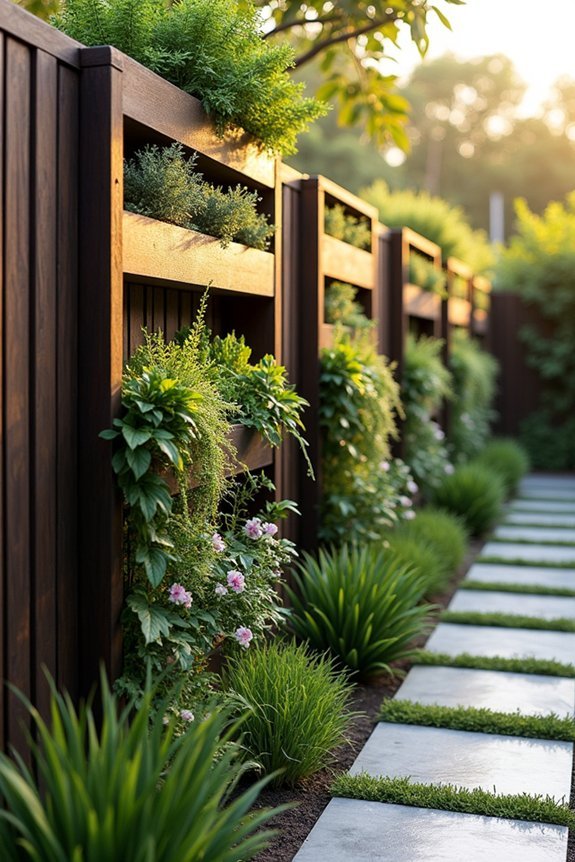
As vertical gardens gain prominence in urban residential applications, batten fence systems now accommodate integrated planting modules that transform boundary structures into productive green infrastructure. You’ll find specialized batten profiles featuring recessed channels and mounting points designed specifically for modular planter installation. These systems support various plant integration methods, including pocket planters, trellis attachments, and hydroponic rails positioned between vertical members.
The living wall benefits extend beyond aesthetics—you’re creating thermal insulation, noise reduction, and improved air quality while maximizing limited ground space. Select batten spacing that corresponds with your chosen planter dimensions, typically 150-300mm intervals. Consider irrigation requirements during design phases, incorporating drip lines or self-watering reservoirs within batten cavities. Material selection proves critical; moisture-resistant composites or treated timber prevent degradation from constant plant proximity and irrigation exposure.
[affiai keyword=”living wall batten system” template=”carousel” count=”3″]