You’ve likely noticed the striking horizontal cedar fence at Frank Lloyd Wright’s Usonian homes, where privacy meets architectural intent through deliberate material placement. Your backyard’s privacy needs require the same strategic approach—balancing sight lines, spatial flow, and contemporary aesthetics. Modern wood fencing isn’t simply about blocking views; it’s about creating dimensional boundaries that define outdoor zones while maintaining visual interest. The right combination of slat orientation, material composition, and integrated features will transform your yard’s perimeter into a design element that serves multiple functions simultaneously.
Horizontal Cedar Slat Design
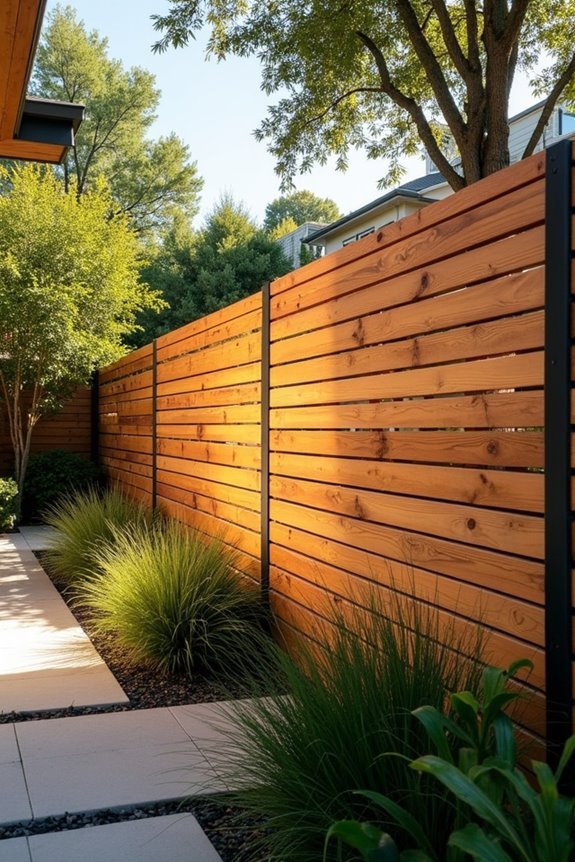
Horizontal cedar slat fencing transforms traditional vertical picket designs into contemporary architectural statements through deliberate material orientation and spacing strategies. You’ll achieve ideal privacy while maintaining airflow by setting your horizontal slat spacing between 1/4 to 1 inch apart. This configuration creates visual barriers without compromising ventilation.
Cedar’s natural oils resist decay and insect damage, but you’ll need to address cedar wood maintenance proactively. Apply penetrating oil sealers annually to preserve the wood’s dimensional stability and prevent silvering. You can also embrace the natural weathering process for a rustic aesthetic.
Install slats with concealed fastening systems to maintain clean sightlines. Mount horizontal rails to sturdy posts spaced 6-8 feet apart, ensuring structural integrity against lateral forces and preventing sagging over time.
[affiai keyword=”horizontal cedar slat fencing” template=”carousel” count=”3″]
Vertical Board-on-Board Style
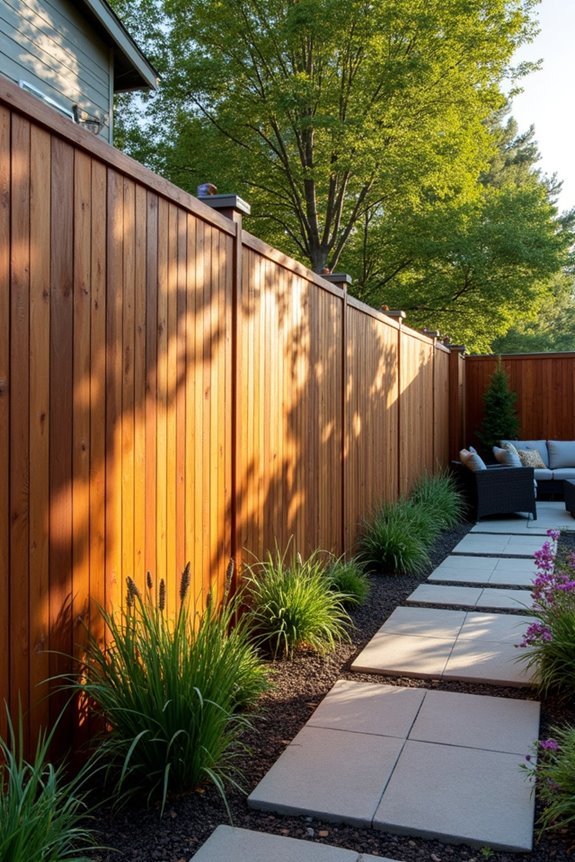
Why settle for partial privacy when vertical board-on-board construction delivers complete visual screening with enhanced dimensional character? This installation method staggers boards on alternating fence sides, eliminating sightline gaps while maintaining airflow. You’ll achieve superior coverage compared to standard picket arrangements.
Vertical design benefits include natural water runoff that extends material lifespan and streamlined installation aligned with typical post spacing. The overlapping pattern creates dimensional depth, casting shadows that enhance visual interest throughout daylight hours.
For vertical fencing materials, select premium cedar or pressure-treated pine in 1×6 or 1×8 dimensions. Space boards with 1-2 inch overlap to guarantee complete coverage from all viewing angles. This configuration supports fence heights from 6-8 feet while maintaining structural integrity without additional horizontal bracing between posts.
[affiai keyword=”vertical board-on-board fencing” template=”carousel” count=”3″]
Mixed Material Composite Panels
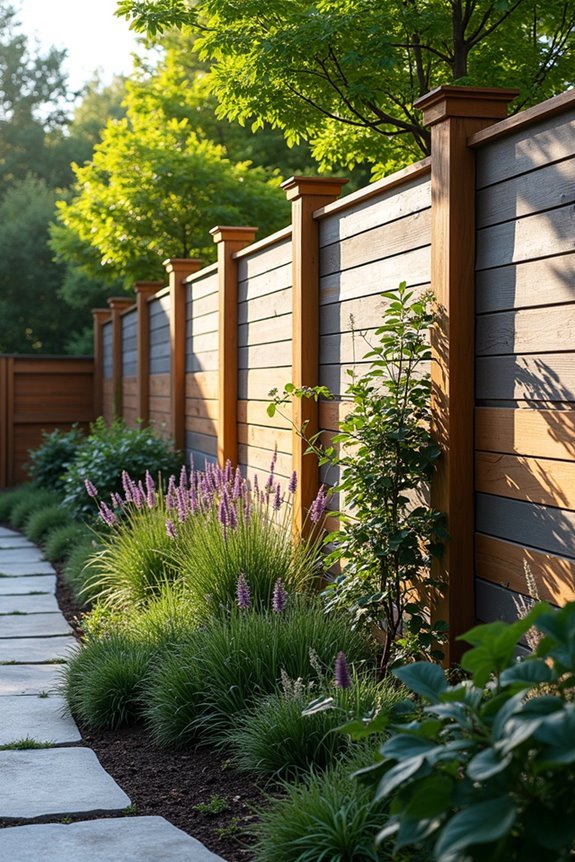
When you integrate composite materials with natural wood elements, you’ll create fence panels that balance modern aesthetics with practical durability. These hybrid systems leverage composite material durability to resist moisture, insects, and UV degradation while maintaining the warmth of authentic timber accents.
You’ll find design color options ranging from industrial grays to rich earth tones, allowing precise coordination with your architectural palette. Position composite slats horizontally against vertical wood posts to establish visual rhythm and dimensional contrast. The materials require different structural supports—composite panels need closer spacing than wood due to flex characteristics.
Consider alternating panel widths to create shadow lines that enhance depth perception. This approach reduces maintenance intervals while preserving the organic character that purely synthetic materials lack, delivering measurable longevity without sacrificing design sophistication.
[affiai keyword=”composite wood fence panels” template=”carousel” count=”3″]

REALISTIC WOOD-LOOK WITHOUT THE MAINTENANCE: Beautifully embossed wood-grain boards provide the warm, natural look of real wood in Slate Grey or Walnut Brown — no staining, sealing, or painting required

Waterproof Interior & Exterior Wall Panels: Upgrade any space with 100% waterproof WPC slat wall panels designed for both indoor and outdoor use. Ideal for exterior wall panels, facade cladding, accent walls, and commercial applications.

High-Quality Privacy Fencing:Our composite fence panels are crafted from sustainable wood-plastic composite materials,not only offering the authentic texture of natural wood but also have a range of advantages,including environmental friendliness and durability.
Louvered Angled Privacy Screen
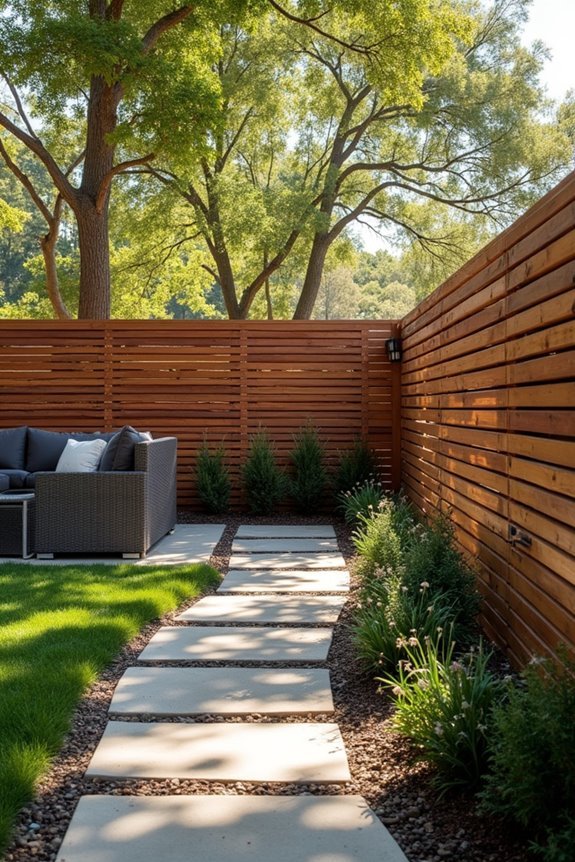
Angled slats introduce controlled sightline management that adapts to your viewing position and sun trajectory throughout the day. The louvered design benefits include strategic light filtration while maintaining privacy from neighboring properties. You’ll optimize spacing between slats at 30-45 degree angles, creating visual barriers that block horizontal views yet permit vertical airflow.
Angled privacy solutions deliver superior ventilation compared to solid panels, reducing wind load by 40-60% while eliminating moisture accumulation between boards. Mount your slats with adjustable brackets for seasonal repositioning, accommodating changing sun angles and privacy requirements. Consider 1×4 or 1×6 cedar boards spaced at two-inch intervals for maximum effectiveness. This configuration blocks direct sightlines from ground level while preserving an open, contemporary aesthetic that doesn’t compromise your yard’s spatial perception.
[affiai keyword=”louvered outdoor privacy screens” template=”carousel” count=”3″]
Shadowbox Lattice Top Fence
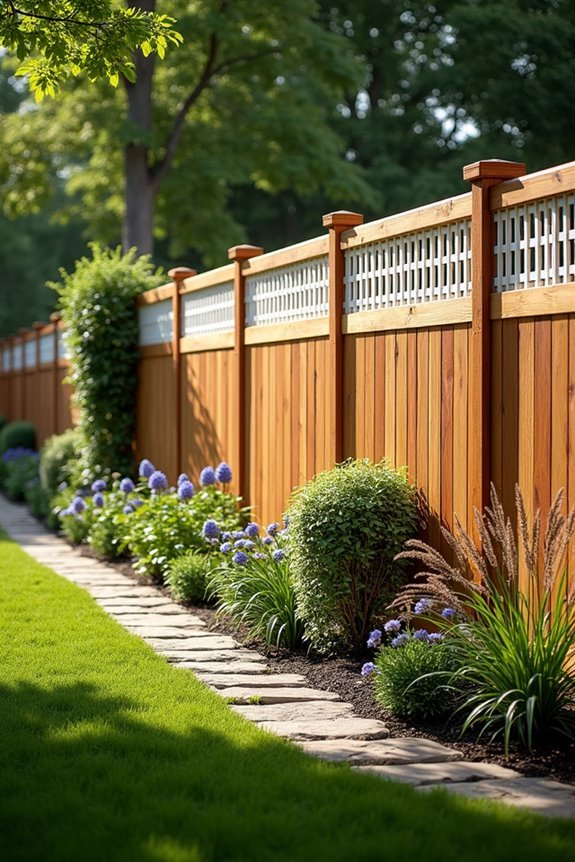
Shadowbox construction creates dimensional depth by alternating board placement on opposite fence sides, while the lattice top component adds decorative relief and supplemental height without visual heaviness. This hybrid approach delivers design benefits including enhanced airflow, bilateral aesthetic appeal, and graduated privacy levels. You’ll achieve ideal structural integrity by spacing pickets one board-width apart and securing them to alternating rail faces. Installation tips include maintaining consistent 4-6 inch lattice panel height, using galvanized fasteners to prevent rust staining, and ensuring your posts extend sufficiently to support the combined fence-plus-lattice elevation. The shadowbox base provides 85% opacity while the lattice crown softens the fence line against sky exposure. This configuration works exceptionally well for corner lots requiring attractive perimeter treatment from multiple viewing angles.
[affiai keyword=”shadowbox lattice top fence” template=”carousel” count=”3″]
Staggered Height Modern Picket
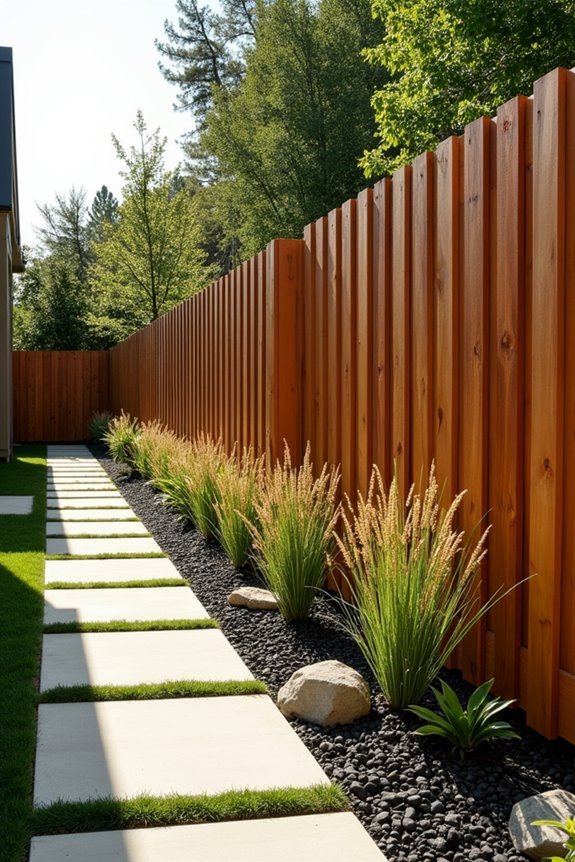
Staggered height modern picket fencing breaks the monotonous horizontal plane by introducing rhythmic vertical variation—pickets terminate at different elevations to create sculptural silhouettes that transform standard perimeter barriers into architectural features. You’ll achieve maximum visual impact by establishing a deliberate pattern: alternating between two or three specific heights rather than random variation. This picket design works exceptionally well in contemporary landscapes where geometric precision matters. The staggered heights create dynamic shadow play throughout the day while maintaining functional privacy at your property’s perimeter. Consider spacing pickets closer together—typically 1-2 inches apart—to preserve security without sacrificing the design’s visual rhythm. This approach particularly complements mid-century modern and minimalist architecture, where clean lines and intentional asymmetry define the aesthetic vocabulary.
[affiai keyword=”modern staggered picket fence” template=”carousel” count=”3″]
Floating Panel Frame Construction
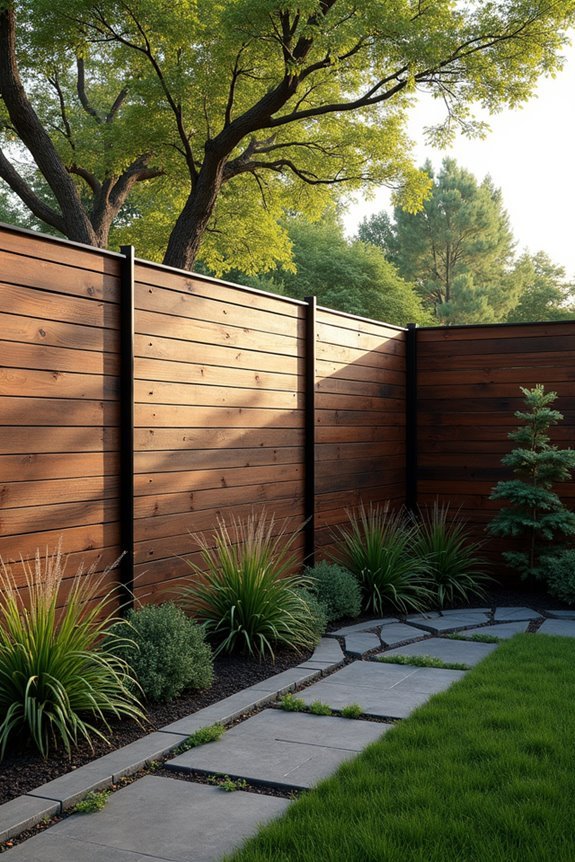
Floating panel frame construction suspends solid infill panels within a perimeter framework, creating deliberate reveals that emphasize each component’s distinct role in the fence’s structural and visual hierarchy. You’ll position rectangular panels with consistent gaps between the frame members, establishing shadow lines that articulate depth and dimension. This technique works exceptionally well when you’re combining contrasting floating panel materials—cedar panels within powder-coated aluminum frames, or stained hardwood against natural wood posts.
The floating panel advantages include simplified panel replacement, enhanced visual interest through layered composition, and improved air circulation behind panels that reduces moisture retention. You’ll achieve clean sightlines while maintaining structural integrity, as the frame bears all loads independently. This construction method transforms standard fencing into architectural statement pieces through calculated spatial relationships.
[affiai keyword=”floating panel fence frame” template=”carousel” count=”3″]
Charred Shou Sugi Ban Finish
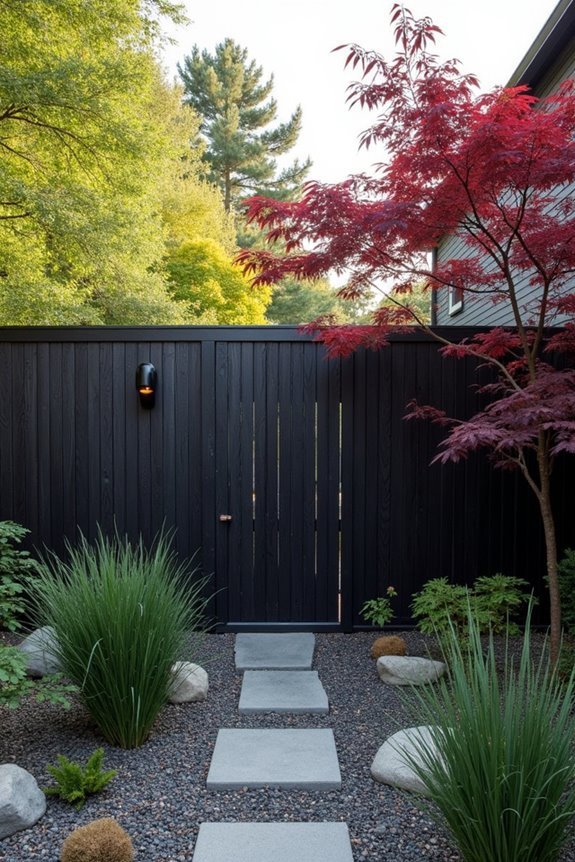
Ancient Japanese preservation techniques meet contemporary fence design through Shou Sugi Ban, where controlled charring transforms wood surfaces into deeply textured, carbon-sealed barriers resistant to rot, insects, and UV degradation. You’ll achieve the best charred texture by torching cedar or cypress planks until the surface carbonizes to your desired depth—light charring creates subtle grain definition, while aggressive burning produces dramatic alligator-skin patterns. The charcoal layer creates a hydrophobic barrier that repels moisture and extends fence longevity to 80+ years.
Maintenance tips include annual soft-bristle brushing to remove surface debris and periodic oil application to preserve the finish’s depth. You can install charred boards vertically or horizontally, spacing them traditionally or in geometric configurations that emphasize the wood’s dimensional transformation while maintaining privacy.
[affiai keyword=”charred wood shou sugi ban” template=”carousel” count=”3″]
Corrugated Metal Wood Hybrid
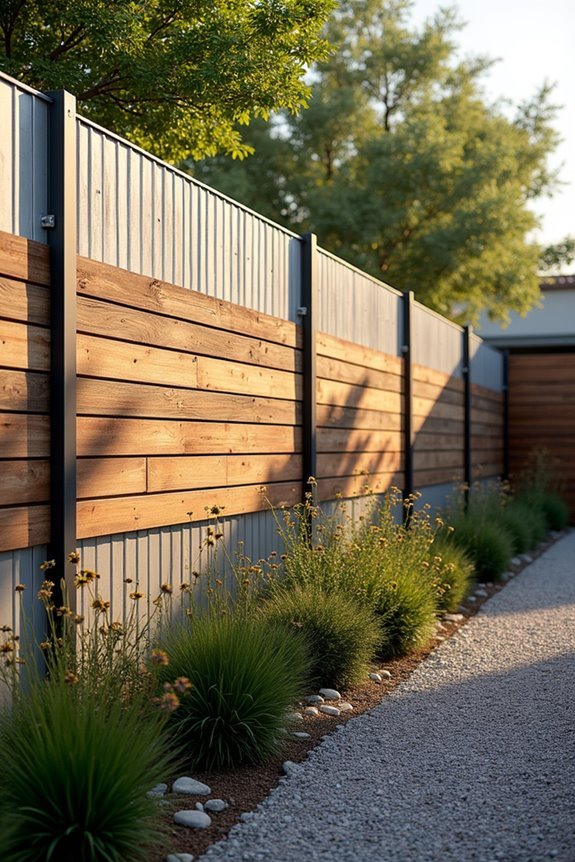
Industrial aesthetics merge with natural warmth when you combine corrugated metal panels with horizontal wood slats, creating dimensional contrast that breaks up visual monotony while optimizing material costs. This rustic industrial approach alternates material zones—typically 3-4 foot sections—allowing you to strategically place metal where privacy matters most while using wood to soften harsh sightlines.
You’ll achieve maximum durability by selecting galvanized or Cor-Ten steel panels alongside weather resistant materials like cedar or thermally-modified wood. The vertical ribs of corrugated metal complement horizontal wood grain, establishing rhythm through perpendicular lines. Mount metal panels with concealed fasteners to maintain clean connections between materials. This hybrid design reduces lumber requirements by 30-40% while delivering contemporary edge that withstands decades of exposure without compromising structural integrity.
[affiai keyword=”corrugated metal wood hybrid” template=”carousel” count=”3″]

Innovative Design: The wooden fence panels posts features a U-channel design—simply attach the brackets to the posts and slide in (3/4" x 5.5") wood planks to lock. Easy DIY installation and plank replacement, even for one person, saving time, effort, and labor costs in the short and long term

【Easeful Elegance】 Transform your backyard into a curated sanctuary with our innovative metal fence post. Designed for those who appreciate both form and function, these privacy fence post allow you to effortlessly assemble horizontal wooden boards into a sleek, modern fence that complements gardens, patios, and lush landscapes. No more uneven nails or messy installations—just clean lines and timeless style.

Give your garden the charm it deserves—with a fence that defines beauty, structure, and peace of mind.
Diagonal Chevron Pattern Panels
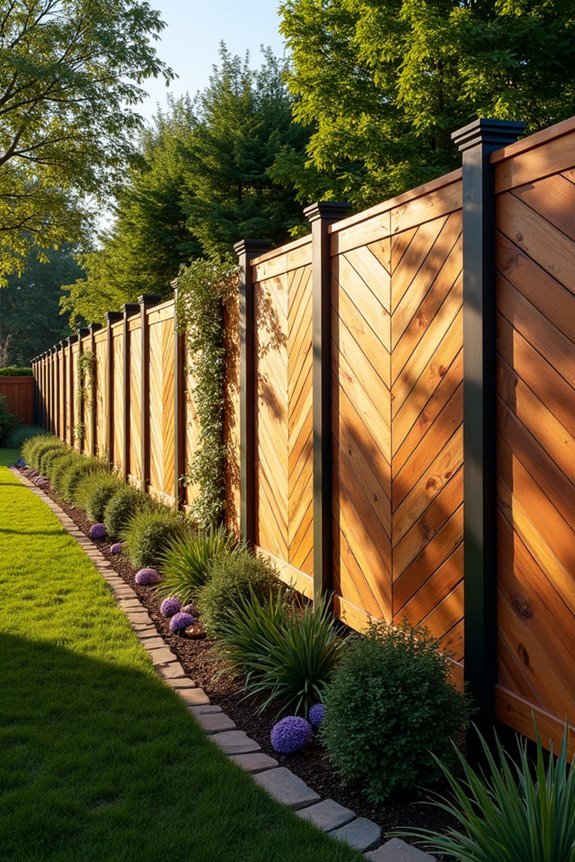
Chevron patterns transform flat fence planes into dimensional installations by arranging boards at opposing 45-degree angles that meet at central vertices, creating V-shaped visual rhythms across your property line. You’ll need precise miter cuts and consistent spacing to maintain pattern integrity across multiple panels. The directional flow naturally draws eyes along the fence length while creating depth through shadow play. Consider alternating chevron directions between panels for added visual interest, or incorporate color combinations like charcoal and natural cedar to emphasize the geometric motif. Install decorative accents such as metal trim strips along center vertices to reinforce angular shifts. Frame each chevron panel with contrasting borders to define pattern boundaries and create gallery-like focal points throughout your perimeter.
[affiai keyword=”diagonal chevron fence panels” template=”carousel” count=”3″]
Living Wall Planter Integration
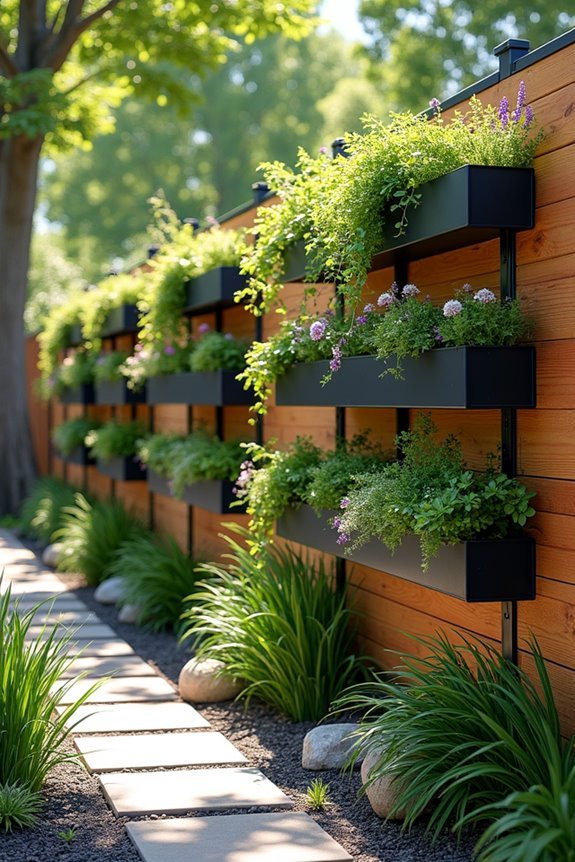
Living walls merge structural boundaries with functional gardening by incorporating planter boxes, mounting rails, and irrigation systems directly into fence architecture. You’ll maximize vertical space while creating oxygen-rich microclimates that reduce ambient temperatures by 10-15 degrees. Install modular pocket systems with 6-8 inch depth for herbs and succulents, or integrate 12-inch boxes for vegetables and flowering perennials. Position drip irrigation lines behind panels, connecting to smart timers for water efficiency. The living wall benefits extend beyond aesthetics—you’re establishing natural sound barriers and improving air quality. Configure planters at staggered heights to create visual rhythm while ensuring adequate sunlight exposure. This approach transforms your fence into a productive element, exemplifying sustainable gardening principles through space optimization and resource conservation.
[affiai keyword=”living wall planters” template=”carousel” count=”3″]
Bamboo Screen Privacy Fence
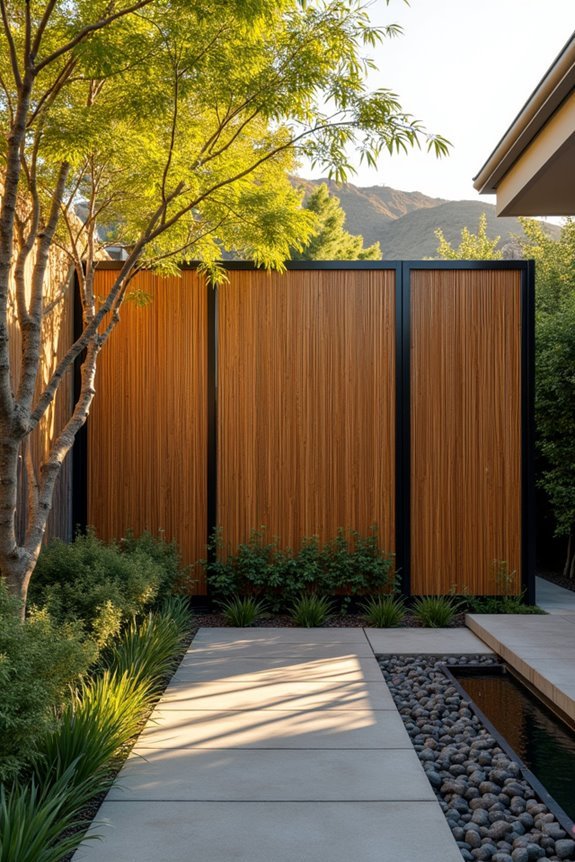
Because bamboo screens deliver 85-90% visual blockage while maintaining airflow, they function as ideal privacy solutions for narrow property lines and urban courtyards. You’ll find bamboo durability benefits include natural resistance to moisture, insects, and UV degradation—lasting 15-20 years with minimal maintenance. Mount 6-8 foot panels directly to metal frames or existing fence structures using galvanized hardware spaced 24 inches on-center.
When selecting sustainable fencing options, specify heat-treated bamboo species like Moso or Tonkin for maximum density ratings of 0.7-0.8 g/cm³. You can configure screens in overlapping layers to achieve 95% opacity, or space them 2-3 inches apart for semi-transparent partitions. Install ground-level drainage channels to prevent moisture accumulation and extend material lifespan.
[affiai keyword=”bamboo privacy screen” template=”carousel” count=”3″]

QUALITY – Our premium bamboo slat fence are all hand made, using the high quality bamboo from the subtropical monsoon climate region. Garden fence is made of split bamboo and can be used to section off parts of the garden or line a path or driveway to add a tropical charm to your outdoor living space. Bamboo is eco-friendly materials, all bamboo stakes are hand selected and hand treated.

Premium Materials: Our bamboo fence is made from high-quality bamboo, handcrafted and sourced from the subtropical monsoon climate zone. Each bamboo stick is carefully selected and processed to ensure durability and aesthetic appeal. The split bamboo is perfect for partitioning garden areas, laying paths, or driveways, bringing a touch of tropical charm to your outdoor space. Bamboo is an eco-friendly material, representing our respect and appreciation for nature.
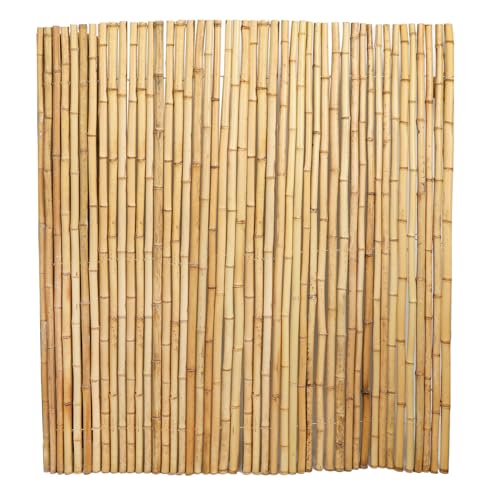
PREMIUM QUALITY: Made from high-quality, natural bamboo, carefully air-dried to enhance durability and minimize moisture retention. The sturdy bamboo poles are securely held together with galvanized steel wire for long-lasting performance.
Reclaimed Barn Wood Panels
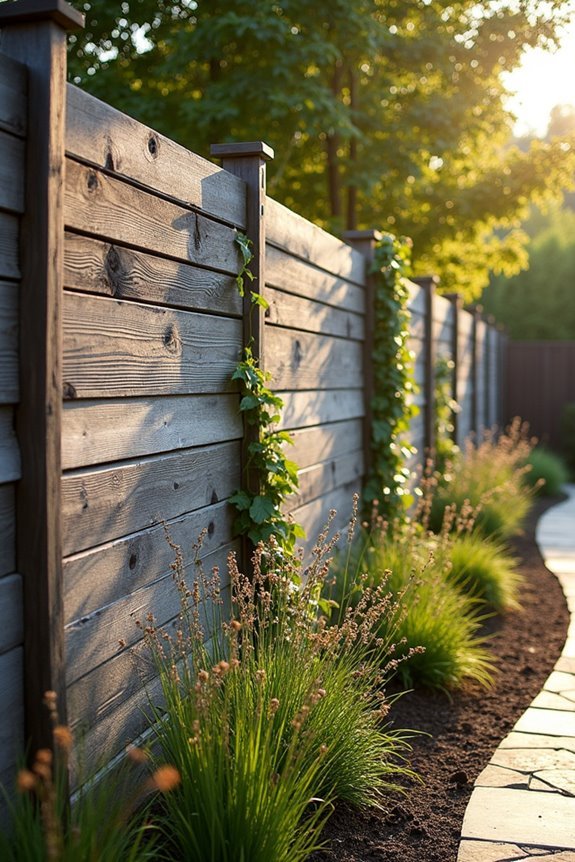
Reclaimed barn wood panels introduce authentic weathered character through 50-150 year old timber salvaged from agricultural structures across North America. You’ll find these boards display natural patina variations from gray to brown, created by decades of sun exposure and oxidation. The weathered texture provides dimensional depth that manufactured distressing can’t replicate.
Install panels horizontally for contemporary applications, maintaining 1/8-inch gaps to accommodate seasonal wood movement. You’ll need to treat salvaged timber with borate solutions to eliminate pest concerns while preserving the rustic charm. Mount boards to 4×4 pressure-treated posts spaced 6-8 feet apart, using stainless steel fasteners to prevent rust staining. Each panel spans 6-12 feet in length, depending on original barn dimensions, creating seamless fence sections with minimal joints.
[affiai keyword=”reclaimed barn wood panels” template=”carousel” count=”3″]

EASY TO INSTALL: 3/8'' Thickness & Various Lengths Ensures Sturdy Boards For A Lifetime Of Enjoyment

RECLAIMED WOOD ACCENT: Real reclaimed and recycled wood, naturally-weathered wood paneling adds a beautiful, rustic accent to your walls

【REAL WOOD】– Made of 100% dried fir wood imitating vintage reclaimed barnwood appearance for interior finish. The colors will vary from browns to grays depending on the batch.
Modern Slatted Gate Entry
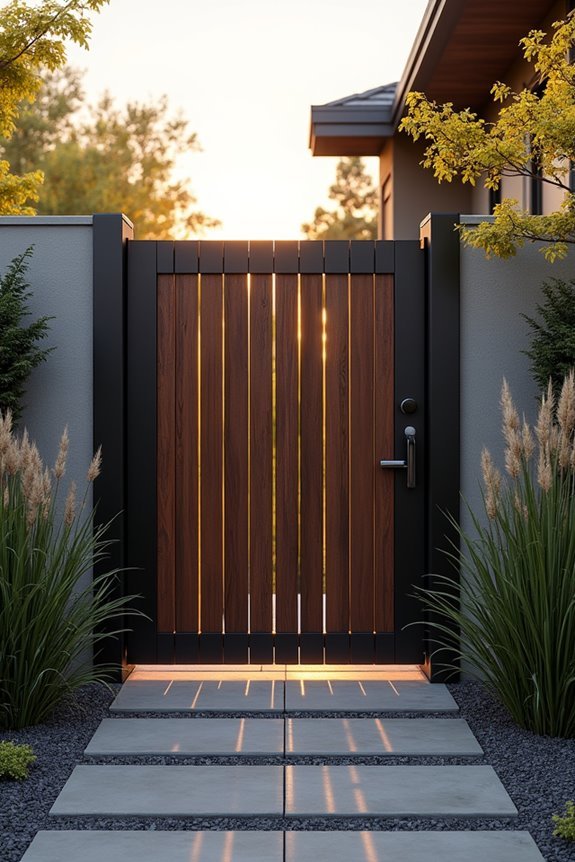
When you’re designing a modern slatted gate entry, vertical slat spacing becomes the defining architectural element that balances privacy with visual lightness. You’ll want to maintain consistent 1-2 inch gaps between slats to create rhythm while obscuring direct sightlines. Modern gate materials like ipe, thermally-modified ash, or composite decking offer dimensional stability against warping. Frame your gate with steel or aluminum posts for structural integrity and clean lines. Install contemporary locking mechanisms such as magnetic latches or keypad systems that integrate seamlessly into the slat pattern. Position your gate 36-42 inches wide for single entry or 72 inches for double configurations. Consider LED strip lighting between slats to emphasize vertical lines while providing nighttime illumination and enhanced security.
[affiai keyword=”modern slatted garden gates” template=”carousel” count=”3″]
Glass Panel Accent Sections
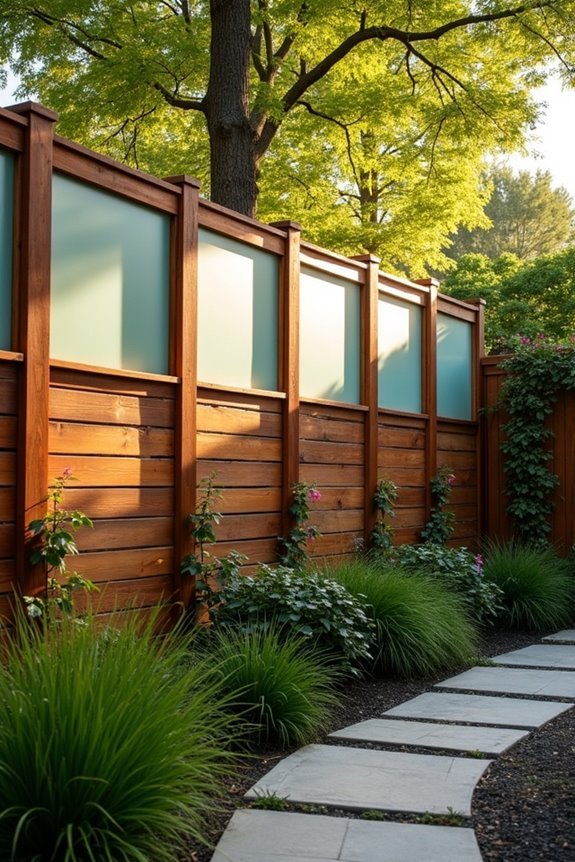
Glass panel accent sections transform traditional wood fencing into architectural statements by introducing transparency at strategic intervals. You’ll position these panels to frame specific views while maintaining privacy boundaries. Consider tempered or laminated glass for superior glass panel durability in outdoor environments. Install panels between vertical wood posts using weatherproof silicone and aluminum channels that accommodate thermal expansion. Decorative glass options include frosted, tinted, or textured varieties that diffuse light while obscuring sightlines. You can alternate panel heights—typically 24 to 48 inches—to create rhythm along fence lines. Mount panels flush with wood surfaces or recess them 2-3 inches for dimensional contrast. Strategic placement near patios or pools maximizes natural light penetration while preserving enclosed spaces. Ascertain proper drainage at glass-to-wood junctions.
[affiai keyword=”glass panel accent fencing” template=”carousel” count=”3″]

[Size & Durability] - Durable Tempered Safety Glass – Constructed from 3/8-inch (9.5 mm) tempered glass that meets ASTM safety standards, offering high-impact resistance and long-lasting strengt


DESIGN: This golden restaurant partition which fits perfectly with modern interior decoration. Translucent privacy screen panel not block the light,but also create privacy in a small space